
Which Schengen Country Should You Apply To? Main Destination, First Entry and Multi-Country Visa Rules
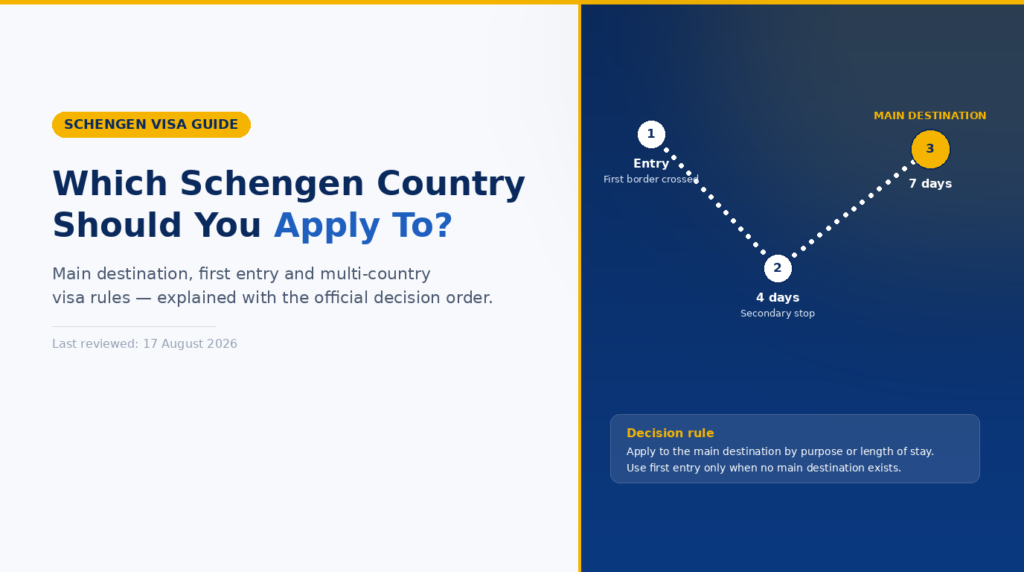
Apply to the Schengen country that is your sole or main destination. For a multi-country trip, the main destination is normally determined by the main purpose of the journey or where you will spend the most days; first entry decides only when no main destination can be identified.[1][2]
Which Schengen country should I apply to? The decision order
Use this order before looking for an appointment:
- One destination: apply to that country’s competent consulate.
- Several destinations: apply to the country that is the main destination because of the journey’s purpose or length.
- No identifiable main destination: apply to the country whose external Schengen border you will cross first.
This identifies the country legally responsible for the application. VFS, BLS or TLS may receive its documents, but the application centre does not change which country is competent.
The first-entry rule is a tie-breaker, not permission to choose any convenient embassy.
As a general rule, you must also apply within the consular jurisdiction where you legally reside. A consulate may accept an application from someone legally present but not resident in its jurisdiction only when the applicant provides justification.[1]
How the Schengen visa main destination rule works
The country of the longest stay
For a holiday with the same purpose throughout, the longest stay usually gives the clearest answer.
Example: You plan seven days in France and four days in Italy, after landing in Amsterdam for a connecting flight. France is the main destination. You should apply to France, not the Netherlands or Italy.
Use calendar dates consistently. An arrival on 10 June and departure on 13 June covers four calendar days but only three hotel nights. Show the calculation clearly in the itinerary and bookings.
The country connected to the main purpose
Length is not the only factor. Article 5 of the EU Visa Code also refers to the purpose of the stay.[1]
A business traveller may attend the trip’s central conference in Germany and add leisure time elsewhere. A student may travel for an academic event. Invitations and the itinerary should show which activity genuinely drives the journey.
If purpose and duration point to different countries, or two countries could reasonably be treated as main destinations, check the relevant consulates before booking. The European Commission’s Visa Code Handbook contains nuanced examples, so mixed-purpose cases should not be decided from hotel-night totals alone.[3]
Main destination vs Schengen visa first-entry rule
Itinerary | Country to apply to | Why |
|---|---|---|
France only | France | It is the sole destination. |
France 7 days, Italy 4 days; first landing in the Netherlands | France | France is the longest stay. |
Spain 5 days, Germany 5 days; tourism throughout; enter through Spain | Spain | No longer stay or stronger purpose; Spain is the first external entry. |
Germany conference, then tourism in Austria | Usually Germany if the conference is the main purpose | Purpose can determine the main destination; confirm if the itinerary is ambiguous. |
Denmark 4 days and Spain 10 days on two visits within two months | Spain | Spain is the longer destination across the intended visits.[3] |
“First entry” means the first external Schengen border crossed. If you fly from India to Paris through Amsterdam and pass Schengen passport control in Amsterdam, the Netherlands is the first external entry. It does not become the application country when France is clearly the main destination.
Can you enter through a different Schengen country?
As a general rule, a holder of a valid uniform Schengen visa may cross another Schengen country’s external border. You do not always have to enter through the country that issued the visa.[2]
However, a visa does not guarantee admission. Border officers may ask for evidence of your purpose, accommodation, funds, return plans and onward journey. Carry an itinerary that explains why the issuing country remains your main destination.
If the main destination changes before travel, ask the issuing consulate whether action is required. Do not use artificial bookings to make one country appear to be the main destination.
Multi-country travel and multiple-entry visas are different
A multi-country trip visits several Schengen countries in one continuous stay. A multiple-entry visa permits more than one entry while valid, subject to its authorised duration and the Schengen-wide 90/180-day limit.
A uniform Schengen visa is generally valid across all 29 Schengen countries, unless the sticker has limited territorial validity.[4][5] The same Schengen day limit applies across the area; it is not a separate allowance for each country.
For a new multiple-entry visa application, the Commission handbook recommends the usual or most frequent main destination. If none exists, it points to the first planned trip.[3] Always check the sticker’s validity, entries and permitted stay.
Where should you submit the application?
After identifying the correct country:
- Find that country’s official embassy or consulate page for your place of legal residence.
- Check whether applications are received directly or through an authorised service provider.
- Confirm the correct application-centre jurisdiction for your residential address.
- Check whether another Schengen country represents your destination locally.
- Follow the destination country’s current checklist and appointment procedure.
An available appointment at another country’s centre does not make that country competent. Under the Visa Code, a consulate that is not competent should return the application and indicate the competent consulate.[1]
Schengen travel insurance guidance
Choosing the correct consulate does not mean buying insurance only for that country. For a uniform Schengen visa, travel medical insurance must be valid throughout the Member States, cover the entire intended stay or transit, and provide at least EUR 30,000 of coverage for specified medical and repatriation risks.[1]
Before buying, check:
- the certificate names every traveller correctly;
- coverage applies throughout the Schengen Area and for all declared dates;
- the benefits meet the official visa requirement;
- exclusions and pre-existing-condition wording suit the traveller;
- emergency assistance, direct-payment and reimbursement procedures are clear;
- later trips are insured if you receive and use a multiple-entry visa.
Compare policy wording and assistance arrangements, not only price. Verify the latest insurance checklist on the responsible consulate’s website before submission.
Common mistakes to avoid
- Applying to the country with the fastest appointment instead of the competent country.
- Assuming first landing always determines where to apply.
- Counting hotel nights while overlooking arrival and departure dates.
- Ignoring a clear business, study or family purpose.
- Giving different dates in the form, itinerary, bookings and insurance certificate.
- Treating VFS, BLS or TLS as the visa decision-maker.
- Cancelling the declared main stay immediately after receiving the visa without a genuine explanation.
Application-country checklist
- Identify every Schengen destination and travel date.
- State the genuine primary purpose of the journey.
- Calculate the days spent in each country consistently.
- Select the sole or main destination.
- Use the first external entry only if no main destination can be determined.
- Confirm the consulate and territorial jurisdiction on an official website.
- Align the form, cover letter, bookings, transport and insurance.
- Recheck before submission because representation and provider arrangements can change.
SchengenSure practical step: SchengenSure can help you identify which consulate to apply based on your travel plan. Use SchengenSure “correct consulate finder” to identify which consulate to apply based on the journey’s purpose or duration. This is to be taken as preliminary guidance. Always check with the consulate before you apply.
Frequently asked questions
Do I apply to the country of first entry or longest stay?
Apply to the main destination, commonly the country of the longest stay. Use the first external entry only when no main destination can be established by purpose or duration.
What if I spend equal days in two Schengen countries?
If the purpose is the same and neither country is a stronger main destination, apply to the country whose external border you will cross first. For mixed-purpose or otherwise ambiguous trips, confirm with the relevant consulate.
Can I apply to the easiest Schengen country?
No country is legally competent merely because it has appointments or is perceived as easier. Apply according to your genuine destination, purpose and itinerary.
Must I enter through the country that issued my visa?
Not necessarily. A valid uniform visa generally permits entry through another Schengen country, but you should be able to explain and document your main destination.
Where should an Indian resident apply?
After identifying the competent Schengen country, use its official mission website to find the consulate or authorised centre responsible for your Indian residential jurisdiction.
Do I need separate visas for several Schengen countries?
Normally, one uniform Schengen visa covers travel throughout the Schengen Area. Check the visa sticker because a visa with limited territorial validity is an exception.
What if my main destination changes after the visa is issued?
Keep evidence explaining a genuine change and contact the issuing consulate if it is substantial. A visa remains subject to border checks.
Conclusion
When asking “which Schengen country should I apply to?”, start with the real purpose and day-by-day itinerary, not the first airport or the easiest appointment. Apply to the sole or main destination; use the first external-entry country only when no main destination can be determined.
Keep every document consistent and confirm country-specific submission arrangements before applying. This is easier to explain to the consulate and at the border.
Next step: Use SchengenSure “correct consulate finder” to identify which consulate to apply.