Your Schengen Visa Was Rejected Over Insurance - Here's Why That's Different From a Claim Rejection
Reviewed and Verified against official sources on 16 August 2026
A visa refusal can feel personal, especially when you have spent weeks collecting bank statements, reservations, employment documents and invitation letters. However, an insurance document problem is usually much narrower than it first appears.
According to SchengenSure’s Schengen Visa 2024 Statistics post, the overall refusal rate fell from 16% in 2023 to 14.8% in 2024.5 That still works out to roughly 1 in 7 applicants. A refusal does not automatically mean that the applicant was careless or unsuitable for travel. Sometimes a document simply does not present the required information clearly enough.
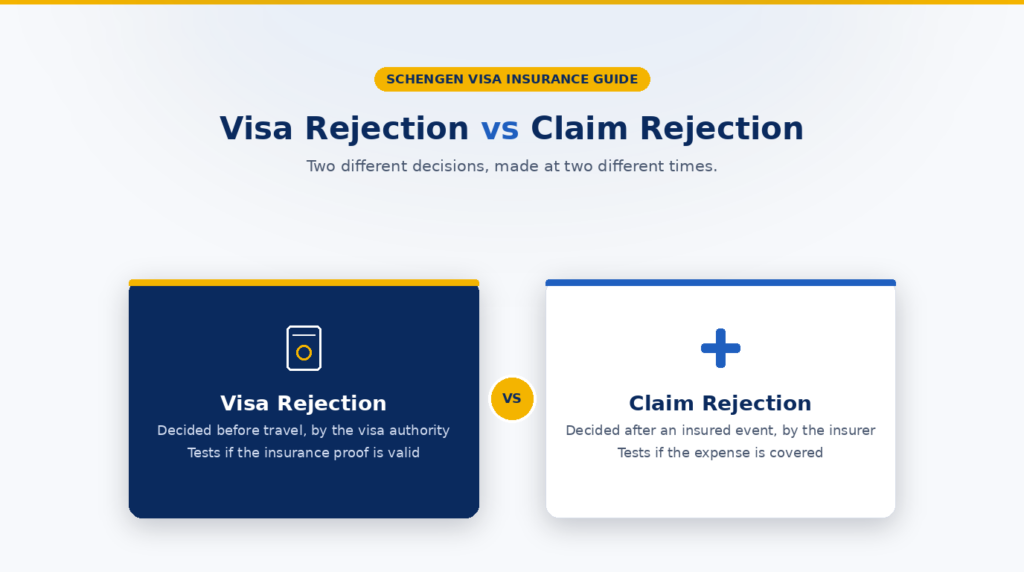
A Schengen visa can be refused if you do not provide proof of adequate and valid travel medical insurance. That is a document-compliance problem at the visa stage. A travel insurance claim rejection is different, it happens after an insured event, when the insurer decides whether a particular expense is covered under the policy terms.
The key is to separate the insurance problem from the rest of your application. If the refusal refers specifically to travel medical insurance, review the certificate and policy wording against the issues listed below. Do not assume that buying another policy with a different logo will solve the problem. The replacement document must correct the actual defect.
If you are gathering documents on behalf of a parent, check the certificate yourself rather than assuming that the agent, bank or insurer entered every detail correctly.
Can a Schengen visa really be rejected because of travel insurance?
Yes. Under the EU Visa Code,1 applicant who must hold travel medical insurance have to prove that the cover is adequate and valid. The insurance must normally cover the full intended stay, be valid throughout the Schengen territory, and provide at least EUR 30,000 of cover for relevant medical and repatriation risks.
QUOTE-WORTHY: A Schengen visa insurance rejection is about whether your insurance proof meets visa requirements. A claim rejection is about whether a later expense is payable under the policy contract. |
What can “travel medical insurance not valid” mean?
A policy may create a visa problem if the certificate or policy does not clearly satisfy the required conditions. Common issues include:
- dates that do not cover the entire intended stay or transit;
- territorial cover that does not apply across the required Schengen territory;
- medical cover below the EUR 30,000 minimum;
- missing or unclear emergency medical, hospital treatment or repatriation cover;
- a certificate that does not clearly identify the applicant;
- an insurer or product that is not accepted under a country-specific consular rule;
- inconsistencies between insurance dates and the itinerary.
The issue is not necessarily that the insurer is “bad.” The proof submitted may simply be unsuitable for that visa application.1
Schengen visa insurance rejection vs travel insurance claim rejection
Visa rejected over travel insurance | Insurance claim rejected |
Happens during the visa application | Happens after an insured event |
Decision by the visa authority | Decision by the insurer or claims administrator |
Tests whether insurance proof is adequate and valid | Tests whether the expense is covered by the contract |
Can stop the trip before it begins | Can create an out-of-pocket cost during or after travel |
Requires checking the refusal reason and visa procedure | Requires checking exclusions, evidence and claims procedure |
The decisions are separate. A policy can be accepted for visa purposes but a later claim can still be denied under an exclusion or other policy condition. A policy could also offer useful medical benefits yet create a visa problem if its certificate does not meet the consulate’s documentary rules.
Is Indian travel insurance accepted for a Schengen visa?
Yes, Indian travel insurance can be accepted, but applicants should not assume every Indian policy is accepted.2,3,4
For applicants in India, the German Missions state that they accept Indian travel medical insurance only from approved Indian travel insurance companies on the published list.2,3 Their guidance also says an applicant may seek insurance in another country where claims against the insurer would be recoverable in a Schengen State.
So ask a more useful question: “Will the consulate handling my application accept this exact insurer, plan and certificate?”
If you already know you need Schengen insurance, where should you buy it?
Compare policies on two levels: visa acceptance and real-world claims support.
Check visa-document suitability first
Before paying, confirm that the certificate will show:
- your correct name and travel dates;
- required territorial validity;
- at least EUR 30,000 medical coverage;
- emergency medical, hospital and repatriation cover;
- any consulate-specific insurer or certificate requirement.
If the policy cannot satisfy the visa checklist, its other benefits do not solve the application problem.
Then compare how the policy works during an emergency
Two Schengen-compliant policies can still produce different traveller experiences. Compare:
- 24/7 emergency assistance;
- whether direct billing or a payment guarantee may be arranged, and under what conditions;
- whether you must pay first and seek reimbursement;
- exclusions, pre-existing-condition rules and deductibles;
- document or translation requirements;
- notification deadlines;
- support languages and contact methods.
Do not assume a European or destination-based insurer automatically offers cashless treatment, or that an Indian insurer automatically requires reimbursement. These features depend on the policy and assistance network.
Indian insurer vs European or destination-based insurer: what matters most?
The insurer’s location is only one factor.
What to compare | Why it matters |
Consular acceptance | The policy must work for the visa application |
Certificate clarity | Clear evidence can reduce document questions |
Claims recoverability in Schengen | Relevant under the Visa Code |
Emergency assistance | Important if hospital help is needed abroad |
Direct billing availability | May reduce upfront payment where available |
Exclusions and deductibles | Affect what the insurer actually pays |
Documentation requirements | Matter when medical records are foreign-language |
Visa-refusal cancellation terms | Apply only if expressly included |
A comparison tool can narrow the market, but always read the policy wording and official visa checklist before purchase.
SchengenSure: Compare Schengen travel insurance options by visa suitability, medical cover, assistance model and claims process.
A simple example: two different rejections
Traveller A: The applicant submits an acceptable policy and receives the visa. During the trip, a medical claim is later rejected because the expense falls under a policy exclusion. The visa decision and claim decision are separate.
Traveller B: The applicant buys travel insurance, but the certificate does not demonstrate adequate and valid Schengen cover. The visa authority refuses the application before travel. No insurance claim has occurred.
Traveller A needs to review the claim decision and policy terms. Traveller B needs to address the visa refusal reason and the insurance evidence required for an appeal or new application.
Common insurance mistakes
- Buying the cheapest policy without checking the certificate.
- Confusing domestic health insurance with Schengen travel medical insurance.
- Assuming EUR 30,000 alone guarantees compliance.
- Selecting the wrong travel dates.
- Ignoring country-specific approved-insurer rules.
- Uploading a payment receipt instead of the required certificate.
- Assuming credit-card travel cover automatically meets every requirement.
- Focusing only on visa acceptance and not on claims handling abroad.
Checklist before buying Schengen travel insurance
☐ Check the current consular visa checklist.
☐ Confirm validity for the required Schengen territory.
☐ Confirm cover for the full intended stay or required period.
☐ Confirm at least EUR 30,000 medical coverage.
☐ Confirm emergency medical, hospital and repatriation cover.
☐ Check whether an approved-insurer list applies.
☐ Read exclusions, deductibles and pre-existing-condition wording.
☐ Check emergency assistance and reimbursement/direct-billing procedures.
☐ Match the certificate to your passport name and itinerary.
☐ Save the certificate, policy wording and emergency contacts.
What should you do if your Schengen visa was rejected over travel insurance?
Read the refusal notice carefully. Do not assume buying another policy automatically reverses the decision.
If the reason concerns inadequate or invalid travel medical insurance, compare what you submitted with the official checklist and Visa Code requirements. Then follow the appeal or reapplication procedure provided by the Member State that refused the visa.
If reapplying, correct the actual problem. That may mean fixing dates, territorial validity, certificate wording, insurer acceptance or another documentary issue.
Conclusion
A Schengen visa rejected over travel insurance is not the same as a travel insurance claim rejection. The first concerns whether you provided adequate and valid insurance for the visa, and the second concerns whether a later expense is covered by the contract.
If you are ready to buy, compare policies on both fronts: will the certificate satisfy the visa process, and will the policy work practically if you need medical help in Europe? SchengenSure can help you compare options, but the final check should always be against the current official requirements of the consulate handling your application.
FAQs
Can a Schengen visa be rejected because of travel insurance?
Yes. The EU Visa Code provides for refusal where an applicant who is required to hold travel medical insurance does not provide proof of adequate and valid cover.
Is Indian travel insurance accepted for a Schengen visa?
It can be. Check the rules of the consulate handling the application. In India, some Schengen missions publish approved Indian insurer requirements.
Is EUR 30,000 coverage enough to guarantee visa acceptance?
No. It is the minimum medical coverage requirement, but the policy must also meet applicable requirements on territory, duration and relevant medical and repatriation cover.
Is domestic health insurance valid for a Schengen visa?
Not automatically. It would need to satisfy the applicable Schengen travel medical insurance requirements and be acceptable to the consulate.
What if my insurance claim is rejected after I receive the visa?
That is a separate insurance-contract issue. Review the claim decision, exclusions, evidence requirements and complaint or appeal process under the policy.
Should I buy Schengen travel insurance from India or Europe?
Choose based on consular acceptance and the actual policy, not the country label alone. Compare certificate compliance, claims recoverability, assistance, payment arrangements, exclusions, deductibles and documentation requirements.