
How to Prove Purpose, How to Prove Home Ties and How to Prove Intention to Return for a Schengen Visa
Imagine this situation: Aarav plans a 12-day holiday in France and Italy. He submits flight and hotel reservations, a healthy bank balance, and valid travel medical insurance. Yet his application is refused because the purpose and conditions of the trip were not considered reliable and his intention to leave could not be established.
The problem was not necessarily that Aarav lacked documents. It was that his documents told different stories. His cover letter described ten nights in France, his hotel reservations showed six, his employer approved only seven days of leave, and a large deposit appeared in his account shortly before the application. Each item looked plausible on its own. Together, they created doubt.
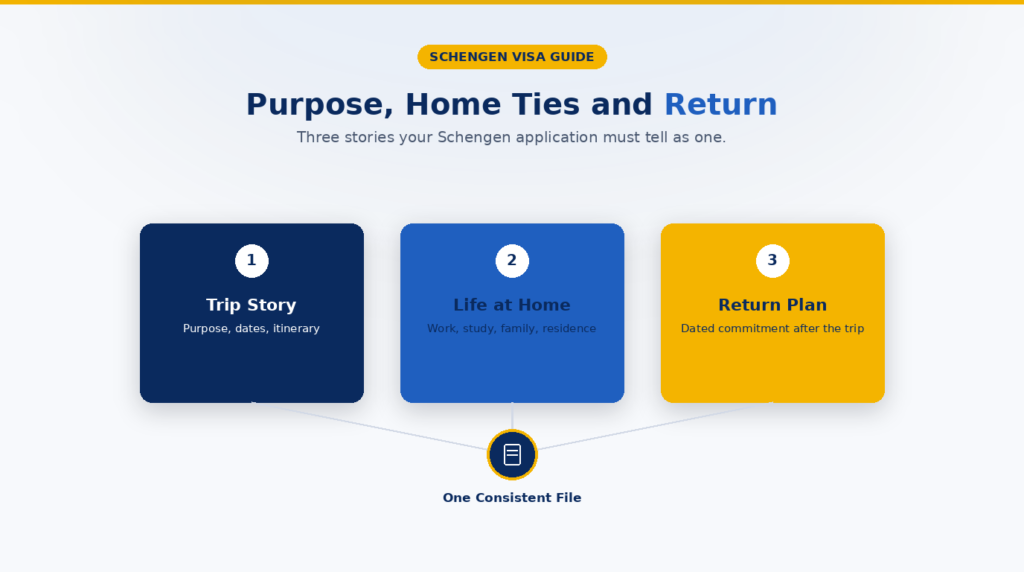
In practice, avoiding this type of Schengen visa rejection requires one coherent file that answers three questions:
- Why exactly are you travelling?
- What established life will you return to in your country of residence?
- What evidence makes your departure before the visa expires credible?
That is the practical meaning of How to Prove Purpose, How to Prove Home Ties, and How to Prove Intention to Return. The goal is not to overwhelm the consulate with paper. It is to make every important statement specific, verifiable, and consistent with the rest of the application.
Quick answer: Prove your Schengen trip with evidence that matches your stated purpose, dates, itinerary, finances, accommodation, employment or personal circumstances, and return plan. A return reservation alone is not enough. The strongest file shows why the trip makes sense now and why your normal life requires you to come back.
This guide concerns short-stay Schengen visas for temporary visits of up to 90 days in any 180-day period. Requirements can vary by country, purpose, and application location, so always use the current checklist issued by the consulate responsible for your application. The European Commission’s official Schengen visa guide provides the general framework and links to each Schengen country’s official website.
What the Consulate Is Legally Assessing
The EU Visa Code does not use “home ties” as a stand-alone approval test. It requires applicants to provide documents showing the purpose of the journey, accommodation, sufficient means, and information that allows an assessment of whether they intend to leave before the visa expires.
During examination, the authorities consider the justification for the purpose and conditions of stay, financial means, valid travel medical insurance where required, immigration risk, and intention to leave. They may also assess the authenticity and reliability of the documents and statements. These requirements appear in Articles 14, 15, 21 and 32 of the consolidated EU Visa Code.
Annex II of the Visa Code gives a non-exhaustive list of evidence that may help assess intention to leave, including:
- A return or round-trip reservation or ticket.
- Proof of financial means in the country of residence.
- Evidence of employment and bank statements.
- Evidence of real estate ownership.
- Evidence of integration in the country of residence, including family ties and professional status.
“Non-exhaustive” matters. You do not need to own property, be married, or hold a permanent job to qualify. You need evidence appropriate to your real circumstances. A salaried employee, freelancer, student, business owner, homemaker, and retiree will not prove the same facts in the same way.
The Three-Story Test Before You Submit
Think of the application as three connected stories:
- The trip story: destination, purpose, dates, itinerary, accommodation, funding, and insurance.
- The life-at-home story: employment, studies, business, family responsibilities, residence, finances, or other established commitments.
- The return story: a realistic end to the trip followed by specific commitments at home.
A strong application connects all three. For example, a salaried applicant taking eight approved leave days for an eight-night holiday, paying from regular salary savings, returning before work resumes, and holding insurance for the declared travel period presents an easy-to-follow narrative.
A weak application may have impressive documents but no connection between them: a 21-day itinerary with five days of approved leave, a sponsor paying for everything without a clear explanation, or accommodation dates that do not cover the full trip.
How to Prove Purpose of Travel in Practice
How to Prove Purpose begins with a simple rule: use documents created by the real reason for the trip. A tourism application should look like genuine tourism. A family visit should establish the host, relationship, accommodation, and funding. A business trip should connect the applicant, employer, inviting organization, and event.
The Visa Code lists examples such as business invitations, evidence of work relationships, fair or congress tickets, course enrolment, accommodation documents, organized-trip confirmations, event programmes, and medical-institution confirmations. The exact documents required in your case come from the current local consular checklist.
Scenario 1: A First-Time Tourist With a Generic Itinerary
Meera says she will spend ten days in Germany. Her itinerary lists Berlin, Hamburg, Munich, Cologne, and the Black Forest, but the travel times are unrealistic. Her hotel reservations cover only seven nights, and her return flight leaves from a city not mentioned anywhere else.
The fix is not a longer cover letter. It is a more credible trip:
- Reduce the number of destinations to what can reasonably be visited.
- Cover every night with accommodation evidence or explain any overnight transport.
- Make flight, train, hotel, leave, insurance, and application dates agree.
- Include a few specific planned activities that fit the route.
- Show how the trip will be funded from available, traceable money.
For tourism, How to Prove Purpose is mainly about showing an achievable temporary visit—not producing a decorative day-by-day schedule copied from the internet.
Scenario 2: Visiting Family or Friends
Priya is visiting her brother in Lyon. She submits his invitation but nothing proving that he is her brother, that he can host her at the stated address, or who will pay for the trip.
A clearer file could include, where required and relevant:
- The official invitation or private-accommodation form required by France.
- A copy of the host’s passport or residence document.
- Evidence of the relationship.
- Proof of the host’s address.
- A clear explanation of who pays, supported by the applicant’s or sponsor’s financial evidence.
- Plans and dates consistent with the host’s invitation and the applicant’s leave.
An invitation proves that someone has invited you. It does not automatically prove the relationship, the financial arrangement, your own home ties, or your intention to return.
Scenario 3: A Business Traveller
Rohan receives an invitation to a trade fair in Munich. The invitation names the event but does not explain why he is attending or how it relates to his work.
To strengthen the purpose, he could add:
- Registration or entry confirmation for the trade fair.
- An employer letter describing his role and the business reason for the visit.
- Evidence of the relationship between his employer and the inviting company, if relevant.
- A clear statement about who pays for flights, accommodation, and daily expenses.
- Approved leave or duty-travel dates and the date he is expected back at work.
These documents support each other: the European event explains the trip, while the home employer explains why Rohan is the person travelling and why he will return.
Scenario 4: Short Study, Training or Medical Travel
For a short course or training within the Schengen short-stay limit, provide the enrolment or admission confirmation, course dates, fee information, accommodation, funding, and evidence of what you will resume at home afterward. A course exceeding the short-stay rules may require a national long-stay visa or residence route instead.
For medical travel, the Visa Code identifies an official document from the medical institution confirming the need for treatment and proof of sufficient financial means to pay for it. The consulate may require additional medical, accommodation, sponsorship, or return evidence.
Here, How to Prove Purpose means showing a defined appointment or programme—not a vague intention to explore treatment, education, or work opportunities after arrival.
How to Prove Home Ties Without Forcing the Wrong Evidence
How to Prove Home Ties is often misunderstood as “show property.” Property can help, but it is only one form of evidence and is never a visa guarantee. The better question is: what parts of your established life will continue after this short trip?
Scenario 5: The Salaried Employee
Neha submits a basic employment certificate stating only her job title. It confirms employment but says nothing about the proposed absence or return.
A more useful employment letter can confirm:
- Her role and start date.
- Salary, if required by the checklist.
- Approved leave matching the travel dates.
- The date she is expected to resume work.
- Employer contact details for verification.
Salary credits visible in bank statements can support the employment story. Payslips, tax documents, and a contract may also be relevant if requested. The point is not to submit every employment document available; it is to show an ongoing professional relationship that remains in place after the holiday.
Scenario 6: The Freelancer With No Leave Letter
Arjun is self-employed and assumes he has no strong ties because nobody can approve his leave. His real evidence is different:
- Business registration or professional tax records, where applicable.
- Recent client invoices and matching payments.
- Ongoing client contracts.
- Confirmed projects or deliverables scheduled after his return.
- Business bank statements and tax returns.
- A short explanation of how the trip fits around his work.
For a freelancer, How to Prove Home Ties means documenting continuity: established work before the trip and credible obligations after it.
Scenario 7: The Student, Homemaker or Retiree
A student can use enrolment confirmation, attendance records, the next term’s start date, exams, approved absence, and family or financial evidence. A homemaker may rely on household circumstances, spouse or family ties, residence, shared finances, dependants, and the sponsor’s evidence. A retiree may use pension income, property or lease documents, close family relationships, medical or community commitments, and a stable financial history.
None of these profiles should imitate an employee application. How to Prove Home Ties is about presenting the strongest truthful evidence for the applicant’s own situation.
Scenario 8: A Sponsored Applicant
Kabir’s father will pay for his trip. The sponsorship letter and the father’s bank balance may show who can fund the visit, but they do not fully answer why Kabir will return.
Kabir still needs evidence of his own circumstances, such as university enrolment, employment, business activity, dependants, residence status, or another genuine post-trip commitment. Sponsorship can solve a funding question. It does not automatically solve the purpose or return-intention questions.
Evidence That Can Support Proof of Ties to Your Home Country
Choose evidence that exists naturally in your life and is allowed or requested by the consulate. Depending on your circumstances, this may include:
- Employment contract, employer letter, approved leave, payslips, and salary credits.
- Business registration, tax records, invoices, contracts, and post-return commitments.
- School or university enrolment and a dated academic calendar.
- Marriage, birth, or dependency records where relevant.
- Lease, mortgage, property ownership, or ongoing housing payments.
- Regular income, savings, pension payments, and normal bank activity.
- Valid residence permission if applying from a country of legal residence rather than nationality.
- Evidence of care responsibilities or other established obligations.
- Previous visas and evidence that earlier trips were completed lawfully.
Do not submit sensitive or irrelevant documents merely to make the file thicker. Follow the official checklist, redact only where permitted, and never alter, fabricate, or buy supporting documents.
How to Prove Intention to Return Before the Visa Expires
How to Prove Intention to Return is not answered by writing “I promise to come back.” The consulate must be able to assess that intention from the whole application.
A Return Reservation Helps, but It Is Not the Whole Case
Annex II includes a return or round-trip reservation or ticket among the possible documents used to assess intention to leave. It is one piece of evidence, not a substitute for employment, financial, family, professional, or residence evidence.
Use the booking format required by the consulate. Do not buy expensive, non-refundable tickets solely to make an application appear stronger unless the official instructions require purchase. A reservation does not repair an unrealistic itinerary or missing home ties.
Show What Happens Immediately After the Trip
Dated post-return obligations are often easier to understand than general claims. Examples include:
- A confirmed return-to-work date.
- A client project or business appointment after return.
- A university term, examination, or mandatory attendance date.
- A child’s school schedule or documented care responsibility.
- A professional licence renewal, medical appointment, or other genuine commitment.
The obligation must be real and supported where appropriate. Creating a convenient appointment only for the application can damage credibility if the authorities seek verification.
Use Travel History Accurately
Lawful use of earlier visas can support reliability. Article 14 of the Visa Code expressly refers to the lawful use of previous visas in certain circumstances, and Article 21 allows the authorities to consult the Visa Information System and check previous and intended stays.
Submit relevant previous passports or visas if the checklist asks for them. Do not describe yourself as a “frequent international traveller” if the evidence shows only one short trip, and do not assume that travel history replaces current financial or home-tie evidence.
First-time applicants are not disqualified. They simply need the current file to stand on its own.
Use a Schengen Visa Cover Letter as a Map, Not as New Evidence
A concise Schengen visa cover letter can help the reader connect the evidence. A useful structure is:
- Purpose and exact travel dates.
- Main destination and short itinerary.
- Who funds the trip and where the money comes from.
- Employment, study, business, family, or residence ties.
- The dated return plan.
- An explanation of any unusual fact, such as a sponsor, recent account transfer, itinerary change, or previous refusal.
- A short list of supporting documents.
A letter of intent to return should not repeat emotional promises or claim that approval is deserved. It should make the evidence easier to verify. That is How to Prove Intention to Return in a cover letter: point to objective facts instead of substituting words for proof.
The Consistency Check That Prevents Avoidable Refusals
Before submission, compare the following fields across every document:
Application detail | Documents that should agree | Common risk signal |
|---|---|---|
Travel dates | Form, flights, hotels, itinerary, leave, invitation, insurance | Different arrival, departure, or leave dates |
Main destination | Form, nights per country, itinerary, accommodation | Applying through a country that is not genuinely the main destination |
Purpose | Cover letter, invitation, bookings, employer or course documents | Tourism stated in one place and business, study, or job-seeking implied elsewhere |
Funding | Form, sponsor letter, bank statements, payslips, bookings | Unexplained deposits or conflicting statements about who pays |
Employment or study | Form, letters, payslips, enrolment, bank activity | Job title, salary, or dates that do not match |
Accommodation | Hotels, host documents, itinerary | Uncovered nights, duplicate bookings, or unexplained city changes |
Return plan | Flight reservation, leave letter, post-return obligation | Trip extends beyond approved leave or conflicts with home commitments |
Insurance | Certificate, dates, territory, minimum cover, traveller details | Wrong name, missing day, limited territory, or inadequate cover |
Read the file once as if you know nothing about the applicant. If an explanation exists only in your head, it is not yet in the application.
Other Schengen Visa Rejection Reasons to Check
Even a strong purpose and return story can fail if another independent requirement is missing.
Insufficient or Unclear Financial Means
The Visa Code requires sufficient means for both the stay and the return. The amount is assessed according to factors such as trip length, purpose, destination-country reference amounts, accommodation, and sponsorship. There is no single bank-balance figure that guarantees approval across all Schengen countries.
Use the current consular requirement for Schengen visa financial means. Explain major legitimate transfers, show the source where relevant, and ensure the budget is realistic for the itinerary.
Applying to the Wrong Schengen Country
Under Article 5 of the Visa Code, apply to the country that is the sole destination. For a multi-country trip, apply to the main destination based on length or purpose. If no main destination can be determined, competence generally falls to the country whose external border you intend to cross first.
Do not design a false itinerary simply to obtain an appointment from a preferred consulate. The itinerary submitted should be the trip genuinely intended.
Inadequate Travel Medical Insurance
For applicants who must provide travel medical insurance, Article 15 requires coverage for medical repatriation, urgent medical attention, emergency hospital treatment, and death. The policy must be valid throughout the relevant Schengen territory, cover the intended stay or transit, and provide at least €30,000 in coverage. The authorities also assess whether claims against the insurer would be recoverable in a Schengen country.
Insurance does not prove your home ties and cannot guarantee a visa. However, inadequate or invalid insurance is a separate refusal ground under Article 32. Check the traveller’s name, passport details if shown, destination territory, travel dates, benefits, exclusions, and certificate before submission.
SchengenSure‘s Schengen visa insurance guide explains the insurance requirement in more detail.
Unreliable Statements or Documents
Article 32 permits refusal where there are reasonable doubts about document authenticity, the truth of their contents, the reliability of statements, or intention to leave. False employment records, manipulated bank statements, invented hotel bookings, or a concealed purpose can affect far more than one line of the checklist.
If a genuine fact is unusual, explain it and support it. Do not replace it with a simpler but untrue story.
Previous Schengen Visa Refusal: Appeal or Reapply?
A previous Schengen visa refusal is not an automatic refusal of a new application. Article 21(9) states that a new application must be assessed using all available information. The Visa Code also requires the refusal reasons to be notified on a standard form, gives applicants a right to appeal under the national law of the country that decided the application, and records refusal information in the Visa Information System.
Step 1: Diagnose the Exact Refusal Grounds
Read every box checked on the refusal form and any additional remarks. Relevant grounds may include:
- Purpose and conditions of stay were not sufficiently justified.
- The submitted information about purpose and conditions was not reliable.
- Statements or supporting documents were not considered reliable or authentic.
- Intention to leave before visa expiry could not be established.
- Sufficient financial means were not proven.
- Adequate and valid travel medical insurance was not proven.
Do not summarize all of these as “weak home ties.” Each ground requires a different response.
Step 2: Decide Whether the Decision or the File Needs to Change
An appeal argues that the refusal should be reconsidered under the procedure and deadline stated in the refusal notice. The competent body, deadline, fee, language, and evidence rules differ by country.
A reapplication is a new application and usually requires a new fee. Official EU guidance confirms that an applicant is free to apply again after a refusal and recommends addressing the earlier reasons before doing so. There is no advantage in an immediate reapplication if the new file contains the same gaps.
Consider an appeal when the decision appears to have overlooked or misunderstood evidence that was properly submitted and the national appeal route is practical. Consider reapplying when you need to correct dates, provide missing evidence, clarify funding, improve the itinerary, add a stronger return plan, or reflect a material change in circumstances. For case-specific legal advice, consult a qualified immigration lawyer in the relevant jurisdiction.
Step 3: Build a Refusal-to-Evidence Response
Earlier refusal issue | Weak response | Stronger reapplication response |
|---|---|---|
Purpose not justified | Add a longer personal statement | Replace vague plans with purpose-specific, verifiable documents and consistent dates |
Purpose information unreliable | Resubmit the same bookings | Correct contradictions and explain why the revised itinerary is genuine |
Intention to leave not established | Add only a return reservation | Add employment, study, business, family, residence, financial, and dated post-return evidence appropriate to the profile |
Insufficient financial means | Deposit borrowed money before applying | Show a realistic budget, regular income or credible sponsorship, account history, and documented source of funds |
Documents considered unreliable | Add more copies of the same records | Obtain verifiable originals or official replacements and address the specific authenticity concern |
Invalid insurance | Submit the same certificate | Obtain a certificate meeting the consulate’s current territory, duration, benefit, and minimum-coverage rules |
This is where the three primary questions become especially useful. In a reapplication, How to Prove Purpose means repairing the trip story, How to Prove Home Ties means documenting the life that continues after the trip, and How to Prove Intention to Return means connecting those ties to a credible departure plan.
Scenario 9: A Stronger Reapplication After Refusal
Return to Aarav. He does not reapply the following week with the same documents. He redesigns the trip around the leave his employer actually approved, removes cities he cannot reasonably visit, obtains accommodation for every night, explains a legitimate transfer from a matured fixed deposit, aligns his insurance with the corrected dates, and includes a brief cover letter mapping each refusal issue to new evidence.
The revised file still cannot guarantee approval. It is stronger because the contradictions that caused doubt are no longer present and each concern is addressed with relevant evidence rather than volume.
A Practical Schengen Visa Documents Checklist
Use this as a final logic check, not as a replacement for your consulate’s official checklist.
Purpose and Trip
- Correct application form and truthful purpose selection.
- Realistic itinerary for the declared dates.
- Accommodation or hosting evidence covering the trip.
- Purpose-specific invitation, registration, course, event, or medical evidence where relevant.
- Flight or transport reservation in the format required by the consulate.
Finances and Funding
- Bank statements for the period required by the consulate.
- Payslips, tax records, pension, business income, or other proof appropriate to the applicant.
- Sponsor documents and relationship evidence where another person pays.
- Explanation and source documents for unusual transactions.
Home Ties and Return
- Employment, business, study, residence, family, housing, or dependency evidence relevant to the applicant.
- Approved leave or another dated post-return commitment.
- Previous passports and travel history if requested.
- A concise cover letter linking purpose, funds, home ties, and the return plan.
Independent Visa Requirements
- Passport and photos meeting the current rules.
- Adequate travel medical insurance certificate.
- Correct consulate and application jurisdiction.
- Translations, legalization, copies, and document order required by the local checklist.
Complete the Insurance Requirement With SchengenSure
Once your dates and itinerary are consistent, do not let an avoidable insurance mismatch weaken an otherwise careful application. The Visa Code treats valid travel medical insurance as an independent requirement and inadequate proof as a possible refusal ground.
SchengenSure helps travellers compare destination-based travel medical insurance options for Schengen trips. You can review plan details such as territory, medical coverage, emergency assistance, repatriation, and cashless or direct-settlement features where offered, then select a policy suited to your destination and travel dates.
Before buying, confirm that the individual certificate meets the current checklist of the consulate handling your application. Cashless treatment or direct billing can depend on the selected policy, hospital, assistance process, eligibility, and insurer authorization; always read the policy wording and exclusions.
Ready to complete the insurance part of your application? FindSchengen travel medical insurance options.
SchengenSure does not decide visas and cannot guarantee approval. Its role is to help travellers compare insurance options and prepare the travel-protection part of the journey. After approval, travellers can also compare local eSIM options for Europe before departure.
Frequently Asked Questions
How to Prove Purpose for a Schengen tourist visa?
Show a realistic temporary itinerary supported by accommodation, transport plans, trip funding, and dated activities appropriate to tourism. Every date and destination should match the application form, leave approval, insurance, and cover letter. Follow the responsible consulate’s current checklist.
How to Prove Purpose when visiting family or friends?
Provide the required invitation or private-accommodation evidence, the host’s identity and residence documents where requested, proof of the relationship, clear funding arrangements, and trip dates consistent across all records. An invitation alone does not prove your own intention to return.
How to Prove Home Ties if I do not own property?
Property is not mandatory. Employment, studies, business activity, a long-term lease, family responsibilities, legal residence, stable finances, and genuine post-return commitments can all support proof of ties to your home country. Use the evidence that truthfully fits your circumstances.
How to Prove Home Ties as a freelancer or business owner?
Use business registration, tax records, contracts, invoices, client payments, ongoing operations, and work scheduled after the trip. The evidence should demonstrate that your professional activity exists before the visit and continues after your planned return.
How to Prove Intention to Return as a first-time traveller?
Build the case from current facts: a credible short itinerary, sufficient traceable funds, employment or study continuity, family or residence ties, and a dated commitment after the trip. First-time travel is not a refusal ground, but you cannot rely on previous visa compliance as supporting evidence.
How to Prove Intention to Return if my trip is sponsored?
Use the sponsor’s evidence to explain funding, then provide your own home-tie and return evidence. A sponsor’s bank balance may show who pays, but it does not by itself establish why the applicant will leave the Schengen Area on time.
Is a return flight ticket enough to prove intention to leave?
No single document guarantees that conclusion. A return or round-trip reservation is listed in Annex II of the Visa Code as possible evidence, but authorities assess the complete file, including purpose, funds, professional or family situation, document reliability, and the wider return plan.
Can a large bank balance compensate for weak home ties?
Not necessarily. Funds answer whether the trip and return can be financed. Home ties and return evidence answer different questions. A sudden unexplained balance increase may create additional questions, while normal account activity and a documented source of funds are easier to assess.
Can I reapply immediately after a Schengen visa refusal?
EU guidance allows a new application after refusal, but submitting the same file immediately is unlikely to resolve the earlier concern. Read the refusal form, correct each issue, and reapply when you can present materially clearer or stronger evidence. A new application normally involves a new fee.
Does a previous Schengen visa refusal mean I will be refused again?
No. Article 21(9) of the Visa Code says a previous refusal must not automatically cause a new refusal. The new application is assessed using all available information, so disclose the previous decision where asked and address its reasons directly.
Is it better to appeal or reapply after a Schengen visa refusal?
It depends on the decision and the national procedure. An appeal may be suitable if properly submitted evidence was overlooked or the decision appears incorrect. Reapplication may be more practical when you need to correct or add evidence. Follow the appeal instructions and deadline in the refusal notice or obtain qualified legal advice.
Can travel medical insurance improve my visa approval chances?
Valid insurance satisfies an independent application requirement; it does not compensate for an unclear purpose, insufficient funds, weak documentation, or doubts about return. A compliant certificate prevents an avoidable insurance-related refusal ground but never guarantees a visa.
Final Takeaway
The strongest Schengen application is not necessarily the thickest. It is the one in which the form, itinerary, accommodation, funds, employment or personal circumstances, return plan, and insurance all describe the same temporary trip.
Remember the sequence: How to Prove Purpose explains why this journey is real; How to Prove Home Ties shows the established life that continues in your country of residence; and How to Prove Intention to Return connects those facts to a credible departure before the visa expires.
No strategy can guarantee a visa grant. But truthful, relevant, verifiable, and internally consistent evidence can reduce avoidable refusal risks and give the consulate a clearer basis on which to assess your application.