Schengen Visa for Retired Applicants and Homewife: Sponsorship and Home Ties
A retired applicant or homemaker can apply for a Schengen visa even without a current salary or conventional employment letter. The application should instead show, with evidence, who will fund the trip, why the journey is genuine, and what circumstances support the applicant’s intention to return home after the visit. Sponsorship can help prove finances, but it does not replace proof of home ties.
Being Retired or a Homemaker Is Not Automatically a Weak Application
A Schengen visa for retired applicants is assessed under the same core visa rules as other short-stay applications. The European Commission says applicants may need supporting documents showing the purpose of the stay, financial means, accommodation and intention to return home. [1]
A retiree may rely on pension income, savings, other lawful resources or sponsorship. A homemaker may rely on genuine household or sponsor funding, subject to the relevant consular requirements.
The practical questions are:
- Is the purpose of the trip credible?
- Is the trip realistically funded?
- Do the documents tell one consistent story?
- Is there evidence relevant to the applicant’s intention to leave the Schengen Area before the visa expires?
What Does a Consulate Assess?
Under the Schengen Visa Code, an applicant must provide documents concerning the purpose of the journey, accommodation, sufficient means for the stay and return, and information enabling an assessment of the intention to leave before the visa expires. [2]
Its non-exhaustive supporting-document list includes financial means in the country of residence, real-estate property, family ties and professional status. These are examples, not a universal checklist. [2]
Quote-worthy principle: A credible application does not depend on one “strong document.” It depends on whether the applicant’s purpose, finances, home circumstances and travel arrangements make sense together.
Sponsorship and Home Ties Solve Different Problems
Question | What it addresses | Examples of relevant evidence |
|---|---|---|
Who will pay for the trip? | Financial capacity | Sponsor evidence, pension, savings, bank records |
Why is the trip genuine? | Purpose and conditions of stay | Itinerary, invitation, accommodation, travel plan |
Why is the applicant expected to return? | Intention to leave | Family ties, property, finances, residence and other personal circumstances |
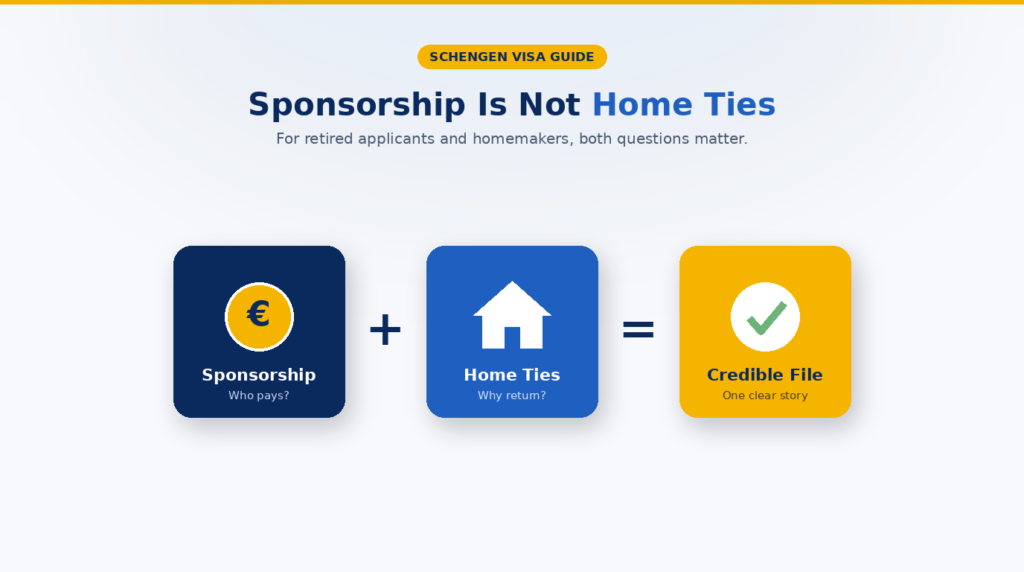
Sponsorship explains funding. Home ties help explain return intention. They are not interchangeable.
How Retired Applicants Can Build a Credible File
For a Schengen visa for retired applicants, useful evidence may include:
- pension or retirement-income evidence, where applicable;
- personal bank statements or savings evidence;
- proof of property or other continuing financial interests, if relevant;
- evidence of close family circumstances in the country of residence;
- a clear itinerary and accommodation plan;
- sponsorship evidence if someone else is paying;
- a concise cover letter explaining retirement status, funding and travel purpose where clarification is useful.
What if the retiree has no pension?
Explain the actual funding arrangement. If an adult child or another person is paying, document the relationship and sponsorship required by the relevant consulate. Savings or genuine sponsorship can be relevant, but the evidence must fit the applicant’s real circumstances.
How Homewife Can Build a Credible File
A Schengen visa for homemaker applicants can be prepared around household circumstances rather than an employment file.
Depending on the case, useful evidence may include:
- proof of the relationship with the spouse or sponsor;
- sponsor financial documents requested by the consulate;
- evidence showing how the household is financed;
- property, family or residence evidence relevant to home ties;
- a genuine itinerary, accommodation and travel purpose;
- a cover letter if the financial arrangement is not obvious from the documents.
Describe the applicant’s situation truthfully; do not present employment evidence that does not apply.
Schengen Visa Sponsorship: What Should Be Clear?
A good sponsorship file should make four things easy to understand:
- Who is sponsoring the applicant?
- What is the relationship between sponsor and applicant?
- Which costs will the sponsor cover?
- Does the sponsor have credible evidence of the ability to cover those costs?
The Visa Code allows Member States to require their own sponsorship/private-accommodation form, and sponsorship may constitute evidence of sufficient means of subsistence. [2]
Official-source check required: Never assume that a privately written sponsorship letter is enough. Check the embassy or consulate website for your main destination and the jurisdiction where you apply. The required form and supporting documents can differ. |
How to Show Proof of Home Ties for a Schengen Visa
Proof of home ties for a Schengen visa is not limited to employment. Relevant evidence may include:
- spouse, children or dependent family relationships at home;
- ownership of real estate or continuing financial interests;
- pension arrangements and established financial activity;
- lawful residence status in the country of application;
- continuing family, social or personal responsibilities;
- a realistic short trip that fits the applicant’s circumstances.
Use evidence that genuinely explains the applicant’s circumstances, rather than documents chosen merely to look impressive.
Retiree vs Homewife vs Sponsored Applicant: Practical Comparison
Applicant profile | Funding story | Home-tie story to document |
|---|---|---|
Retiree with pension | Pension and/or savings | Family, finances, property or other genuine circumstances |
Retired parent sponsored by child | Sponsor plus applicant’s available finances | Applicant’s own family, property, residence and financial circumstances |
Homewife sponsored by spouse | Household/spouse funding | Family, household, property and residence circumstances |
Homewife travelling with spouse | Shared or sponsor-funded trip | Household and family circumstances plus coherent joint itinerary |
There is no universal “best” package: follow the consular checklist and reflect the applicant’s real circumstances.
Keep the Entire Application Consistent
A credible application should connect:
Applicant profile → purpose of travel → funding → home circumstances → itinerary → accommodation → flights → travel insurance
If an adult child sponsors a retired parent’s 10-day holiday, the sponsorship, accommodation, itinerary and insurance should correspond to that trip. Contradictory dates or unexplained funding can make the file harder to understand.
Travel-insurance buying guidance
Travel medical insurance is a formal part of the Schengen visa framework. For a uniform visa, the Visa Code requires adequate and valid cover for medical repatriation, urgent medical attention, emergency hospital treatment or death; it must generally cover the whole intended stay throughout the Member States, with minimum coverage of EUR 30,000. Another person may take out the insurance in the applicant’s name. [2]
When comparing Schengen travel insurance for senior citizens or sponsored family members, check compliance first: applicant name, territory, dates, medical/repatriation cover and certificate. Then compare exclusions, claims process and assistance services. Age limits and policy terms vary, so read the policy wording before purchase.
Visit schengenSure for visa compliant travel insurance.
Common Mistakes to Avoid
- Treating sponsorship as proof that the applicant will return home.
- Hiding retirement, homewife or dependent status.
- Submitting unexplained large deposits or inconsistent financial documents.
- Using generic sponsorship letters without checking the official checklist.
- Creating an itinerary that does not fit the applicant’s finances or circumstances.
- Submitting travel insurance with incorrect names, dates or territory.
- Assuming property ownership alone guarantees approval.
- Copying another applicant’s document package without adapting it to the real case.
Checklist for Retired Applicants and Homemakers
Before submitting, confirm that:
- ☐ Your travel purpose is clear and genuine.
- ☐ The correct consulate and local document checklist have been verified.
- ☐ Your funding source is documented.
- ☐ Any sponsor relationship and required sponsorship form are documented.
- ☐ Your own home circumstances are explained with relevant evidence.
- ☐ Flight, accommodation and itinerary dates are consistent.
- ☐ Your travel medical insurance meets the applicable Schengen requirements.
- ☐ Names, dates and statements are consistent throughout the file.
Frequently Asked Questions
Can a retired person get a Schengen visa without employment proof?
Yes. Retirement should be presented truthfully, with evidence appropriate to the applicant’s finances, trip and circumstances. Current employment is not the only type of evidence relevant to a short-stay visa application.
Can a homewife get a Schengen visa without personal income?
Potentially, yes. A homemaker can document genuine sponsorship or household funding, while also presenting the other required evidence concerning the trip and intention to return.
Can my son or daughter sponsor my Schengen visa?
Sponsorship may be accepted as evidence of financial means, but the exact form and documents can depend on the Member State and consular jurisdiction. Check the official checklist before applying.
Is a sponsorship letter enough for a Schengen visa?
Do not assume so. A Member State may require an official sponsorship or accommodation form plus supporting evidence. Sponsorship also does not replace the rest of the visa application.
What counts as home ties for a retired applicant?
Relevant evidence can include family ties, financial circumstances, real-estate property and other genuine connections to the country of residence. The appropriate evidence depends on the person.
Does owning property guarantee a Schengen visa?
No. Property can be relevant evidence, but the consulate assesses the application as a whole. A visa can be refused if key requirements are not demonstrated or there are reasonable doubts about documents, statements or intention to leave. [2]
Can a sponsor buy Schengen travel insurance for the applicant?
Yes. The Visa Code states that another person may take out insurance in the applicant’s name, provided the required insurance conditions are met. [2]
Conclusion
A strong Schengen visa for retired applicants or homemakers is built on clarity. Show how the trip will be funded, document genuine home ties, keep the itinerary and supporting documents consistent, and follow the official consular checklist.
Sponsorship can answer “Who pays?” Home ties help answer “Why will the applicant return?” Treating those as separate questions produces a more credible, easier-to-understand visa file.