
Flights, Hotels and a Credible Schengen Visa Itinerary
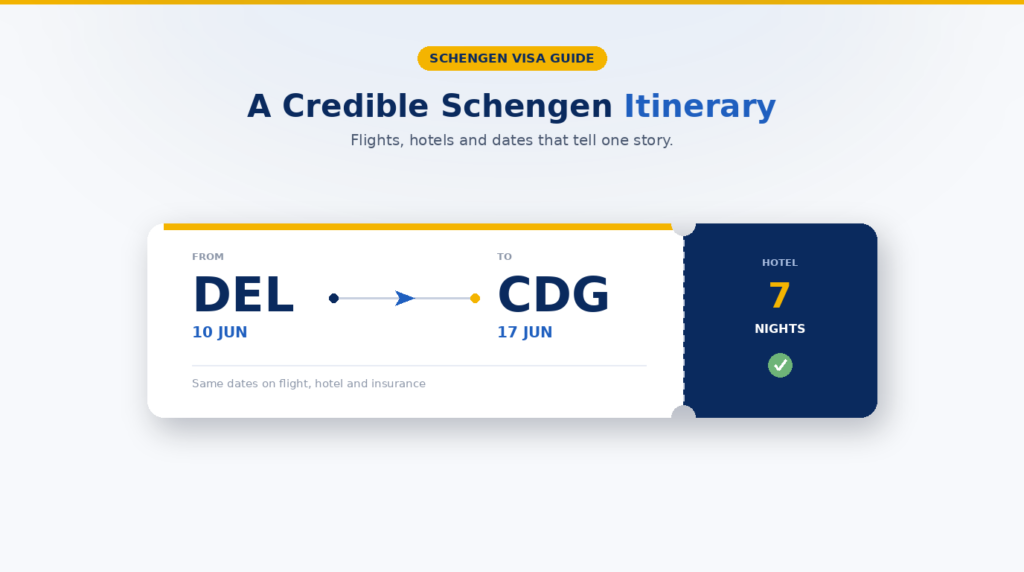
A credible Schengen visa itinerary is a realistic travel plan supported by transport and accommodation evidence that agrees with your application form, cover letter, trip purpose and insurance dates. You normally do not need to buy a non-refundable return ticket simply to lodge an application, but the responsible consulate’s current checklist controls. Use genuine documents and never submit fabricated or misleading bookings.
Official-source check: Requirements vary by Schengen country, application location, purpose and applicant profile. Check the official consulate or authorised application-centre checklist immediately before applying. Students planning a stay longer than 90 days usually need national long-stay rules, not this short-stay guide. |
What makes a Schengen visa itinerary credible?
A credible itinerary answers five questions clearly: Why are you travelling? Where will you be each night? How will you move between places? Who pays? When will you enter and leave the Schengen Area?
Credibility comes from the whole application telling one coherent story. A hotel reservation alone is not strong proof of purpose because it can be cancelled easily; it should support, rather than replace, evidence of the real reason for the trip.
For tourists, the story may be a practical day-by-day route. Business travellers should connect flights and hotels to invitations, meetings or events. Short-course students should connect the itinerary to enrolment or training evidence. Family visitors normally need host and accommodation documents suited to the destination country’s rules.
Why flights, hotels and route consistency matter
The EU Visa Code allows consulates to request evidence of the journey’s purpose, accommodation, means of subsistence, intended travel plans and intention to leave. Applications are examined for the authenticity and reliability of documents and statements.
Your route also helps identify the competent consulate. For a multi-country trip, the main purpose or longest stay generally determines the main destination. If no main destination can be identified, the first external border becomes relevant.
Expert-review flag: Main-destination rules can become complex when a trip combines business, family visits, tourism or separate journeys. Check the official EU guidance or obtain qualified visa advice if the responsible consulate is unclear. |
How to build a credible Schengen visa itinerary
- Start with the true purpose. Choose destinations and activities that logically support tourism, business, study, an event or a family visit. Do not construct a different trip merely to apply through a more convenient consulate.
- Prepare suitable transport evidence. Show the intended entry and exit, passenger name, dates, route and relevant connections. Depending on the checklist, this may be a reservation, a refundable booking or another accepted proof of transport.
- Cover every night. Hotel confirmations, host documents or other accepted accommodation evidence should cover the intended stay without unexplained gaps. Check names, addresses, dates and the number of travellers.
- Add realistic internal movement. Explain how you will travel between cities or countries by train, flight, coach, car or other transport. You may not need to prepay every local ticket, but the travel time must be plausible.
- Run a consistency check. Arrival, departure, destinations and payment arrangements should agree across the application form, itinerary, bookings, invitation, sponsorship evidence, cover letter and insurance certificate.
Reservation, refundable booking or paid ticket?
The European Commission’s handbook says a paid return ticket should not be required when the application is lodged, although it may be requested in exceptional circumstances after a visa is issued. Local checklists still differ, so follow the responsible consulate’s wording.
Booking approach | Advantages | Risks | Best use |
|---|---|---|---|
Genuine temporary reservation | Lower upfront exposure; shows intended route | May expire; not accepted everywhere | When the checklist permits a reservation |
Fully refundable transport | Verifiable and flexible | Higher price or funds tied up; conditions vary | When stronger confirmation is useful and terms are clear |
Free-cancellation hotel | Covers accommodation while retaining flexibility | Deadline or excluded guests may cause problems | When the booking remains valid and names/dates match |
Non-refundable booking | May cost less or secure availability | Loss if the visa is delayed or refused | Only when you accept the financial risk |
Buying guidance: verify cancellation deadlines, refund method, change fees, passenger names and whether a reservation will remain valid long enough for its intended use. A complete application never guarantees visa approval.
Travel insurance must align with the itinerary
For a uniform Schengen visa, the travel medical insurance must be valid throughout the Member States and cover the entire intended stay. The Visa Code sets a minimum coverage of EUR 30,000 and specifies relevant emergency medical and repatriation risks.
Before buying, compare more than the premium. Confirm that the certificate shows the correct traveller, territory and dates; read the covered benefits, exclusions, assistance process, claims process and cancellation terms. The policy wording and insurer’s certificate control.
SchengenSure option: Applicants can compare travel medical insurance for a Schengen visa. Use the comparison as buying support, then verify the selected policy against the current official checklist. No insurer, booking or comparison tool can guarantee a visa decision.
Common itinerary mistakes
- Flight, hotel, form, invitation or insurance dates do not match.
- One or more nights have no accommodation evidence or explanation.
- The stated main destination is inconsistent with the route or real purpose.
- The schedule ignores realistic transfer times or contains too many distant cities.
- Bookings omit a spouse, child or other traveller included in the application.
- A reservation is cancelled or expires before it has served its intended purpose.
- Insurance starts late, ends early or does not cover the required territory.
- A fabricated booking, altered confirmation or false host document is submitted.
Schengen visa itinerary checklist
- The purpose of travel is clear and supported.
- The competent consulate has been checked.
- Entry, exit and main-destination dates are consistent.
- Every night has suitable accommodation evidence.
- Internal travel is logical and achievable.
- All traveller names match their passports and group bookings.
- Who pays for transport and accommodation is explained.
- Travel insurance covers the intended stay and required territory.
- All documents are genuine, readable and current.
- The latest official checklist has been checked before submission.
Frequently asked questions
Do I need to buy a confirmed flight ticket before applying?
Not always. The Commission handbook says a paid return ticket should not be required when lodging an application. However, the responsible consulate’s current checklist may specify the transport evidence it accepts.
Can I use refundable hotel bookings for a Schengen visa?
A refundable booking may be useful if it is genuine and meets the relevant checklist. It should cover the correct travellers and dates, remain valid when needed, and fit the rest of the itinerary.
How detailed should a travel itinerary for a Schengen visa be?
It should clearly show dates, cities, accommodation, major transport and the purpose of each part of the trip. It does not need to promise every meal or minor attraction.
Do I need tickets for every train or coach?
Not necessarily. Requirements vary. If tickets are not required, explain the intended route and make sure the transfer is realistic. Follow the official checklist for your application location.
Can I use a dummy ticket for a Schengen visa?
Do not submit fabricated or altered evidence. If a genuine reservation is permitted, use a verifiable reservation from a legitimate provider and understand its validity and cancellation terms.
Can I change my itinerary after the visa is issued?
Reasonable changes may occur, but the visa does not remove border-entry conditions. Keep evidence of your real purpose, accommodation, funds, return arrangements and insurance, and avoid changes that contradict the basis on which you applied.
Conclusion
A strong Schengen visa itinerary is not the most expensive plan or the one with the most bookings. It is an honest, understandable and practical plan in which the purpose, route, accommodation, funding and insurance agree. Reserve or buy only what the official checklist requires and what you can afford to change or lose.