
Schengen Visa Refusal Reasons Explained: How to Read the Standard Refusal Form
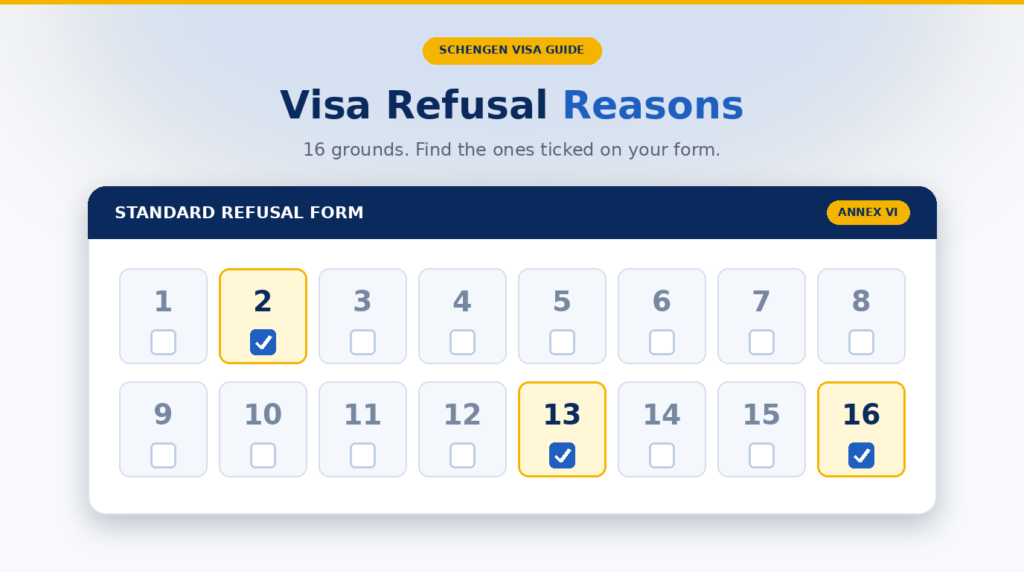
The standard Schengen visa refusal form identifies the legal reason for a refusal by ticking one or more grounds in Annex VI of the EU Visa Code. Read the decision type, every ticked ground, additional remarks and appeal section together: a checkbox names the legal category but may not reveal the exact factual weakness. Then compare that wording with the documents you actually submitted before choosing an appeal or a corrected new application.
Scope: This guide covers short-stay Schengen and airport-transit visa decisions under the Visa Code, not national long-stay visas. Qualifying non-EU family members using EU free-movement rules can be subject to special safeguards, so check the official route before acting.
What the standard refusal form tells you
The form is used for refusal, annulment and revocation. First confirm which decision is marked. A refusal concerns an application; annulment or revocation concerns a visa already issued. [1]
- Identify the authority and Member State that made the final decision.
- Mark every ticked ground; more than one may apply.
- Read any handwritten or typed additional remarks.
- Locate the national law, appeal authority, procedure and deadline.
- Keep the form, envelope and proof of the date you received it.
Plain-English rule: The ticked box is the legal heading. Your task is to find the document, statement or missing proof in your own file that fits that heading. |
All 16 Schengen visa refusal reasons on Annex VI
The current Annex VI separates 16 refusal grounds. Item 17 concerns revocation requested by the visa holder; it is not a normal application-refusal ground. [1]
No. | Official issue, shortened | What it means | Review first |
|---|---|---|---|
1 | False, counterfeit or forged travel document | The travel document was judged not genuine. | Do not guess; obtain specialist advice before responding. |
2 | Purpose or conditions not justified | The file did not adequately show why, where or how you would stay. | Review itinerary, accommodation, invitation or event evidence. |
3 | Sufficient means not proven | Available money for the stay and return was not demonstrated. | Review funds, income, trip cost, duration and sponsorship. |
Grounds 4-16 continue on the next page.
No. | Official issue, shortened | What it means | Review first |
|---|---|---|---|
4 | Lawful access to means not proven | Lawful access to enough money was not demonstrated. | Review source of funds and documented sponsor support. |
5 | 90 days in 180 already used | The permitted short-stay allowance was considered exhausted. | Recalculate entry and exit dates from reliable records. |
6 | SIS alert for refusing entry | A named State entered a refusal-of-entry alert. | Use official data-access/correction routes; seek legal advice. |
7 | Public policy or internal security | One or more States considered you a relevant threat. | Identify the State and obtain specialist legal review. |
8 | Public health | One or more States relied on the public-health ground. | Check the stated basis and obtain expert advice. |
9 | International relations | One or more States objected on this ground. | Identify the State and seek specialist legal review. |
10 | Purpose information not reliable | Travel-purpose or stay information was not believed reliable. | Check inconsistencies among statements, bookings and invitations. |
11 | Specified statement not reliable | The authority doubted a statement on the topic it should specify. | Address the specified point with verifiable evidence. |
12 | Supporting documents doubted | Document reliability, authenticity or content was questioned. | Verify issuers, originals, translations and contradictions. |
13 | Intention to leave not ascertained | The authority was not satisfied you would leave before expiry. | Review lawful residence, work/study, commitments and trip logic. |
14 | Border application urgency not proven | An external-border applicant did not prove why advance application was impossible. | Document the unforeseeable, imperative reason. |
15 | Airport-transit purpose not justified | The purpose and conditions of airport transit were not shown. | Review route, onward travel and destination entry permission. |
16 | Adequate, valid medical insurance not proven | The required insurance evidence was missing or inadequate. | Check certificate, person, dates, territory, cover and official checklist. |
Source for the numbered wording: Annex VI of the consolidated EU Visa Code. [1]
What a ticked box does – and does not – mean
- It records a legal ground, not a guaranteed diagnosis of every weak document.
- Several grounds may be ticked and must be answered separately.
- Codes 10, 11, 12 and 13 are different: purpose reliability, a specified statement, supporting documents, and intention to leave.
- Older online guides may show 11 boxes. Match the exact wording on your form to the current official Annex VI, not an old chart.
Appeal or reapply after a Schengen visa refusal?
The Visa Code gives refused applicants a right to appeal, but the procedure follows the national law of the State that made the final decision. [1][3]
Option | May fit when | Check before acting |
|---|---|---|
Appeal | The decision appears wrong on the evidence submitted, or the national route permits a useful correction. | Deadline, authority, language, form, fee and whether new evidence is accepted. |
Reapply | A clear gap can be corrected or circumstances have materially changed. | A fresh file, new costs and a direct explanation of the earlier refusal. |
Specialist review | Ground 1 or 6-9 is marked, fraud is alleged, or the remedy is unclear. | A qualified lawyer or authorised adviser in the deciding State. |
When an appeal may fit
Use the appeal instructions on your own form and the deciding authority’s current website. Do not copy another country’s deadline or procedure.
When a new application may fit
Correct the underlying gap and explain the previous refusal. Re-submitting the same evidence with a new cover letter rarely resolves the stated concern.
Official-source check: Verify the appeal deadline, competent authority, submission method, language, fee and evidence rules. Special rules may apply to qualifying family members of EU/EEA or Swiss citizens and certain Withdrawal Agreement beneficiaries. [2] |
Common mistakes after a refusal
- Treating ground 13 as only a bank-balance problem.
- Sending an emotional appeal without answering each ticked ground.
- Changing the travel story instead of explaining a genuine correction.
- Using unverifiable bookings, altered documents or unexplained cash deposits.
- Buying replacement insurance before checking the official certificate requirements.
- Missing the deadline or sending the appeal to the application centre instead of the named authority.
Checklist before you appeal or reapply
- Scan the complete decision and note the receipt date.
- List every ground and every additional remark.
- Reconstruct exactly what was submitted and said at interview.
- Map each concern to evidence; keep explanations factual and consistent.
- Check the deciding authority’s current appeal page and checklist.
- Use only genuine, independently verifiable documents.
- Get specialist help for grounds 1 or 6-9, or any allegation of fraud.
Neutral insurance buying guidance for ground 16
Ground 16 means adequate and valid travel medical insurance was not proven. Under Article 15, where insurance is required, it must cover the entire intended stay throughout the Member States, with at least EUR 30,000 cover for specified medical and repatriation risks. Always check the deciding consulate’s current checklist. [1]
- Compare the certificate wording, insured name, dates, territory, benefits and coverage amount – not price alone.
- Also compare exclusions, excess, assistance and visa-refusal cancellation or refund terms.
- Insurance can address ground 16; it cannot repair doubts about purpose, documents or intention to leave.
If insurance is genuinely the issue, you may compare travel medical insurance through SchengenSure after verifying the official requirements. SchengenSure is a comparison/referral publisher, not the visa authority or insurer; provider terms apply.
Frequently asked questions
Is a Schengen visa rejection the same as a refusal?
In everyday searches, the terms are used interchangeably. The Visa Code and Annex VI use the legal term ‘refusal’.
Does a refusal mean I am banned from Schengen?
Not by itself. If ground 6 or a public-interest ground is marked, request official information and obtain specialist advice.
What does Schengen visa refusal reason 13 mean?
It means the authority could not ascertain that you would leave before the visa expired. Review the whole return-risk picture, not only funds.
Can I apply again after a refusal?
A new application should address the recorded concerns and follow the competent authority’s current instructions. Do not hide the earlier refusal.
Can travel insurance cause a Schengen visa refusal?
Yes. Ground 16 covers failure to prove adequate and valid travel medical insurance where required.
Who handles an appeal?
The appeal is against the State that made the final decision and follows that State’s national law. Use the authority and deadline printed on your form.
Conclusion
Read a Schengen visa refusal form as a structured decision: status, authority, ticked grounds, remarks and remedy. Answer the precise legal category with consistent, verifiable evidence, and verify country-specific appeal rules before time runs out.