
How Many Days of Travel Insurance Do You Need for a Schengen Visa?
How Many Days of Travel Insurance Do You Need for a Schengen Visa?
Your Schengen visa travel insurance should normally cover every calendar day of your intended stay in the Schengen Area, including the day you arrive and the day you leave. You do not automatically need 90 days of insurance, and an extra 15 days is not a universal insurance rule; always check the instructions of the consulate handling your application. |
|---|
The basic Schengen insurance-duration rule
Under Article 15 of the EU Visa Code, travel medical insurance for a uniform Schengen visa must cover the entire period of the intended stay or transit and be valid throughout the Member States.[1] In simple terms, the dates on your insurance certificate should cover the Schengen dates shown by your itinerary and application.
Three different periods are often confused:
- Insurance coverage period: the dates during which the policy protects you.
- Visa validity period: the window in which the visa may be used, subject to its conditions.
- Authorised duration of stay: the maximum number of days the visa permits you to spend in the Schengen Area.
These periods are related, but they are not necessarily identical. A visa that may be used within a wider date window does not automatically require insurance for that whole window.
How to calculate your Schengen visa travel insurance duration
1. Find your first day in the Schengen Area
Use the date on which you expect to enter the Schengen Area, not simply the date printed on your flight ticket from home. An overnight journey may leave your country one day and arrive in Schengen the next day.
2. Find your final day in the Schengen Area
Use the date on which you expect to leave the Schengen Area. If your flight departs at night, that departure date still needs to be covered. Check local dates and time zones rather than relying only on the policy’s stated expiry time.
3. Count both dates
Count calendar days inclusively:
Insurance days = Schengen departure date – Schengen arrival date + 1
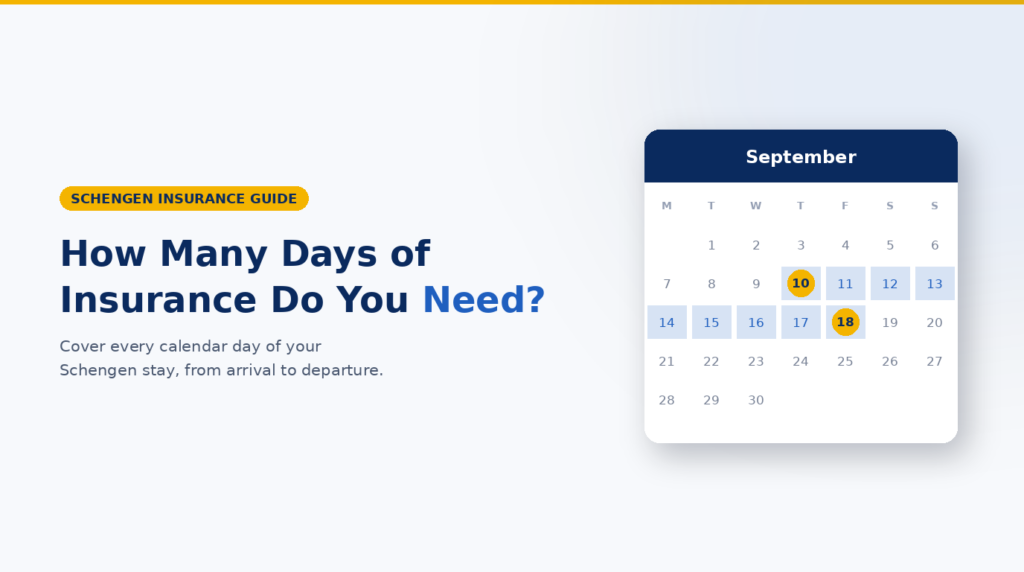
For example, arrival on 10 June and departure on 18 June require coverage for 9 calendar days. Both 10 June and 18 June count.
4. Match the full itinerary
The dates should agree across your application form, flight reservation, accommodation, invitation or business schedule, cover letter and insurance certificate. If one document shows a later departure, insure through that later date or correct the inconsistency before submission.
Worked examples
A seven-day holiday
You enter France on 4 September and leave the Schengen Area from Italy on 10 September. Counting both dates gives seven insured days.
An overnight return journey
You leave Spain at 22:30 on 10 September and reach home on 11 September. The core Schengen requirement concerns the intended period in the Schengen Area, so 10 September must be covered. However, some policies define the insured trip from departure from home until return home. Check the policy wording before choosing the end date.
A trip involving the United Kingdom
You spend five days in Germany, three days in the UK and four days in the Netherlands. The UK is outside the Schengen Area. Your Schengen insurance evidence must cover both Schengen portions. Confirm that the policy also covers the UK if you want protection there.
Exact dates, flexible cover or annual insurance: a comparison
Policy approach | May suit | Check before buying |
|---|---|---|
Fixed-date single-trip policy | One confirmed journey | Every Schengen date is included; date-change and cancellation terms |
Single-trip policy with a date buffer | Travellers whose dates may move | Whether unused extra days cost more and whether changes need approval |
Annual multi-trip policy | Frequent business or family visitors | Maximum length per trip, geographic scope, age limits and whether the certificate is suitable for the application |
The best option is not simply the policy with the most days. It is the policy that covers the correct dates, satisfies the official checklist and provides useful protection for the traveller.
Do you need 15 extra days of insurance?
Not as a universal rule. The EU-wide requirement is coverage for the entire intended stay.[1] Some consular guidance advises applicants to arrange cover for up to 15 days beyond the planned stay so that delays or postponed travel dates can be accommodated.[5]
Treat extra days as a flexibility choice or a location-specific instruction. They do not increase the number of days you are authorised to stay. Before paying for a buffer, check:
- the embassy or consulate’s current checklist;
- whether your policy dates can be changed without buying a new policy;
- whether an extension made after the policy starts is allowed; and
- whether delayed return is covered automatically or only for specified insured events.
OFFICIAL-SOURCE CHECK: Consular instructions can differ by application location and can change. Verify the checklist of the competent consulate or its authorised application centre before submission. |
|---|
Single-entry and multiple-entry visas
For a single-entry visa, the certificate should cover the intended trip submitted with the application.
For a multiple-entry visa application, Article 15 states that the applicant normally proves insurance for the first intended visit and acknowledges the need to hold insurance for later visits.[1][4] This does not mean later trips are uninsured. You should have valid insurance for every subsequent stay and be ready to show proof when travelling.[3]
An annual policy may be convenient for frequent travellers, but check its per-trip limit. A policy described as annual may still restrict the number of days covered on each journey.
What to compare before buying
Visa compliance is a minimum document standard; it is not the same as a strong claims experience. Compare the certificate and the policy wording.
Check that:
- your name and travel dates are correct;
- the territorial wording covers the entire Schengen Area;
- the certificate states at least EUR 30,000 of medical cover;[1][3]
- emergency medical care, hospital treatment and medical repatriation are covered;
- exclusions, deductibles and pre-existing-condition rules are understandable;
- emergency assistance is available during your trip;
- direct settlement may be arranged where offered, without assuming it is guaranteed; and
- date-change, cancellation and visa-refusal refund conditions are clear.
You can compare suitable policies through SchengenSure or another provider. Read the certificate and full terms before purchasing. Insurance does not guarantee that a visa will be issued.
Common mistakes
- Starting insurance one day after arrival.
- Ending it one day before the Schengen departure.
- Counting nights instead of calendar dates.
- Covering only the main destination when the policy must cover the Schengen Area.
- Assuming a 90-day visa rule means buying 90 days of insurance.
- Treating an optional 15-day buffer as mandatory everywhere.
- Using the first trip’s certificate for later multiple-entry trips when it is no longer valid.
- Ignoring time-zone differences or an overnight itinerary.
- Buying a policy before checking whether dates can be corrected.
Pre-submission checklist
- Confirm the first Schengen arrival date.
- Confirm the final Schengen departure date.
- Count both dates as insured days.
- Compare the dates with every itinerary document.
- Check that all Schengen countries are covered.
- Check the required benefits and minimum medical cover.
- Verify the applicant’s name and certificate number.
- Review the relevant consulate’s current checklist.
- Save a digital copy and carry accessible proof while travelling.
Frequently asked questions
Do I need 90 days of travel insurance for a Schengen visa?
No, unless your intended insured trip lasts 90 days or official instructions for your case require it. The short-stay limit of up to 90 days in any 180-day period is not a default insurance duration.
Does insurance have to cover the full visa validity period?
Normally, the insurance evidence should cover the entire intended stay rather than every possible day in a wider visa-validity window. Follow any different instructions issued for your application.
Are the arrival and departure dates included?
Yes. Coverage should include the calendar date you enter the Schengen Area and the calendar date you leave it.
What if my travel dates change after I buy insurance?
Ask the insurer to amend or replace the certificate before travelling. Do not assume that the old policy automatically moves with the booking.
Can someone else buy the policy for me?
Often yes, but the visa applicant must be clearly identified as the insured person. Confirm the insurer’s eligibility rules and certificate format.
What insurance is needed for later trips on a multiple-entry visa?
You need valid travel medical insurance for each stay. Proof submitted for the first visit does not protect later journeys after that policy expires.
Is this guidance valid for a long-stay student or work visa?
Not necessarily. This article concerns short-stay Schengen visas. National long-stay visas and residence permits can have different health-insurance rules. Check the relevant national authority.
Conclusion
Calculate Schengen visa travel insurance duration by covering every calendar day from entry into the Schengen Area through departure. Match the certificate to the itinerary, separate insurance dates from visa validity, and verify any request for extra days with the consulate handling your application.