
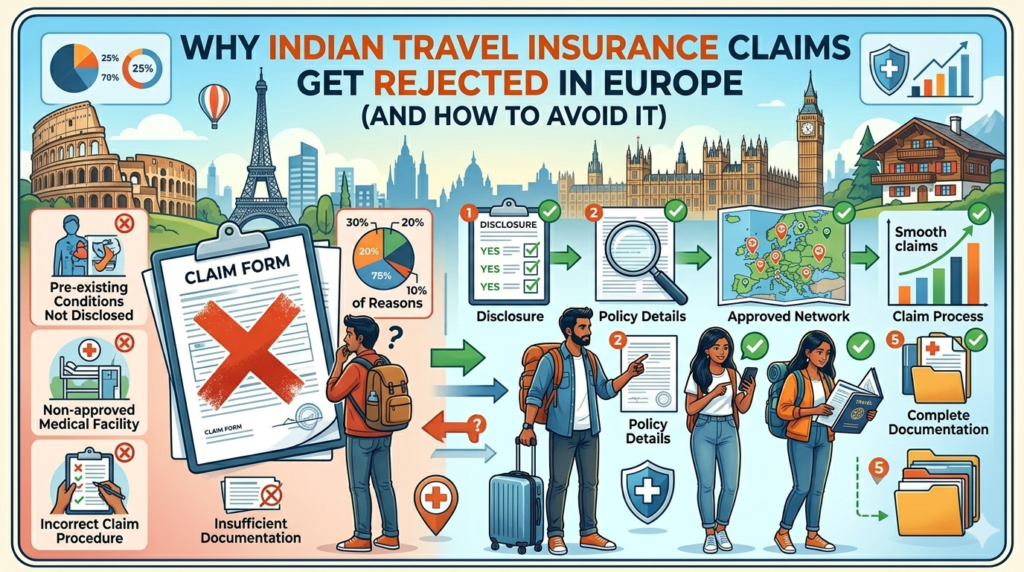
Traveling from India to Europe or other parts of the world is exciting, but filing a travel insurance claim abroad can quickly become stressful if something goes wrong. Every year, a significant number of Indian travelers face travel insurance claim rejections in Europe, often not because the incident wasn’t covered—but due to technical mistakes, missing documentation, or policy misunderstandings.
Understanding these rejection reasons can save you thousands of euros and ensure your trip remains financially protected. This guide also explains how smart policy selection through platforms like SchengenSure can reduce claim risks significantly.
One of the biggest reasons claims are rejected is simple: the incident is not covered under the policy.
Common exclusions include:
Many travelers assume “travel insurance covers everything,” which is incorrect. Always read the exclusions section carefully.
Insurance companies in Europe are strict about paperwork. Even valid claims get rejected if documents are incomplete.
Typical missing documents include:
Without proper documentation, insurers cannot verify the claim.
Timing matters a lot in insurance claims.
Many policies require:
Delays often lead to rejection even if the claim is valid.
A common mistake among Indian travelers is buying insurance that:
If your policy is not active during the incident, the claim will be automatically rejected.
For Schengen countries, insurance must meet strict requirements:
If your policy does not meet these conditions, not only can your visa be affected, but claims may also be denied.
Travel insurance is designed for emergencies, not routine healthcare.
Rejected claims often include:
Insurers expect proof of emergency necessity.
One of the most serious reasons for rejection is non-disclosure of medical history.
Examples:
If the insurer discovers undisclosed conditions during claim assessment, the entire claim may be denied—even if unrelated to the emergency.
Insurance companies in Europe use strict verification systems. Claims may be rejected if:
Even minor inconsistencies can trigger rejection.
Some policies exclude coverage in certain regions or during:
If an incident happens in a restricted area, the claim may be invalid.
Here’s how Indian travelers can reduce rejection risks significantly:
Use trusted platforms like SchengenSure to compare policies that meet Schengen (European) visa and medical standards.
Always declare pre-existing conditions.
Save digital and physical copies of:
Contact your insurer as soon as an emergency occurs. Ensure that you have saved the 24×365 days emergency of the insurance provider number saved.
Know what is included and excluded before you leave India.
Indian travelers often face more claim rejections in Europe due to:
Education and preparation are key to avoiding these issues.
Travel insurance is not just a visa requirement or formality—it is a financial protection system that only works when used correctly. Most claim rejections are preventable with proper policy selection and disciplined documentation.
By choosing transparent, compliant, and well-structured plans through platforms like SchengenSure, Indian travelers can significantly reduce the risk of claim rejection and travel with confidence across Europe.
Destination-based travel medical insurance
for the world. Locally optimized. Globally
trusted. Schengen compliant.
© 2026 SchengenSure. All rights reserved.
Crafted by Medowa Global