
Can You Enter Through a Different Schengen Country Than the One That Issued Your Visa?
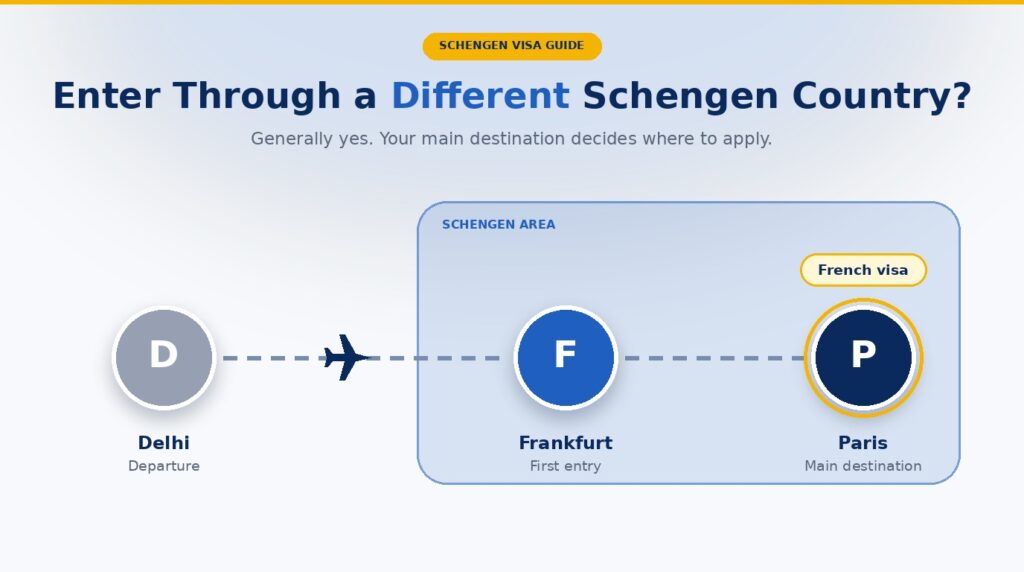
Yes, as a general rule, a valid uniform Schengen visa can be used to enter the Schengen Area through a different Schengen country from the one that issued it. The European Commission specifically states that you may generally cross any Schengen border with a visa issued by any Schengen country.
However, the visa does not guarantee admission. You should be able to explain your genuine destination and itinerary, and the country that issued the visa should normally have been the country responsible for your application under the main-destination rules.
First Entry and Main Destination Are Different Rules
The most common confusion is treating “first entry” as a universal rule. It is not. The first-entry country and visa-issuing country do not always have to be the same. [1]
At the application stage, you normally apply to the country you intend to visit or, for a multi-country trip, the country where you will spend the longest time. Where stays are equal, EU guidance says to apply to the first Schengen country you will visit. [2]
France-Visas gives a useful official example: if France is the main destination but your flight arrives through another Schengen country, you still apply to France. [3]
Comparison: Visa-Issuing Country vs First-Entry Country
Question | What matters |
Which country should process the application? | The sole/main destination; for equal-length stays, the first country visited |
Where may you first enter? | Generally any Schengen external border if the uniform visa is valid |
What happens at first entry? | Border checks take place in the country where you first cross the external Schengen border |
Does a visa guarantee admission? | No. Entry conditions are checked at the border |
Does this apply to every visa? | Check territorial validity; a limited-territorial-validity visa is different |
Example: French Visa, First Landing in Germany
Suppose you obtained a French Schengen visa because you plan to spend eight nights in France, but your flight from India lands in Frankfurt before you continue to Paris. Germany is your first Schengen entry point, but France can still be the correct visa-issuing country because France is your main destination.
At Frankfurt, German border authorities can check your visa and ask about your journey. Carrying the Paris connection, French hotel bookings and other supporting documents makes the itinerary easy to understand.
What Happens With a Connecting Flight?
If your itinerary is Delhi -> Frankfurt -> Paris, you normally enter the Schengen Area in Frankfurt. The European Commission explains that travel to one Schengen State through another Schengen airport is not treated as international airport transit: once you enter Schengen, flights between Schengen States are treated as internal flights for this purpose. [1]
By contrast, if you remain in an airport’s international transit zone while travelling between two non-Schengen countries, different airport-transit rules may apply.
Can You Enter Another Country With a Single-Entry Visa?
Generally, yes, provided it is a uniform Schengen visa valid for that country. “Single entry” means you may enter the Schengen Area once; it does not normally mean that your first external border must be in the country that issued the visa. [1]
Once you leave the Schengen Area, a single-entry visa normally cannot be used for another entry. A visa marked “02” permits two entries, while “MULT” permits multiple entries during the visa’s validity, subject to the authorised stay.
Important Exception: Limited Territorial Validity
Check the “VALID FOR” field on your visa sticker. The Visa Code defines a uniform visa as valid throughout the Schengen territory, but a visa with limited territorial validity is valid only for one or more specified Member States. [4]
If your visa is territorially restricted, do not assume that the general “enter through another country” rule applies. Follow the countries listed on the visa and seek official advice if your route would cross a country outside that validity.
What Can Border Control Ask You to Show?
A Schengen visa is not an automatic right of entry. The European Commission states that at the external border you may have to provide supporting documents in addition to your passport and visa, including evidence that you have sufficient means and documents explaining the purpose of the stay. [1]
Depending on the trip, useful evidence can include:
- Onward flight, train or bus reservation to the main destination.
- Hotel or accommodation bookings.
- Return or onward travel arrangements.
- Business invitation, conference registration or family-visit evidence where relevant.
- Evidence of sufficient funds for the stay and return journey.
- Travel medical insurance documentation relevant to the trip.
France, for example, tells short-stay visitors that border police may request evidence of trip purpose, means of subsistence, return arrangements and an insurance certificate. [5] Requirements and checks can vary by situation, so keep the documents that explain your actual journey.
What If Your Itinerary Changed After the Visa Was Issued?
Real travel plans can change. A new flight route, cancelled connection or hotel change does not automatically mean that a valid uniform visa becomes unusable.
The important question is whether your current trip remains genuine and compatible with the visa. If a major change means the visa-issuing country is no longer part of the trip, or your new itinerary looks very different from the application, border officials may reasonably ask for an explanation. Keep evidence of genuine changes such as airline cancellation or revised bookings where relevant.
Entering Another Country Is Not Automatically “Visa Shopping”
Entering Germany first with a French-issued visa is not, by itself, evidence of visa shopping. The concern is different: whether the application was lodged with the correct country based on the genuine intended trip.
Do not create an artificial itinerary for one country merely because appointments are easier or you believe that country grants visas more readily. Apply according to the actual destination rules and keep the trip consistent and truthful.
Common Mistakes
- Believing you must always enter through the visa-issuing country first.
- Believing first entry is always the rule for deciding which consulate should receive the application.
- Applying to an easier consulate even though another country is the genuine main destination.
- Assuming a valid visa guarantees admission at the border.
- Travelling without documents that explain an unusual first-entry route.
- Ignoring the “VALID FOR” field and possible territorial restrictions.
- Leaving Schengen on a single-entry visa and assuming you can re-enter.
- Changing travel dates without checking that the visa and insurance remain valid.
Pre-Travel Checklist When Entering Through Another Schengen Country
☐ Confirm the visa is still valid on the planned entry date.
☐ Check the “VALID FOR” field for territorial validity.
☐ Check whether the visa is single-entry, two-entry or MULT.
☐ Confirm that the trip still has a genuine and explainable main destination.
☐ Carry the onward connection to the main destination where relevant.
☐ Keep accommodation and itinerary documents accessible.
☐ Carry evidence of sufficient funds and return/onward travel where relevant.
☐ Check that your travel medical insurance covers the actual dates and destinations.
☐ If the itinerary changed materially, keep evidence explaining why.
☐ Use official consular or border guidance if your route involves an unusual visa restriction.
OFFICIAL-SOURCE CHECK: Schengen border procedures, entry systems and country-specific guidance can change. Recheck the European Commission, Visa Code, Schengen Borders Code and relevant national authority whenever this article is updated.
Buying Guidance: Check Insurance Against the Real Itinerary
Once your route is final, make sure your travel medical insurance matches the trip you will actually make. If your dates changed after the visa was issued, check the policy start and end dates rather than assuming the original certificate still fits.
When comparing insurance, consider territorial coverage, emergency medical treatment, hospitalisation, repatriation, exclusions, assistance and the clarity of the insurance certificate. Do not select a policy only because it is the cheapest.
SchengenSure can be used as a comparison starting point. The final insurance and entry requirements should always be checked against the official rules relevant to your journey.
FAQs
Do I have to enter the country that issued my Schengen visa first?
No general rule requires that for a valid uniform Schengen visa. The European Commission states that, as a general rule, you may cross any Schengen border with a visa issued by any Schengen country. [1]
Can I enter Germany first with a French Schengen visa?
Generally, yes, if the visa is valid for Germany and France remains the genuine main destination. Be prepared to explain the itinerary and show onward travel or bookings if asked.
What is the difference between first entry and main destination?
Main destination is primarily an application-jurisdiction rule. First entry is the country where you first cross the external Schengen border and is also used to determine the correct consulate where equal-length stays do not identify another main destination. [1][2]
Can border control refuse entry even with a valid visa?
Yes. A short-stay visa does not automatically entitle the holder to enter. Border authorities can verify the purpose of the visit, funds and other entry conditions. [1]
Can I use a single-entry visa to enter through a different Schengen country?
Generally, yes, if it is a uniform visa valid for that country. Single entry limits the number of entries into Schengen, not normally the country of first external entry.
What if my visa says it is valid only for certain countries?
That may be a limited-territorial-validity visa. Follow the territories printed on the sticker rather than assuming it is valid across the whole Schengen Area. [4]
What documents should I carry when entering through another country?
Keep documents that make the trip easy to understand, such as onward transport, accommodation, return travel, proof of funds, purpose-of-travel evidence and relevant insurance documentation.
Conclusion
You can generally enter Schengen through a different country than the one that issued your uniform visa. The first-entry country and visa-issuing country do not have to match simply because they are different stages of the journey.
The key is that you applied to the correct country for the genuine trip, your visa is territorially valid for the route, and you can satisfy normal border-entry conditions. Carry a clear itinerary, keep supporting documents available and make sure your insurance covers the trip you will actually take.