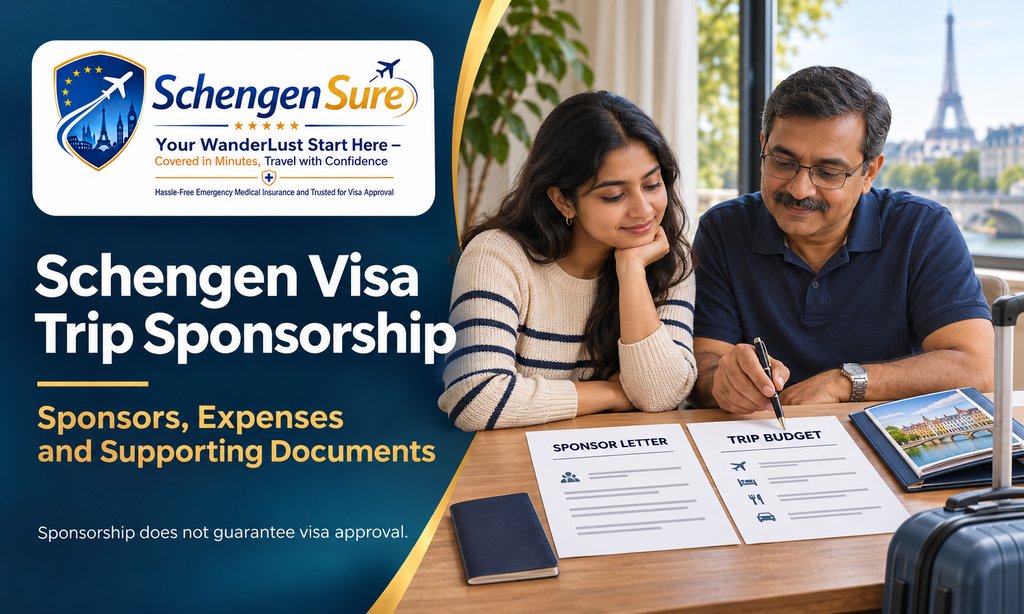
DIRECT ANSWER: A Schengen visa applicant may have a parent, child, spouse, partner or another person pay for some or all of the trip. The application should clearly identify the sponsor, explain which expenses they will cover, and include the sponsor documents required by the competent consulate. Sponsorship supports the financial part of an application; it does not guarantee approval or replace the applicant’s other evidence.
What does Schengen visa sponsorship mean?
Schengen visa sponsorship means that another person or organisation accepts responsibility for specified travel expenses. These may include transport, accommodation or daily costs.
Under Article 14 of the EU Visa Code, an applicant may need evidence of the journey’s purpose, accommodation, sufficient means of subsistence and an intention to leave before the visa expires. Proof of sponsorship or private accommodation may help demonstrate sufficient means.[1]
Three roles are often confused:
- Sponsor: pays some or all expenses.
- Host or inviting person: invites the applicant or provides accommodation.
- Applicant: applies for the visa and remains responsible for presenting a credible application.
One person can be both sponsor and host, but this is not automatic. If different people pay and provide accommodation, explain each person’s role.
Which Schengen visa sponsor documents may be needed?
There is no single checklist for every applicant. The relevant embassy or consulate may require its own form and evidence.
| OFFICIAL-SOURCE CHECK: Download the current checklist from the competent embassy or consulate before preparing the file. Required forms, document periods, translations, certification and legalisation can vary by destination and application location. |
|---|
A sponsored application commonly includes, where requested:
- a signed sponsorship letter or official sponsorship form;
- the sponsor’s passport or identity document;
- proof of the sponsor’s legal residence, if relevant;
- recent evidence of employment, business, pension or other lawful income;
- bank statements for the period requested by the checklist;
- proof of relationship with the applicant;
- an invitation or private-accommodation document, if applicable; and
- a clear statement of the expenses the sponsor will pay.
The applicant normally still provides their application form, passport, itinerary, accommodation evidence, travel medical insurance and documents required for their personal situation.
What should a sponsorship letter explain?
Unless an official form replaces it, a concise letter can state:
- the applicant’s and sponsor’s full names and contact details;
- their relationship;
- the destination, purpose and intended dates;
- the costs covered by the sponsor;
- where the applicant will stay; and
- a list of supporting documents.
The letter should agree with the application, bookings and financial evidence. Do not use exaggerated promises or unverifiable claims.
Sponsorship, invitation and accommodation compared
| Document or role | Main purpose | Important limitation |
|---|---|---|
| Sponsorship evidence | Shows who will pay specified expenses | Does not by itself prove accommodation or return ties |
| Invitation letter | Explains who invited the applicant and why | Does not automatically show that the host will pay |
| Private-accommodation proof | Shows where the applicant will stay | Does not automatically cover travel or daily expenses |
| Applicant’s own evidence | Shows personal circumstances and reason to return | Should remain credible even when the trip is sponsored |
Some Member States use a combined sponsorship and private-accommodation form. For example, the Netherlands requires particular formalities in relevant family-visit cases.[3] Treat this as a country-specific example, not a universal procedure.
Sponsoring parents for a Schengen visa
An adult child may pay for a parent’s short visit, subject to the applicable checklist. A useful file explains why sponsorship is needed and how the child can afford the commitment.
Possible relationship evidence includes a birth certificate or other official civil-status record. The parent should also submit their own relevant circumstances, such as pension, property, family responsibilities or other home-country ties, where requested.
Practical example
An adult daughter living in Germany invites her retired parents for a three-week visit. She pays for flights and daily expenses, while her parents stay in her home. The file may therefore need evidence for sponsorship, accommodation, relationship and her lawful residence, plus each parent’s separate application documents.
Sponsorship should not create a false impression that the parent has no independent life or reason to return.
Sponsoring students
Students often have limited income, so a parent or guardian may fund a holiday, family visit, educational tour or short course. The application should distinguish a short-stay Schengen trip from a national long-stay study visa.
Useful evidence may include:
- proof of enrolment;
- approved leave or academic-calendar evidence, where relevant;
- proof of relationship to the sponsor;
- the sponsor’s financial documents; and
- the student’s own account evidence, if requested.
A student should still explain the trip’s purpose, dates and reason to return to studies. Money alone does not establish those points.
Sponsorship by a spouse or partner
A spouse or partner may pay for the applicant’s trip. The evidence depends on whether the couple is married, in a registered partnership or unmarried.
A marriage certificate or registered-partnership record may show the relationship. An unmarried couple may need other credible evidence, but applicants should submit only proportionate, genuine material requested for their case.
Important EU-family-member distinction
A non-EU spouse, qualifying registered partner, durable partner or dependent parent travelling with or joining an EU citizen may, in some circumstances, use a special EU-family-member procedure. Eligibility depends on the relationship, destination, the EU citizen’s nationality and whether they are exercising free-movement rights.[4]
This route is not the same as an ordinary sponsored visitor application. Unmarried partners are not treated identically in every country. Check the competent authority’s instructions or obtain qualified advice if the correct route is uncertain.
| EXPERT-REVIEW POINT: Seek qualified immigration advice where dependency, durable partnership, EU free-movement rights or the correct short-stay route is disputed. Do not rely on financial sponsorship alone to claim family-member status. |
|---|
Can a sponsor live outside the Schengen Area?
Sometimes. A family member in the applicant’s country of residence may fund a trip, while a different person hosts the applicant in Europe. Official checklists can distinguish between an overseas payer and a local host.[3]
Explain the arrangement clearly and provide evidence for both roles. Do not assume that a personal letter can replace a destination country’s official sponsorship form.
Neutral financial and insurance guidance
There is no safe universal sponsor-bank-balance figure. The assessment depends on the destination’s current subsistence rules, trip length, prepaid costs, number of travellers and the sponsor’s existing commitments.
Before choosing services or buying insurance:
- use the competent consulate’s current checklist;
- compare policies by eligibility, territorial cover, medical benefits, exclusions and claims assistance;
- ensure the insurance certificate names each insured applicant and covers the required trip dates; and
- check date-change and visa-refusal refund conditions.
SchengenSure allows travellers to compare travel medical insurance options, but applicants should read the certificate and full terms before purchasing. A sponsor can pay the premium, but the traveller must be correctly identified as the insured person.
Common sponsorship mistakes
- Calling the host a sponsor when the applicant will pay personally.
- Submitting a letter without financial evidence.
- Failing to state which costs are covered.
- Using an unofficial letter when a national form is required.
- Providing inconsistent dates, addresses or relationships.
- Omitting proof connecting the applicant and sponsor.
- Relying only on the sponsor’s finances and ignoring the applicant’s return ties.
- Treating unmarried-partner evidence as automatically equal to a marriage certificate.
- Confusing a short visit with family reunification or a long-stay student visa.
- Assuming sponsorship guarantees approval.
Sponsored application checklist
- Identify the competent consulate and correct visa route.
- Download its latest official checklist and sponsorship form, if any.
- Identify the sponsor, host and payer separately.
- State who pays flights, accommodation and daily expenses.
- Include the sponsor’s identity and requested financial evidence.
- Include proof of relationship where relevant.
- Match names, dates, destinations and addresses across documents.
- Add the applicant’s personal, purpose-of-travel and return-tie evidence.
- Obtain compliant travel medical insurance for each traveller.
- Arrange translations, legalisation or certification only where required.
Frequently asked questions
Who can sponsor a Schengen visa applicant?
A relative, partner, friend, employer or organisation may be able to fund a trip, depending on its purpose and the consulate’s rules. The sponsor must be identifiable and able to prove the promised support.
Does the sponsor have to live in Europe?
Not always. Some checklists accept funding from a person in the applicant’s country of residence. A destination may separately require a local host’s invitation or official form.
Does a sponsored applicant need personal bank statements?
Possibly. A consulate may request the applicant’s own statements or other financial evidence even when another person pays. Follow the specific checklist.
Can I sponsor both of my parents in one application?
You may fund both trips, but each parent normally submits an individual visa application and the supporting evidence required for that file.
Can an unmarried partner sponsor a Schengen visa?
Potentially, but sponsorship does not establish a legally recognised partnership. Provide truthful relationship evidence requested by the consulate and verify whether ordinary visitor or EU-family-member rules apply.
Does the applicant still need travel insurance?
Yes, unless an official exemption applies. Sponsorship and travel medical insurance address different requirements. The sponsor may pay, but the certificate should identify the applicant as insured.
Is a sponsorship letter the same as an invitation letter?
No. Sponsorship concerns payment, while an invitation explains the visit or host relationship. One document may address both only if accepted by the relevant authority.
Conclusion
A strong Schengen visa sponsorship file clearly shows who is paying, what they will cover and how the applicant and sponsor are connected. Use the destination’s official forms, keep every document consistent, and remember that sponsorship supports—but does not replace—the applicant’s purpose, insurance and evidence of return.
Official sources
- European Union, Visa Code, Regulation (EC) No 810/2009, consolidated text, Article 14: Open official source
- European Commission, Handbook for the Practical Application of the Visa Code, 2024: Open official source
- Government of the Netherlands, Schengen visa checklist for visiting family or friends: Open official source
- Your Europe, Travel documents and visas for non-EU family members: Open official source
- Your Europe, Residence rights for partners in the EU: Open official source