Schengen Visa Financial Requirements: Bank Balance, Statements and Sponsorship (2026)
Sources checked 13 October 2026. For ordinary short-stay Schengen visa applications. National long-stay visas and residence permits have different requirements.
There is no single minimum bank balance that guarantees a Schengen visa. You need evidence that you can pay for your planned stay and return or onward journey. The country you visit, your accommodation, trip length, income and any sponsorship all affect the documents you should prepare. Financial means are one part of the application, alongside your travel purpose, accommodation and other supporting evidence.
This guide helps you work out a realistic funding plan, choose the documents relevant to your situation and explain transactions that might otherwise be unclear. Start with your responsible consulate’s checklist, then use the worksheet and examples below.
Use the free Financial Readiness Checker to organise your preparation. Compare its guidance with your official checklist before submission.
Start with your own application
Write down these six details before collecting bank statements:
- Where you legally live and will apply. This determines which local checklist to use. Your nationality and country of residence can be different.
- Your main destination and other countries visited. If you are unsure where to apply, use the Correct Consulate Finder and confirm the result with the official mission.
- Your arrival and departure dates. Count both arrival and departure days in your planning worksheet; record hotel nights separately.
- Who is travelling. List each adult and child and identify who funds each person’s expenses.
- Your accommodation. Distinguish booked hotels, unbooked nights and a private host with the required supporting form.
- Who pays. You, a parent or partner, a host, an employer, or a combination.
Choose your document route: Employed | Self-employed | Retired | Student or sponsored | Family with children.
The European Commission generally directs applicants to the consulate responsible for their legal residence. Use the destination’s official checklist for that application location rather than a checklist for another country.
Published country reference amounts for 2026
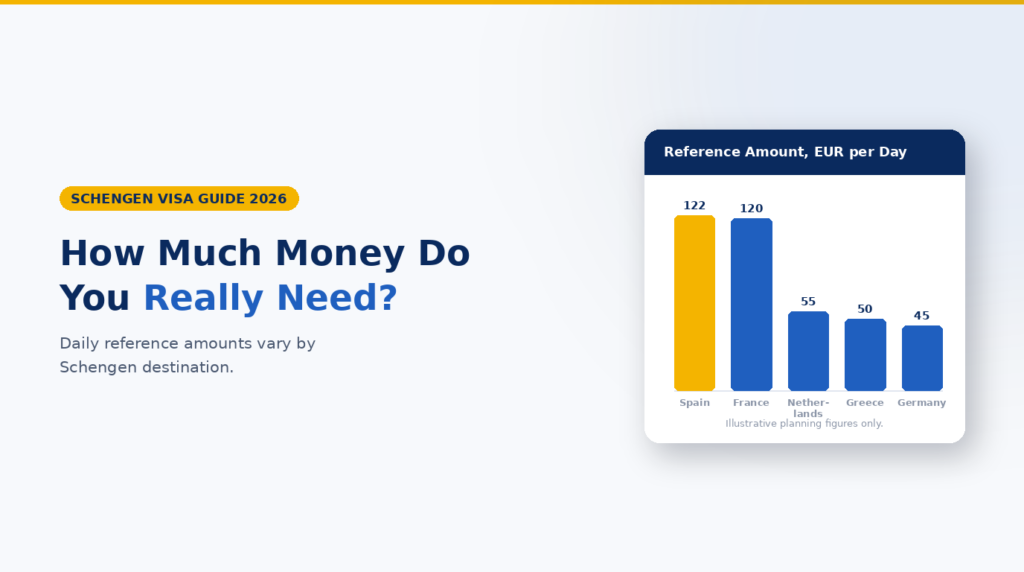
The table summarises selected published reference amounts. The Commission document used here is dated 8 June 2026. It concerns financial means at external borders; these amounts are useful context for planning, but your visa application also needs the supporting documents requested by the responsible mission. A daily reference is not a universal required bank closing balance.
Selected country references checked on 13 October 2026
Destination | Published reference | Qualification and source |
|---|---|---|
Spain | €122.10 per person per day; minimum €1,098.90 per person. | The minimum applies regardless of trip length. Check return travel evidence separately. |
France | €65 per hotel-booked day; €120 per unbooked day; €32.50 with an accepted attestation d’accueil. | A private invitation alone does not establish the lower amount. |
Germany | No mandatory fixed daily amount; €45 is a fallback indication. | Individual assessment; return or onward travel also matters. |
Italy | Trip-length and group-size table; one traveller: €269.60 for 1–5 days, €44.93 daily for 6–10 days. | Longer trips use different calculations. |
Netherlands | €55 per person per day. | Check whether sponsorship is needed for your situation. |
Greece | €50 daily; minimum €300 for up to five days. | Published amounts are halved for minors. |
Portugal | €75 per entry plus €40 daily. | An exemption may apply when board and lodging are guaranteed. |
Austria | No fixed reference amount. | Case-by-case assessment. |
Switzerland | Approximately CHF 100 daily; CHF 30 for students with valid student identification. | Private-host cases have separate guarantee arrangements. |
Visiting several countries? Prepare one coherent budget for the whole journey. Do not multiply your main destination’s rate by the entire trip and describe that result as a binding rule for every country. Check the requirements relevant to your application, entry and accommodation arrangements.
Travelling with children? Budget for everyone. Do not apply a child discount across countries unless the official source allows it. Include shared costs such as one family hotel room only once.
For other destinations, use the Commission’s official country links and the current local checklist. Recheck amounts if you apply in a later year.
Build a funding plan without counting costs twice
Prepare two separate records: the relevant country reference calculation, and the actual expenses of your trip. They answer different questions. A reference amount does not tell you how much your particular flights, hotels or family itinerary will cost.
For your practical budget, list each expense once. Record the total price, how much has genuinely been paid, how much remains payable and who will pay it. A hotel reservation marked “pay at property” belongs in the unpaid column.
Trip funding worksheet
Expense | Total cost | Already paid | Still payable | Payer |
|---|---|---|---|---|
Return or onward transport | _____ | _____ | _____ | _____ |
Accommodation | _____ | _____ | _____ | _____ |
Meals and daily expenses | _____ | _____ | _____ | _____ |
Local transport and activities | _____ | _____ | _____ | _____ |
Insurance and other trip costs | _____ | _____ | _____ | _____ |
Personal contingency | _____ | Not applicable | _____ | _____ |
Total | _____ | _____ | _____ | _____ |
Your planning target: add the costs still payable by you and a contingency you can justify for your trip. Compare this with your genuinely accessible funds and the relevant country reference. If either comparison reveals a gap, review your budget or document a genuine sponsor. This is a preparation method, not a legal minimum formula.
Do not subtract prepaid expenses from a published country reference unless the country’s rules expressly permit that treatment. Do not count sponsor-funded expenses as your own obligations and then count the same funding twice.
If your account uses INR or another currency, record the conversion date, rate and source next to your euro estimate. Use a current bank or recognised currency reference and allow for exchange-rate movement. The official assessment is not determined by a conversion estimate on this website.
Three worked examples
Example 1 An employed traveller visiting France
Fictional example: one traveller plans ten calendar days in France. The hotel is booked and already paid at €800. The return flight is paid at €600. Remaining expenses are €350 for meals, €120 for local transport, €100 for activities and €180 contingency.
The remaining practical budget is €750. The hotel-booked reference illustration is 10 × €65 = €650. Keep these figures separate; do not add the €800 hotel or €600 flight again to the remaining budget. Show the paid bookings alongside accessible funds and income evidence. Meeting either figure alone does not guarantee approval.
Example 2 A short Spain trip
For one person staying seven days, 7 × €122.10 equals €854.70. The published minimum is €1,098.90, so that minimum controls the reference illustration. For two people, the corresponding minimum is €2,197.80. A family’s actual unpaid costs still need their own budget.
Example 3 A student funded by a parent
Fictional example: a student’s parent pays for flights and hotels, while the student pays daily expenses. The application, sponsor letter and budget should all say this. Gather evidence of the relationship, the parent’s identity and ability to pay, the student’s enrolment and any applicant bank records requested locally. Describe the real split rather than checking “all expenses sponsored” when that is not true.
Use the Family and Sponsored Application Checker to organise questions to review against the official checklist.
Prepare bank statements that explain the money
Read your destination’s local checklist for the required statement period, recency, certification and format. “Three months of transactions” and “a document issued within the last three months” are different instructions.
India-specific examples: the Dutch tourism checklist currently includes personal statements for the past three months stamped and signed by the bank, or the specified Indian income-tax evidence. Germany’s visit or family-and-friends checklist asks for three months of bank-stamped applicant statements and says passbook copies are not accepted. Germany also requests applicant economic-status evidence when a trip is sponsored. These examples are not rules for every Schengen application. [7] [8]
- Check that the account holder, currency, statement period and transaction history are clear.
- Provide all required pages in their original sequence. Do not edit transactions, balances or dates.
- Connect income credits with the relevant salary, pension or business evidence.
- Explain important transfers between your own accounts so they are not mistaken for new income.
- Use a separate short note for an unusual deposit and attach evidence of its source.
- Keep genuine funds available for the journey; a briefly inflated balance does not explain who owns the money.
For statement formatting and certification questions, read Schengen Visa Bank Statement Requirements. This funding guide focuses on the overall plan.
Choose your financial document checklist
These are preparation prompts. Submit the documents and exact periods your official checklist requests. Do not add irrelevant material simply to make the file longer.
If you are employed
- Personal bank statements and matching salary evidence for the required period.
- Employment confirmation and approved leave where requested.
- Requested tax evidence, such as ITR acknowledgements or Form 16 for relevant India applications.
- Evidence explaining any material bonus or non-salary transfer.
If you are self-employed or own a business
- Personal funds used for the trip, plus relevant business statements where requested.
- Business registration and applicable local tax documentation.
- Selected invoices, contracts or payment records that explain irregular income if clarification is needed.
- A short explanation of transfers from the business to your personal account. A company balance is not automatically personal spending money.
If you are retired
- Pension credits and the corresponding pension documents.
- Accessible savings or other genuine income used for the trip.
- A sponsor package if a relative pays some expenses.
If you are a student unemployed or sponsored
- An accurate description of your current circumstances and the trip’s payer.
- Enrolment evidence if you study, and applicant statements if requested.
- Sponsor identity, relationship evidence, financial documents and a clear description of costs covered.
- Any official guarantee or accommodation form required for the destination.
The Dutch India tourism checklist illustrates how supporting evidence differs for employees, business owners, retired applicants and students. Choose the matching checklist for your own application location.
If you travel as a family with children
- List every traveller and identify which adult pays each person’s costs.
- Count shared expenses once and individual expenses for every traveller.
- Include relationship and any consent or custody documents requested locally.
- Check that every application gives a consistent description of the family trip and funding.
Explain sponsorship clearly
A sponsor letter should explain the relationship, travel dates, destination and exact expenses covered. Match it to the sponsor’s financial evidence. A host who provides a room is not necessarily paying for flights or all daily expenses.
Some destinations use formal documents. For the Netherlands, the official process describes a sponsorship form and signature legalisation where a visa is required. German guidance refers to a Verpflichtungserklärung in relevant cases. France’s lower private-accommodation reference requires the accepted attestation d’accueil. Check the applicable procedure rather than replacing an official form with a generic letter.
Copy and edit this sponsor letter
Use only statements that are true. Remove unused options. Include personal identifiers only where requested and send documents through the official application process.
Date: [date]
To: [responsible consulate or visa section]
Subject: Financial sponsorship for [applicant full name]
Dear Visa Officer,
I, [sponsor full name], residing at [address], am the [relationship] of [applicant full name]. I will fund the following expenses for their visit to [destination countries] from [arrival date] to [departure date]: [specific expenses].
The estimated amount I will cover is [amount and currency]. [Explain any expenses paid already.] The applicant will pay [remaining expenses, or state none accurately]. My funds come from [employment, pension, business or savings], as supported by the attached [document list].
I attach [identity and relationship evidence] and [financial evidence]. [Identify any required official guarantee or accommodation form included separately.]
Please contact me at [telephone and email] if clarification is required.
Yours faithfully,
[sponsor name and signature]
Explain large deposits and transfers
Prepare a traceable explanation for an important credit that would otherwise be difficult to understand. Examples include a bonus, matured deposit, sale proceeds, a transfer between your accounts or a genuine family gift. The explanation and evidence must describe the actual transaction.
Evidence to consider when explaining a transaction
Transaction | Possible supporting evidence |
|---|---|
Salary bonus | Employer confirmation or bonus payslip matching the bank credit. |
Matured fixed deposit | Deposit ownership and maturity or redemption record. |
Transfer from your other account | Records showing the debit and matching credit, with account ownership. |
Family gift or sponsorship | Truthful explanation of the arrangement, relationship and transfer source. |
Sale proceeds | Sale agreement, ownership evidence and payment trail. |
Do not describe a loan as savings or invent an explanation for a temporary transfer. A fixed deposit or investment may support the file, but clarify when the money is accessible. Property ownership and spendable trip funds should be identified separately.
Copy and edit this transaction explanation
Date: [date]
To: [responsible consulate or visa section]
Subject: Explanation of [amount and currency] credited on [date]
Dear Visa Officer,
The credit of [amount and currency] on [transaction date] in my submitted statement came from [actual source]. It represents [brief factual explanation].
I attach [supporting documents] showing [ownership, source and payment trail]. [If it is a transfer between your accounts, identify the matching debit and explain that it is not new income.]
The funds are [explain availability and any restrictions or repayment obligation]. The trip costs I will pay are [expenses and estimated amount], as shown in my budget.
Yours faithfully,
[applicant name and signature]
Your final funding review
Before submission, answer each question and record any action still needed:
- Have I checked the official mission’s current requirements for my residence and travel purpose?
- Have I budgeted the whole journey for every traveller without counting shared expenses twice?
- Are prepaid costs supported by genuine payment records rather than reservations alone?
- Are my funds accessible, and do my statements explain their source?
- Have I provided the required periods and formats of bank and income documents?
- Is every important deposit or transfer that needs clarification explained?
- Does any sponsorship specify the actual payer and expenses covered?
- Do the form, budget, bookings, invitation and cover letter agree?
- Have I prepared any required official guarantee or accommodation form?
- Have I checked insurance separately against the trip and local requirements?
Record your result in three parts: funding available, documents still to gather and points to clarify. Avoid treating a completed checklist as an approval score.
Continue with the full Schengen visa document checklist, the form-filling guide or the form-mistake guide, depending on your next task.
Check travel insurance as a separate requirement
Travel medical insurance does not demonstrate that you can afford the trip. Check it separately. Official Dutch guidance describes cover for the entire stay in all Schengen countries, at least €30,000 in medical expenses and the specified emergency and repatriation risks. The policy and local provider requirements still matter. [10]
If you already have a policy, use the insurance verification guide. If you need cover, compare insurance for your trip once your dates are clear. Review final prices, exclusions, deductibles and amendment or cancellation terms before buying.
Affiliate disclosure: SchengenSure may receive a commission if you buy through an affiliate link on its comparison pages. Insurance purchase does not guarantee a visa.
Frequently asked questions
How much bank balance do I need for a Schengen visa
There is no single balance for every applicant. Check the destination’s reference, your actual unpaid trip costs and the evidence required by your responsible mission. A higher closing balance does not explain the source of funds by itself.
Does a hotel reservation mean the hotel is already paid
No. A reservation may be payable later. Put that expense in the unpaid column unless you have evidence that payment has been made.
Can my parent or partner pay for the trip
Document the genuine arrangement with the required sponsor evidence and relationship documents. Check whether the destination requires an official form. Your own circumstances may still need evidence.
Should I submit three months or six months of statements
Follow the precise local checklist. Several India examples use three months, but do not turn that into a universal rule or confuse transaction history with document issue date.
Can I use a joint account or fixed deposit
Check local acceptance and show ownership and accessibility. Explain who can use the money and any withdrawal restrictions. These documents should support a clear funding plan.
Do I have to buy flights before applying
Follow the responsible mission’s instructions. For example, the Dutch India tourism checklist asks for a travel reservation and says a paid ticket is not required. A reservation is evidence of travel plans, not proof that transport has already been paid.
What if my financial evidence was questioned in a refusal
Read the actual refusal reason and instructions. Identify whether the issue concerns availability, evidence, an unexplained transaction or an inconsistent payer. Address that issue rather than only increasing the balance. Use the issuing mission’s appeal or reapplication guidance.
Should I keep funding evidence after receiving the visa
Keep relevant trip and funding documents accessible when travelling. France’s official arrival guidance includes proof of accommodation, financial means and return arrangements among documents that border authorities may request.
Official sources and verification dates
The following sources were checked on 13 October 2026. Check the current mission checklist again before submission. A source check date does not mean every authority revised its rules on that date.
- European Commission Applying for a Schengen visa. General application scope, residence and supporting documents.
- European Commission Annex 25 reference amounts. Document dated 8 June 2026. Germany page 6; Greece page 8; Portugal page 22; Austria page 20; Switzerland page 30.
- Spanish Embassy Schengen visa guidance. Published 2026 financial amounts. Use the Spanish mission responsible for your own application.
- France-Visas Your arrival in France. Accommodation-dependent references and border documents.
- Italian Ministry of Foreign Affairs means of support table. Use the full duration and group-size table.
- NetherlandsWorldwide family and friends checklist. Published €55 daily funding reference.
- NetherlandsWorldwide tourism checklist for applicants in India. Local financial documents, applicant profiles and travel reservation instructions.
- German Missions in India visit and family or friends checklist. Applicant and sponsor evidence and statement format.
- NetherlandsWorldwide sponsoring a visitor. Formal sponsorship process and signature legalisation.
- NetherlandsWorldwide general tourism checklist. Travel medical insurance evidence.
Return to the starting checklist or review your financial preparation.