Schengen Visa Documents and Checklist: Complete Applicant Guide
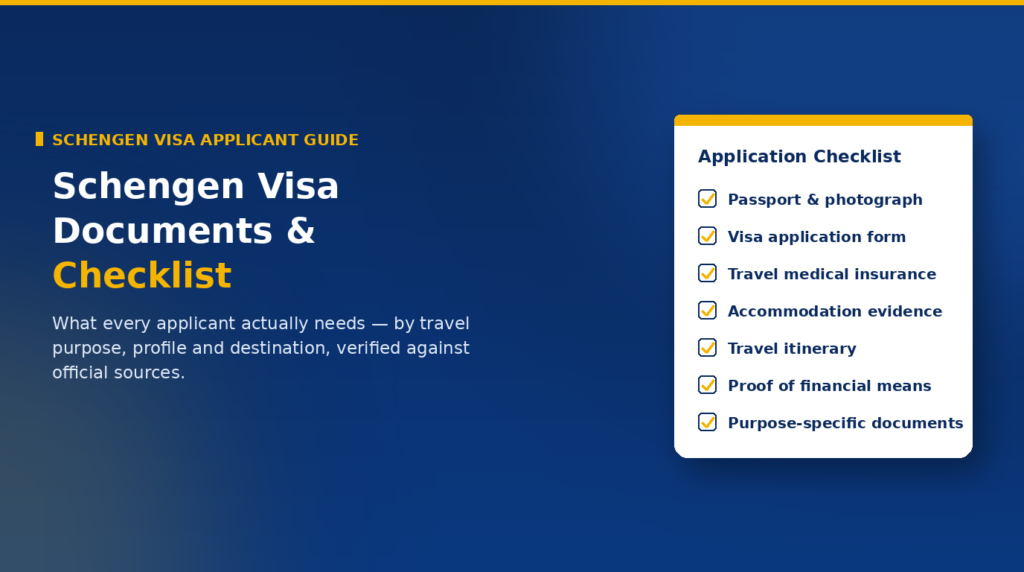
A Schengen visa application normally needs identity documents, the application form, a compliant photograph, travel medical insurance, and evidence explaining the trip, accommodation, finances and intention to return. The exact Schengen visa documents depend on the responsible consulate, travel purpose, country of application and applicant profile, so the current official checklist must be the final authority.
There is no single universal Schengen visa checklist
The European Commission identifies common document categories, while consulates may request additional evidence. The Commission handbook also says documents must be assessed in relation to the individual application and that one document can sometimes make another unnecessary
Quote-worthy rule: A useful checklist is not the longest possible document list. It is the correct official list for the applicant’s real trip, location and personal situation. |
Requirement layer | Typical examples | Where to verify |
|---|---|---|
Common legal framework | Travel document, form, photo, insurance, purpose, accommodation, funds and intention to return | EU Visa Code and European Commission guidance |
Purpose-specific | Tourism plan, business invitation, host evidence, course or event confirmation | Official checklist for the real main purpose |
Applicant-specific | Employment, self-employment, study, sponsorship, retirement or minor documents | Checklist for the applicant’s true profile |
Location-specific | Copies, translations, bank format, declarations, document order or local insurer list | Responsible consulate and authorised application centre |
Core Schengen visa documents
Use these as organising categories, not as a substitute for the responsible consulate’s checklist.
1. Application and identity
- Completed and signed visa application form, using the official form or portal specified.
- Valid travel document or passport, plus the pages and copies requested locally.
- Recent photograph in the required format, unless the local process captures it digitally.
- Proof of legal residence where you apply, if you are not applying in your country of nationality.
- Biometrics or appointment-related documents where applicable.
For a uniform visa, the Visa Code sets travel-document conditions including sufficient validity, at least two blank pages and issuance within the previous 10 years. Local checklists specify the copies and presentation format.
2. Purpose, travel and accommodation
- A truthful explanation of the main purpose of travel.
- Transport reservation or other accepted travel evidence.
- Accommodation for the intended stay, such as hotel bookings or host documents.
- A realistic itinerary for tourism or a schedule linked to meetings, visits, study or events.
- An invitation, enrolment, registration or relationship document when relevant.
3. Financial means and intention to return
Financial evidence should show who pays, whether funds are accessible and whether the budget is credible for the trip. Depending on the checklist and applicant, relevant records may include bank statements, income or tax documents, employment or business evidence, pension records, sponsor documents and proof of continuing professional, family or study responsibilities.
Official-source check: There is no universal number of bank-statement months or single mandatory tie document for every application. Use the period, bank format and profile evidence stated by the responsible authority. |
4. Travel medical insurance
For a uniform Schengen visa, insurance must be valid throughout the Member States for the intended stay, cover emergency medical, hospitalisation and repatriation risks, and provide at least EUR 30,000 coverage. Special situations exist, so the local checklist still controls. [1][2]
Documents that change with the travel purpose
- Tourism: credible itinerary, accommodation and transport evidence covering the planned route.
- Business: invitation, employer or business letter, meeting or event details and a clear payment arrangement.
- Family or friends visit: host, relationship, accommodation and sponsorship evidence required by that destination.
- Short study, training or event: admission, enrolment, programme or registration evidence linked to the visit.
- Medical, cultural, sporting or official travel: category-specific confirmation and funding documents.
Purpose changes the evidence. For example, an official Netherlands India business checklist asks for an invitation or other evidence of trade or employment relations and a cover letter, while its tourism checklist focuses on the tourism plan. [4][5]
Documents that change with the applicant profile
- Employee: employment evidence, income records and approved leave where requested.
- Self-employed or freelancer: registration or professional evidence, tax history, contracts, invoices and matching payments as applicable.
- Student: enrolment evidence, permission or academic schedule, and sponsor documents if someone else pays.
- Retired or unemployed applicant: pension, other income, sponsor or personal-funding evidence suited to the real situation.
- Sponsored applicant: sponsor letter, relationship evidence and the sponsor’s financial records in the required form.
- Minor: birth, parental-authority, consent, custody and parent-identification documents specified by the checklist.
Consistency is as important as completeness
A complete file can still be difficult to understand if the documents contradict one another. Names, passport details, dates, destinations, accommodation, funding, invitations, cover letter and insurance should describe the same trip.
Practical example: If the form says 10 nights, the hotel evidence covers 8 nights and the insurance covers 9, the problem is not simply a missing page. The application contains three different versions of the trip. |
Buying guidance for bookings and insurance
Before paying for flights or hotels, read the official checklist and the supplier’s cancellation terms. Some checklists accept reservations rather than paid tickets; the Netherlands India tourism checklist, for example, states that a paid travel ticket is not needed. Do not assume this wording applies to another authority. [4]
When comparing insurance, check the traveller’s name, destination territory, dates, covered risks and coverage amount on the certificate. Then review exclusions, deductibles, assistance, claims, cancellation and any destination-specific approved-insurer rule. Price alone does not show whether the certificate fits the application.
SchengenSure option: Applicants can compare Schenb gen visa travel medical insurance and then verify the selected certificate against the official checklist. No policy or comparison service can guarantee visa approval.
Common document mistakes
- Using a generic checklist for the wrong country, purpose or application location.
- Submitting an incomplete form, missing signature or outdated photograph.
- Providing bookings, invitation, form and insurance with conflicting dates.
- Showing unexplained bank credits or sponsor funds without a clear relationship and payment plan.
- Submitting employee, student or business evidence that does not match the applicant’s true status.
- Ignoring instructions about originals, copies, translations, legalisation, bank stamps or document order.
- Adding fabricated, altered or unverifiable reservations and financial records.
- Assuming that a complete file guarantees approval or prevents requests for further documents.
Final Schengen visa application checklist
- Correct consulate and application jurisdiction confirmed.
- Correct short-stay category and main purpose selected.
- Current official checklist reviewed close to the appointment.
- Form, passport, copies, photograph and legal-residence evidence prepared.
- Purpose, transport and accommodation documents cover the whole trip.
- Financial means, sponsor and return-tie evidence match the applicant’s profile.
- Insurance certificate matches the required name, territory, dates, risks and coverage.
- Minor or family documents included where applicable.
- Names, dates, destinations and funding agree across every document.
- Originals, copies, translations, order and appointment instructions checked.
Frequently asked questions
What documents are required for a Schengen visa?
Common categories include the application form, passport, photograph, travel medical insurance, trip-purpose evidence, accommodation, financial means and evidence supporting the intention to return. The responsible consulate’s current checklist gives the exact list and format.
Is one Schengen visa checklist valid for every country?
No. The common legal framework is shared, but local checklists vary by destination, application country, purpose and profile. Always use the checklist issued for the authority handling your application.
How many months of bank statements are required?
There is no single period for every application. Submit the number of months and the bank format stated in the official checklist, and make unusual credits or transfers easy to understand.
Do I need paid flights and hotels before applying?
Not always. Some authorities accept reservations, but requirements differ. Follow the exact wording of your checklist and consider refundable options when a paid booking is necessary and the terms are suitable.
Is an income tax return mandatory for every applicant?
No universal rule makes the same tax document mandatory for everyone. Some local checklists request tax returns for particular applicant profiles. If a requested document is unavailable, obtain official guidance rather than assuming an alternative will be accepted.
Can the consulate request additional documents?
Yes. The European Commission states that consulates may request additional documents. A complete checklist file supports assessment, but it does not remove the authority’s ability to seek clarification or further evidence.
Conclusion
The best Schengen visa documents checklist is accurate, current and specific to the applicant. Start with the common evidence categories, then apply the responsible consulate’s purpose-, profile- and location-specific instructions. Submit a genuine, readable file in which the trip, funding, accommodation, ties and insurance tell one consistent story.