
Schengen Visa Cover Letter and Itinerary Examples
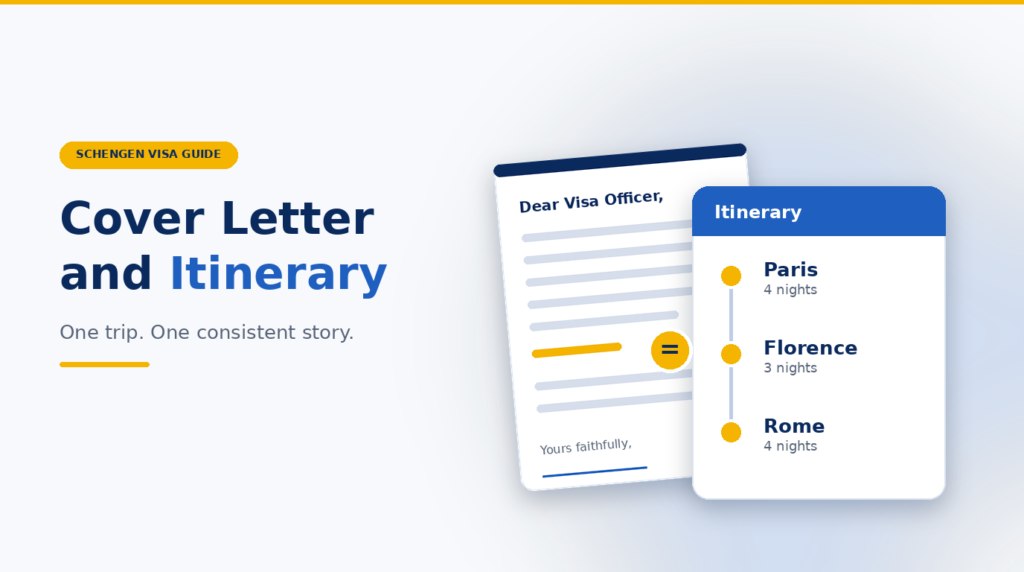
A strong Schengen visa cover letter explains why you are travelling, while the itinerary shows how the trip will actually work. Neither document should create a separate story: the purpose, dates, countries, accommodation, funding, reservations and travel insurance should remain consistent across the application.
Do You Need a Cover Letter and Itinerary for a Schengen Visa?
The EU Visa Code requires supporting documents showing the purpose of the journey, accommodation, sufficient means and information relevant to assessing whether the applicant intends to leave before the visa expires. Annex II specifically lists itinerary-related evidence for tourism and private travel.[1]
A personal cover letter is not a single universal requirement written into the Visa Code for every applicant. Local checklists can, however, ask for one. For example, Germany’s current tourism checklist for applicants in India asks for a personal covering letter and a detailed travel itinerary.[2] Always check the official checklist for the Schengen country and location where you apply.
“A cover letter explains the trip. An itinerary demonstrates the travel plan. The supporting documents should substantiate the same story.” |
Cover Letter vs Itinerary: What Is the Difference?
Cover letter | Itinerary |
Explains why you are travelling | Shows where you plan to be and when |
Summarises applicant circumstances | Lists destinations, dates and movements |
Explains funding or sponsorship where useful | Shows accommodation and practical route |
Can clarify unusual facts | Helps demonstrate whether the trip is realistic |
Connects the supporting evidence | Should correspond with flights, hotels and other bookings |
What Should a Schengen Visa Cover Letter Include?
- Applicant name and passport number.
- Visa type and genuine purpose of travel.
- Intended travel dates and main destination.
- Short summary of the route and accommodation.
- Who will pay for the trip and, if relevant, who is sponsoring you.
- Employment, business, study, retirement or other circumstances relevant to the application.
- A short explanation of any fact that could otherwise appear confusing.
- A polite request for assessment of the visa application.
Keep the letter factual. It does not need dramatic promises, exaggerated language or a long autobiography. If an important fact is already obvious from the documents, one clear sentence is usually better than several persuasive paragraphs.
Schengen Visa Cover Letter Sample: Tourist Applicant
To: Visa Section, [Embassy/Consulate] |
Use this only as a structure. Replace every placeholder with truthful information and remove sentences that do not apply. A copied template containing facts that conflict with your documents is worse than a shorter original letter. Visit SchengenSure “Cover Letter Generator App”.
Schengen Visa Cover Letter Example: Sponsored Family Visit
To: Visa Section, [Embassy/Consulate] |
For students, homemakers, retired applicants or sponsored travellers, adapt the financial and personal-circumstances section instead of pretending to be employed. The letter should explain the real applicant profile, not imitate somebody else’s sample.
What Should a Schengen Visa Itinerary Include?
For tourism or private journeys, Annex II of the Visa Code includes documents indicating the envisaged travel plans among the possible supporting documents.[1] A useful itinerary should therefore make the proposed trip easy to understand.
- Date or day number.
- City and country.
- Main planned activity or reason for being there.
- Accommodation or overnight location.
- Intercity movement where relevant.
- Arrival and departure details where useful.
You do not need to schedule every hour. A credible itinerary is specific enough to show a real route but flexible enough to look like normal travel rather than a fictional timetable.
Schengen Visa Itinerary Sample: 7-Day Single-Country Trip
Day | Location | Example plan |
Day 1 | Paris, France | Arrive, hotel check-in, short evening walk. |
Day 2 | Paris | Central Paris sightseeing and museum visit. |
Day 3 | Paris | Montmartre and nearby attractions. |
Day 4 | Paris | Day trip or additional sightseeing. |
Day 5 | Paris | Flexible tourism day; confirmed accommodation continues. |
Day 6 | Paris | Final sightseeing and preparation for departure. |
Day 7 | Paris -> India | Hotel checkout and return flight. |
Schengen Visa Itinerary Example: Multi-Country Trip
Dates | Destination | Example route |
5-8 Oct | Paris, France | Arrival in Paris; three full tourism days. |
9 Oct | Paris -> Florence, Italy | Travel to Florence; hotel check-in. |
10-11 Oct | Florence | Tourism in Florence and surrounding area. |
12 Oct | Florence -> Rome | Travel to Rome. |
13-15 Oct | Rome | Rome sightseeing. |
16 Oct | Rome -> India | Return journey. |
For a multi-country application, make sure the itinerary supports the country that is competent to examine the visa application under the applicable destination rules. Your first entry and main destination can be different concepts, so do not change the route merely to fit a preferred embassy.
Visit “SchengenSure Travel Itinerary Generator”.
The SchengenSure One Travel Story Check
Before submission, compare every date and destination across the file:
Purpose: Does the cover letter describe the same reason for travel as the application form and supporting evidence?
Dates: Do the cover letter, itinerary, reservations and relevant insurance documentation describe the same intended travel period?
Countries: Does the route support the main destination stated in the application?
Flights: Do arrival, intercity movements and departure make practical sense?
Accommodation: Is there appropriate accommodation evidence for the places and nights claimed?
Funding: Does the cover letter describe self-funding or sponsorship consistently with financial evidence?
Insurance: Does the travel medical insurance cover the intended journey and meet the applicable Schengen requirements?
“Purpose -> Dates -> Countries -> Flights -> Hotels -> Funding -> Insurance -> Return. If one element tells a different story, review the application before submission.” |
Common Cover Letter and Itinerary Mistakes
- Copying an online sample without replacing facts that do not apply.
- Writing a long emotional letter instead of explaining the trip clearly.
- Using different travel dates in the cover letter, itinerary, flights or accommodation.
- Creating an unrealistic route with too many cities or long transfers.
- Claiming self-funding in the cover letter while submitting sponsorship documents, or the reverse.
- Using vague accommodation statements that do not correspond with the itinerary.
- Adding attractions only to make the itinerary look detailed, even when the route is impractical.
- Treating a polished cover letter as a substitute for missing supporting documents.
Final Checklist Before You Submit
☐ Check whether the official consular checklist requires a personal cover letter.
☐ Use a truthful purpose of travel.
☐ Confirm intended arrival and departure dates.
☐ Make the itinerary realistic for the available time.
☐ Check the main destination and route.
☐ Match hotel or host information to the itinerary.
☐ Match funding/sponsorship statements to financial evidence.
☐ Check flight or transport evidence against the route.
☐ Check travel medical insurance dates and territorial cover.
☐ Remove copied sentences that do not describe your own application.
Buying Guidance: Flights, Hotels and Travel Insurance
Do not make expensive travel purchases simply to make a cover letter look convincing. Follow the official checklist for the type of reservation evidence required by the competent consulate, and understand the cancellation conditions before paying for flights or accommodation.
Once your intended dates are settled, review your travel medical insurance separately. The policy should meet the applicable Schengen requirements and cover the intended journey. SchengenSure can be used to compare suitable options, but the comparison should support the real itinerary rather than determine it.
Visit SchengenSure for buying Schengen visa compliant travel insurance.
FAQs
Do I need a cover letter for a Schengen visa?
Not as one universal Visa Code requirement for every applicant. However, local consular checklists can require a personal covering letter, so check the official list for your application location.[1][2]
What should a Schengen visa cover letter include?
Usually the purpose, travel dates, destinations, funding or sponsorship where relevant, applicant circumstances and a short explanation connecting the supporting documents.
How long should a Schengen visa cover letter be?
There is no universal Visa Code page limit. Keep it concise enough to be read quickly and long enough to explain any facts that genuinely need clarification.
Do I need a day-by-day itinerary?
Requirements vary by checklist, but a structured day-by-day or date-by-date plan is often the clearest way to show the envisaged route, accommodation and movements.
Should my cover letter and itinerary match?
Yes. They should describe the same genuine purpose, dates, destinations and funding arrangement.
Can I use a template from the internet?
Use a template as a structural example only. Replace all facts with your own and remove wording that does not apply.
Should I mention home ties in my cover letter?
If relevant, a short factual explanation can help, but evidence matters more than broad promises that you will return.
Do my insurance dates need to match the itinerary?
Travel medical insurance should cover the intended journey under the applicable Schengen requirements. Review the dates after any itinerary change.
Conclusion
The best Schengen visa cover letter sample is not the one with the most impressive wording. It is the one that accurately explains the applicant’s real trip. Likewise, a strong Schengen visa itinerary sample is realistic, easy to follow and supported by the rest of the application.
Use examples to understand structure, then write your own facts. When the cover letter, itinerary, reservations, finances and insurance all support one coherent travel story, the application is easier to assess and less likely to contain avoidable contradictions.