
Most first-time applicants must appear in person for Schengen visa biometrics, while fingerprints first entered in the Visa Information System less than 59 months before a new application can generally be copied, although fresh collection may still be requested. A passport must normally remain valid for at least three months after the intended departure, contain at least two blank pages and have been issued within the previous 10 years. Postal submission is allowed only where the competent mission’s current instructions permit it; reusable biometrics do not create an automatic right to apply by post.[1][3]
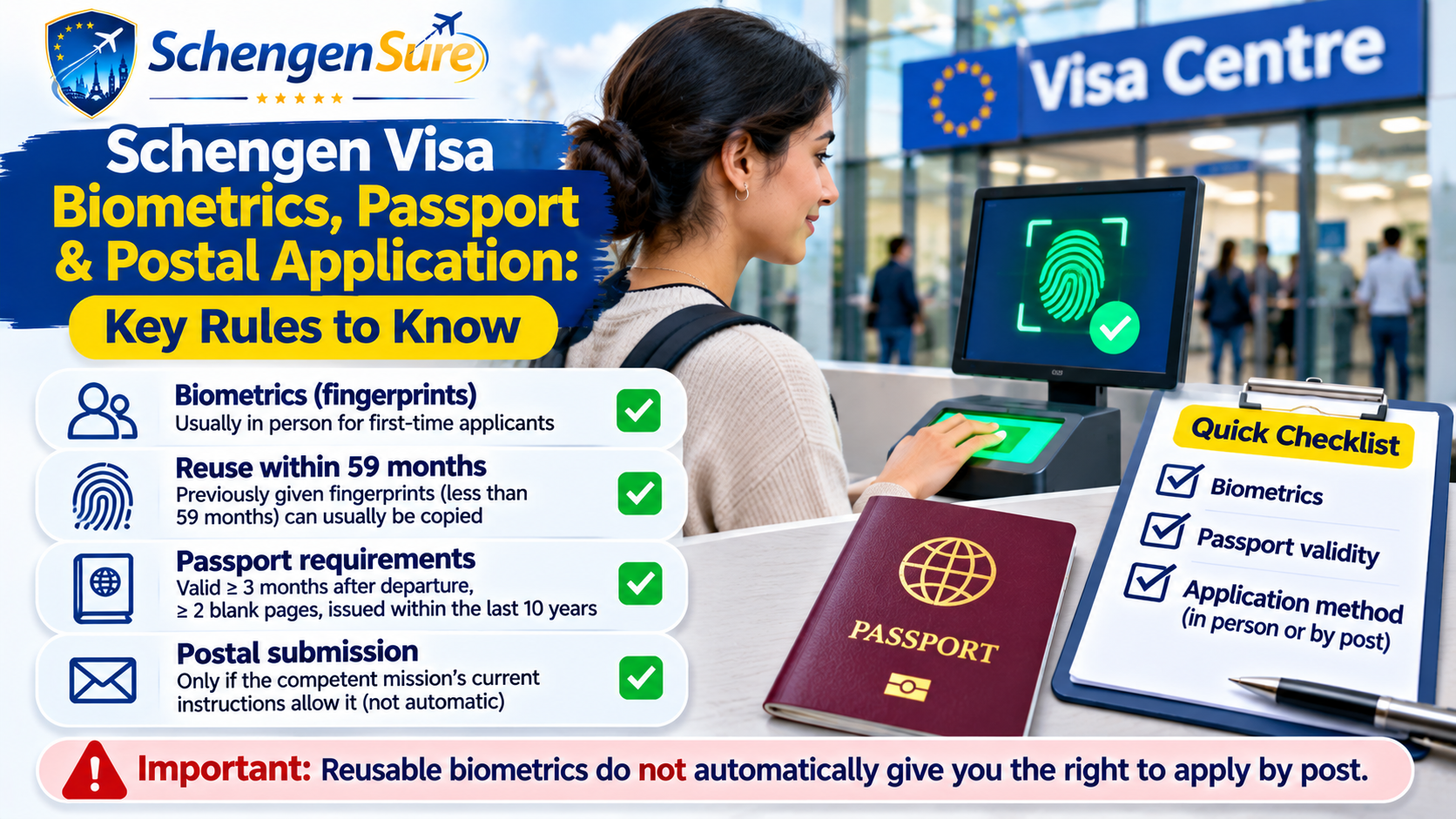
Treat biometrics, passport validity and submission as separate checks
Biometric and passport rules are shared, but submission routes vary by destination, jurisdiction and application centre. Complete all three checks before booking or posting a passport.
| Check | Question to answer | Best source |
|---|---|---|
| Biometrics | Must I attend for fingerprints and a photograph? | Visa Code plus the mission’s instructions |
| Passport | Does my travel document meet validity, issue-date and blank-page rules? | Visa Code and destination checklist |
| Submission | Must I lodge in person, or is mail-in lodging allowed? | Competent mission or its authorised provider |
| Return | Will my passport be collected, posted or returned by courier? | Application-centre delivery instructions |
When are Schengen visa biometrics required?
For a first application, the Visa Code requires personal appearance and collection of a photograph and 10 fingerprints. If fingerprints from an earlier application were first entered in the VIS less than 59 months before the new application, they are normally copied to the new file.[1]
Fingerprints may be collected again if identity is in doubt, the previous record cannot be confirmed or stored prints are unusable.[1][5]
Who is exempt from giving fingerprints?
The main applicant-facing exemptions include:
- Children under 12
- People for whom fingerprinting is physically impossible
- Certain senior officials travelling for an official purpose
Fingerprint exemption does not remove the application, photograph or mission-specific attendance requirements. A child still needs an individual application and travel document.[1]
Quote-worthy distinction: Reusable fingerprints may remove the need for fresh fingerprint collection. They do not, by themselves, prove that postal submission is available.
Visa biometrics are not the same as EES border checks
Visa biometrics are collected for examining a visa application and stored in VIS. The Entry/Exit System records travel-document and biometric data when covered non-EU travellers cross participating external borders. Completing one process should not be described as completing the other.[3][6]
Schengen visa passport validity requirements
Under Article 12 of the Visa Code, the passport or other recognised travel document must normally:
- Remain valid for at least three months after the intended departure from the Schengen Area
- Contain at least two blank pages
- Have been issued within the previous 10 years
For several intended visits, check validity against the last intended departure. A visa’s validity cannot extend beyond the travel document’s validity, so a passport nearing expiry can also affect a requested long-validity multiple-entry visa.[1]
A simple passport-validity example
If a traveller plans to leave the Schengen Area on 10 June, the passport would normally need to remain valid until at least 10 September. The issue-date and blank-page tests must still be satisfied. Use the exact dates in the application and recheck the competent mission’s checklist before submitting.
What if the passport is damaged or will be renewed?
Damage, a name mismatch or planned renewal can affect the file even when calendar validity is sufficient. Ask the issuing authority and competent mission before applying or replacing the passport.
Can you submit a Schengen visa application by post?
A Schengen visa postal application is not universal. Personal appearance is required when fingerprints must be collected, and the competent mission publishes the available lodging arrangements.[1]
Official examples demonstrate the local nature of mail-in eligibility:
- Germany in the United States: an official page directs certain applicants with a qualifying previous biometric Schengen visa to contact BLS International to check whether mail-in submission is available.[4]
- Switzerland in the United States: applicants with fingerprints collected within the previous 59 months may first need confirmation from the competent Swiss representation before sending a complete application to the responsible VFS office. Fresh fingerprints or an interview can still be requested.[5]
In-person, postal and courier services compared
| Route | What it means | Important limitation |
|---|---|---|
| In-person lodging | Applicant attends the mission or authorised centre | Required when biometrics must be collected; an interview may also be requested |
| Postal or mail-in lodging | The application and passport are sent under an approved local procedure | Available only to eligible applicants in specified jurisdictions |
| Accredited intermediary or group | A permitted body lodges applications under the Visa Code | Not the same as an unrestricted friend or agent submitting for anyone |
| Courier passport return | Passport is delivered after in-person or other authorised lodging | It is a return service, not permission to apply by post |
How to check your correct submission route
1. Identify the competent mission
Confirm the main destination and the mission responsible for your place of legal residence.
2. Check your biometric history
Find when your fingerprints were first collected and keep a copy of the related visa if the instructions request it.
3. Audit the passport
Check expiry, issue date, blank pages, damage and consistency with every form and booking.
4. Read the lodging instructions
Look for an explicit mail-in or postal option. Do not infer it from biometric reuse alone.
5. Verify delivery details
Use only the published address and authorised provider. Confirm tracking, packaging, fees and passport-return arrangements.
Neutral buying guidance
If an official postal or courier option is available, compare only authorised services. Consider tracking, signature on delivery, declared-value limits, delivery windows, loss procedures and secure packaging. Never send a passport to an address taken only from an advert, forum or unsolicited message.
Biometrics and passport validity do not replace travel medical insurance. Before buying cover, compare the certificate, insured name, destination territory, travel dates, benefits, exclusions, assistance arrangements and refund terms against the current checklist.[2]
Applicants who still need cover can compare Schengen travel medical insurance through SchengenSure. Review the current policy wording before purchase. SchengenSure may receive a commission from an affiliate link; this should not affect the comparison criteria.
Common mistakes
- Assuming recent biometrics automatically permit postal submission
- Counting from the previous visa’s expiry instead of checking when fingerprints were collected
- Ignoring the passport’s issue date because its expiry date looks sufficient
- Forgetting the two-blank-page requirement
- Treating a child’s fingerprint exemption as an exemption from the full application process
- Confusing courier passport return with mail-in application lodging
- Assuming stored fingerprints cannot be requested again
- Sending an original passport to an unofficial or outdated address
- Confusing visa-application biometrics with EES border registration
Pre-submission checklist
- I confirmed the competent country, mission and application location.
- I checked whether new fingerprints and personal attendance are required.
- My passport remains valid for the required period after departure.
- My passport was issued within the previous 10 years and has two blank pages.
- The passport is undamaged and matches my application details.
- I found explicit official permission before choosing postal submission.
- I verified the authorised address, tracking and passport-return method.
- My supporting documents and travel medical insurance are complete and consistent.
Frequently asked questions
Do I need to give biometrics again for every Schengen visa?
Not necessarily. Fingerprints first entered in VIS less than 59 months before a new application can generally be copied, but fresh collection may be required if the record cannot be confirmed, is unusable or identity needs checking.
Are Schengen biometrics valid for five years or 59 months?
Official information often describes a five-year reuse period, while the Visa Code uses less than 59 months before the new application. For application planning, follow the mission’s current 59-month calculation and instructions.
Can I apply by post if my biometrics are still reusable?
Only if the competent mission or its authorised provider expressly allows postal submission for your circumstances. Reusable fingerprints alone do not establish mail-in eligibility.
Can another person submit my Schengen visa application?
Do not assume so. The Visa Code permits particular lodging routes, including specified accredited intermediaries or organisations. Check whether the mission allows the proposed person or organisation to lodge your application.
How long must my passport be valid for a Schengen visa?
It must normally remain valid for at least three months after the intended departure from the Schengen Area, have been issued within the previous 10 years and contain at least two blank pages.
Do children under 12 need Schengen visa biometrics?
They are exempt from giving fingerprints, but they still need the required application, photograph, passport and supporting documents. Check whether the mission requires the child to attend.
Is passport return by courier the same as postal submission?
No. Courier return delivers the passport after lodging. Postal submission means sending the application for lodging under an expressly permitted procedure.
Can the consulate call me even if I apply by post?
Yes. A mission may require fresh biometrics, further documents or a personal interview when necessary. Postal acceptance does not remove the authority’s examination powers.
Conclusion
Check biometrics, passport validity and the submission route separately. Recent fingerprints may be reusable, but the passport must satisfy the travel-document rules and postal lodging must be expressly authorised. Check the competent mission’s live instructions before travelling or mailing an original passport.
Reliable sources
- EUR-Lex – Consolidated Visa Code – Articles 9, 10, 12, 13 and 24
- European Commission – Applying for a Schengen visa – passport and travel medical insurance overview
- European Commission – Visa Information System – biometric reuse and fingerprint exemptions
- German Missions in the United States – Schengen visa mail-in requirements – location-specific mail-in example
- Swiss representations in the United States – Schengen visa application procedure – biometric confirmation and lodging example
- European Commission – Entry/Exit System – border-system distinction