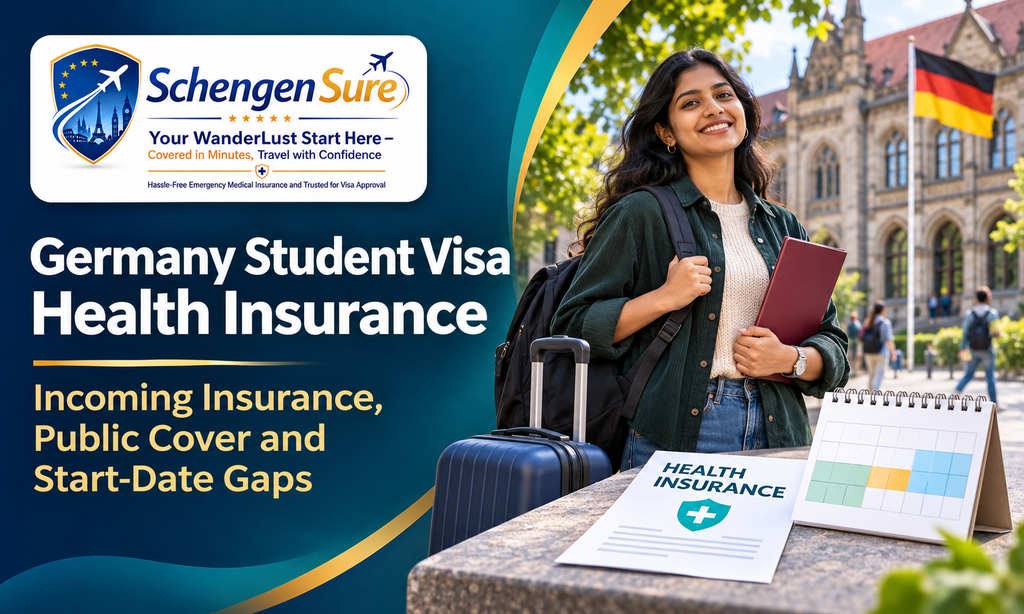
For a Germany student visa, the most important insurance date is usually your intended arrival date, not only the first day of classes. Many students use statutory/public or eligible private cover for their studies and may need separate incoming insurance for an earlier arrival, but a generic Schengen travel policy should never be assumed to satisfy national student-visa rules.
Quick distinction: A stay exceeding 90 days normally uses Germany’s national visa process. Short-stay Schengen travel-insurance rules are not a reliable substitute for the student-visa checklist.[3]
Why health-insurance start dates matter
Health insurance for international students in Germany can involve three different moments: the visa application, arrival in Germany and university enrolment. The documents accepted at one stage may not automatically complete the next stage.
For applications handled in India, the German Missions’ current study checklist asks for a certificate of statutory or private compulsory health insurance from the intended arrival date.[1] Its national-visa FAQ also explains that when insurance begins later than the proposed travel date, the visa start date may be set later.[2] Applicants elsewhere must check the German mission responsible for their place of residence.
The three-stage insurance timeline
- Visa evidence: Provide the insurance document required by the responsible German embassy, consulate or Consular Services Portal checklist.
- Arrival bridge: If long-term cover does not begin on arrival, arrange acceptable cover for every day before it starts.
- Study cover: Complete the insurance process required for enrolment and maintain valid cover during the stay.
Quote-worthy rule: Your insurance timeline should have no blank days between the intended entry date and the start of long-term student cover.
What is incoming insurance?
Incoming insurance is temporary health cover designed for people arriving in Germany from abroad. Students sometimes use it as a bridge before statutory/public or long-term private insurance becomes active.
The label alone proves nothing. Products differ in benefits, exclusions, deductibles, duration and certificate wording. Some are closer to travel insurance; others are designed for longer German stays. Acceptance depends on the policy and the authority reviewing it.
Official check required: Ask the responsible German mission whether the exact incoming policy is acceptable for your visa category and dates. Do not rely only on a provider’s marketing description.
Purchase your incoming insurance here
Public health insurance for students in Germany
Germany’s public system is usually called statutory health insurance, or gesetzliche Krankenversicherung (GKV). Germany distinguishes between statutory and private health-insurance systems.[5] The Federal Ministry of Health provides an official overview of statutory health insurance.[7] Government guidance says students are generally required to use statutory insurance, although exceptions can apply, including to some students over 30.[5]
Eligibility can depend on age, course type, enrolment status and previous insurance decisions. Preparatory courses, Studienkolleg, doctoral study and language courses can be treated differently. Obtain a written eligibility assessment from a German statutory insurer instead of guessing.
Private student health insurance
Private cover may be relevant when a student is not eligible for the statutory student system or has a lawful alternative. However, price alone is not a safe basis for choosing it. Check whether the policy is suitable for the visa, residence process and university enrolment, and understand whether switching later may be restricted.
DAAD advises international students to clarify their insurance early and notes that recognised proof may be needed for a visa or enrolment. It also warns that a decision involving private insurance can affect access to statutory cover during the studies.[4]
Incoming, public, private or ordinary travel insurance?
| Type | Possible role | Useful feature | What to verify |
|---|---|---|---|
| Incoming insurance | Temporary arrival bridge | Can cover a defined pre-study gap | Visa acceptance, dates, limits and exclusions |
| Statutory/public GKV | Long-term student cover when eligible | German public-system administration | Eligibility and actual activation date |
| Private insurance | Alternative long-term cover when suitable | Plan-specific benefits and pricing | Equivalence, enrolment process and switching consequences |
| Ordinary travel insurance | Short-trip emergency cover | Travel-focused protection | Do not assume it meets a national student-visa checklist |
How a start-date gap happens: practical example
A student plans to arrive on 10 September, but the selected long-term plan is confirmed only from 1 October. The period from 10 to 30 September is the potential gap. The student should not simply upload the October certificate and assume the earlier days are covered.
The correct solution depends on the mission and insurer. It may involve changing the long-term start date, adding acceptable incoming cover, or obtaining a combined certificate that clearly covers arrival onward. The dates on the visa form, flight plan and insurance evidence should agree.
Common mistakes to avoid
- Buying only from the semester start when the flight arrives earlier.
- Treating a German national student visa like a short-stay Schengen visa.
- Assuming every policy called incoming insurance is equivalent.
- Choosing private cover without checking future switching consequences.
- Ignoring course status, age or university-specific enrolment instructions.
- Submitting a booking confirmation that does not state the insured person, coverage dates or policy details clearly.
- Cancelling bridge cover before the replacement policy is active in writing.
Germany student visa health-insurance checklist
☐ Confirm whether the stay requires a national visa and use the responsible mission’s current checklist.
☐ Write down the intended entry, accommodation, course, enrolment and long-term insurance dates.
☐ Ask the long-term insurer for the exact activation date and visa certificate.
☐ Cover every earlier day with an accepted solution if a gap remains.
☐ Check public-insurance eligibility or private-cover suitability in writing.
☐ Ask the university how insurance status must be transmitted for enrolment.
☐ Keep certificates, policy wording, payment proof and insurer contact details.
☐ Recheck all requirements shortly before the appointment and before travel.
University enrolment and the M10 notification
Many German universities receive insurance status electronically from a statutory insurer; applicants often call this the M10 notification. A private policy PDF may not by itself complete the university process. Heidelberg University, for example, says it requires an electronic M10 notification from the insurer by enrollment, and applicants must use that university’s own sender number.[6] Procedures and institution numbers are university-specific.
University check required: Follow the enrolment page of your own university. Do not copy another university’s insurer number or process.
Frequently asked questions
Is incoming insurance enough for a Germany student visa?
Sometimes it can form part of an acceptable solution, but the product name is not decisive. Check the exact policy, dates and current instructions of the German mission handling the application.
When should Germany student visa health insurance start?
Use the start date required by the responsible mission. For current applications in India, the study checklist asks for compulsory statutory or private insurance from the intended arrival date.[1]
Can public student insurance start before enrolment?
Activation rules vary by insurer and student status. Ask the chosen statutory insurer for the effective date and written evidence; arrange an accepted bridge if it begins after arrival.
Is Schengen travel insurance sufficient for a German student visa?
Do not assume so. A long-term student stay normally uses a national visa, whose insurance requirements can differ from those for a short Schengen visit.
What if my insurance starts after my flight date?
Change the dates or arrange accepted cover for the gap before submitting. German Missions in India state that a later insurance start may lead to a later visa start.[2]
What is M10?
M10 is commonly used for the electronic insurance-status notification sent by a German statutory insurer to a university. Ask your university and insurer for their exact procedure.
Do students over 30, doctoral candidates or language students follow the same rules?
Not always. Eligibility and enrolment requirements can change with age and programme status. Obtain confirmation from the mission, university and a German statutory insurer.
Conclusion
A credible Germany student visa health-insurance plan connects three stages without a gap: visa evidence, cover from arrival and long-term protection during study. Confirm the exact start date, do not confuse incoming or travel insurance with automatic visa acceptance, and obtain written answers from the responsible mission, university and insurer before paying or cancelling a policy.
Official sources
[1] German Missions in India – Studies, including preparatory college and language courses. Current study-visa checklist and health-insurance start-date wording.
[2] German Missions in India – National Visa FAQs. Explanation of how an insurance start date can affect the visa start date.
[3] German Missions in India – National Visa. National-visa definition and current application route.
[4] DAAD – Healthcare and Health Insurance. General international-student insurance and enrolment guidance.
[5] Make it in Germany – Health Insurance. Federal-government overview of statutory and private cover.
[6] Heidelberg University – Electronic health insurance registration for students. University example confirming the electronic M10 notification required for enrolment.
[7] Federal Ministry of Health – Statutory Health Insurance. Official overview of Germany’s statutory health-insurance system.
One Response