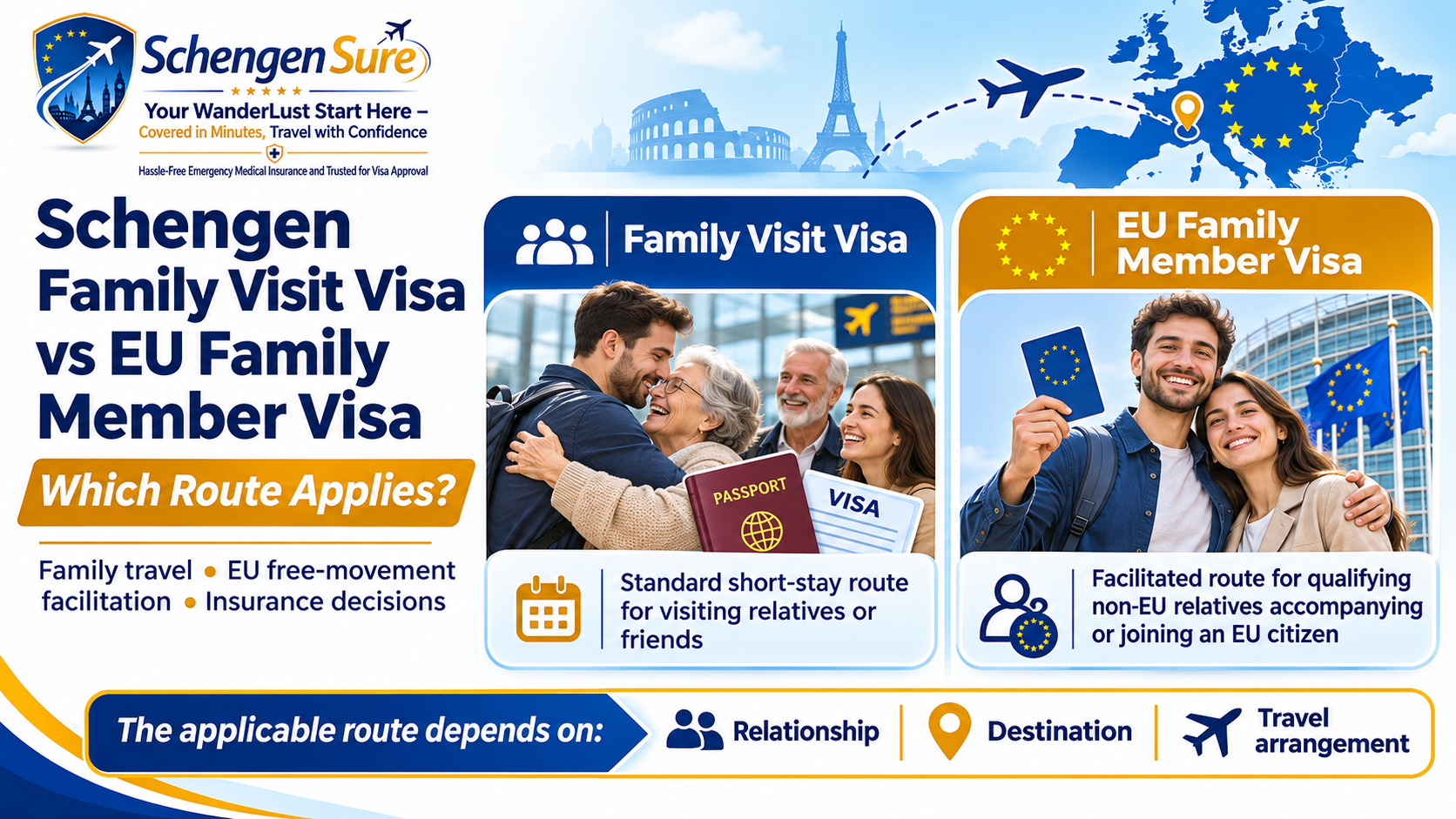
| A Schengen family visit visa is the standard short-stay route for visiting relatives or friends. An EU family member visa is a facilitated route for qualifying non-EU relatives who accompany or join an EU citizen using free-movement rights. The answer depends on the relationship, destination and travel arrangement. |
|---|
Why the visa route matters
The wrong category can cause unnecessary documents, fees or delays. A family connection explains the trip, but it does not automatically create EU free-movement rights.
| A family relationship is the purpose of a standard family visit. It becomes an EU free-movement case only when the legal relationship and travel conditions are also met. |
|---|
Keep family reunification separate. It normally concerns moving to live with a relative and follows residence or national immigration procedures.
What is a Schengen family visit visa?
A Schengen family visit visa is generally a short-stay Type C visa for visiting family or friends. The normal Visa Code assessment covers purpose, funding, accommodation, insurance and intention to leave.
An invitation supports the purpose of travel, but it does not guarantee approval. Each destination country publishes its own local checklist.
Common documents may include:
- A valid passport, application and photograph.
- An invitation identifying the host, address and visit dates.
- Proof of the host’s residence and the relationship, where requested.
- Accommodation, transport, funds or valid sponsorship and evidence of return.
- Travel medical insurance meeting the applicable Schengen rules.
Applicants should use the checklist issued for their country of residence and main destination. For example, the German Missions in India publish a separate Visit/Family & Friends checklist.[5]
What is the EU family member visa route?
The route is based mainly on Directive 2004/38/EC. It can apply when a non-EU family member accompanies or joins an EU citizen in another EU country.[2][3]
Core family members generally include:
- A spouse.
- A registered partner where the host country treats the partnership as equivalent to marriage.
- Children or other direct descendants who are under 21 or dependent.
- Dependent parents, grandparents and other direct ascendants.
Extended relatives and durable partners may receive facilitation, but eligibility requires a destination-specific check.[2]
A simple three-question eligibility test
- Is the person being joined or accompanied an EU citizen?
- Does the applicant have a qualifying family relationship and the required evidence?
- Is the EU citizen travelling to or living in another EU country, and will the applicant accompany or join them there?
If any answer is unclear, do not assume this route applies. National rules usually apply in the EU citizen’s own country; returning-citizen and residence cases may require expert review.[2][4]
Where the Directive applies, the visa should be free and accelerated. Core evidence covers identity, the family relationship and accompanying or joining the EU citizen.[2][3]
Schengen family visit visa vs EU family member visa
| Issue | Standard family visit route | Facilitated EU-family route |
|---|---|---|
| Main purpose | Visit a relative or friend for a short stay | Accompany or join an EU citizen exercising free-movement rights |
| Main rules | Schengen Visa Code and local checklist | Directive 2004/38/EC and related free-movement rules |
| Relationship | Any genuine family or private visit | A qualifying family relationship is required |
| Destination | Apply under the normal main-destination rules | Usually an EU country other than the EU citizen’s country of nationality |
| Supporting evidence | Full standard visa file | Limited evidence establishing identity, relationship and accompanying or joining |
| Visa fee | Standard fees may apply; check the current official page | The visa should be free where the Directive applies |
| Insurance proof | Normally required for a uniform visa | Exempt from presenting proof where the applicant is covered by the Directive[4] |
Practical examples
An Indian parent visiting a German child in Germany
The Directive does not automatically apply merely because the child is German. Germany is the citizen’s own country, so German national rules must be checked.
An Indian spouse travelling with a Portuguese spouse to France
The route may apply because the EU citizen travels to another Member State with a non-EU spouse. They must prove identity, relationship and joint travel.
A sister visiting an Indian student in the Netherlands
This is normally a Schengen family visit visa because the student is not an EU citizen.
Travel insurance: when and what to compare
For the standard route, Article 15 requires adequate insurance for the relevant territory and stay, including urgent care, emergency hospital treatment and medical repatriation. The minimum cover is EUR 30,000.[1]
Before buying, compare more than the premium:
- Certificate wording for territory, dates and medical cover.
- Emergency assistance and hospital payment or reimbursement.
- Age limits, deductibles, exclusions and pre-existing-condition terms.
- Date changes or cancellation after a visa decision.
- Destination-consulate rules for insurers and certificate formats.
SchengenSure can help compare policies, but the destination authority decides whether evidence is acceptable. Read the policy wording and certificate.
Applicants covered by Directive 2004/38 are exempt from presenting insurance for the visa application.[4] They may still buy cover for financial protection.
| Insurance can be sensible without being a visa-document requirement. First identify the legal route; then decide what protection the traveller needs. |
|---|
Common mistakes to avoid
- Calling every visit to an EU relative an EU family member visa case.
- Confusing a short family visit with family reunification or residence.
- Using a generic document checklist instead of the destination’s official instructions.
- Ignoring the EU citizen’s nationality, destination or accompanying/joining condition.
- Assuming an invitation replaces proof of funding or return in a standard application.
- Buying the cheapest insurance certificate without checking exclusions and claims handling.
- Submitting different names, dates or destinations across the invitation, form, bookings and insurance.
Application checklist
- Decide whether the plan is a short visit or a move to live together.
- Check whether the applicant already holds a residence card or permit that removes the visa requirement.[2]
- Record the EU citizen’s nationality and the actual destination country.
- Confirm the relationship and whether dependency must be proved.
- Confirm that the applicant will accompany or join the EU citizen.
- Select the route using the consulate’s official category and checklist.
- Make every name, date, address and itinerary consistent.
- For a standard visit, compare compliant insurance before submission.
- Keep copies of the complete application and supporting evidence.
Points requiring an official source check
| VERIFY BEFORE APPLYING Check official instructions for extended relatives, partners, dependent parents, returning citizens, own-country visits, residence-card exemptions, minors and stays beyond three months. Ireland has separate rules; Switzerland and the EEA states have specific arrangements. |
|---|
Frequently asked questions
Is a family visit visa the same as an EU family member visa?
No. A family visit visa follows the normal short-stay process. The EU family member route is a facilitated procedure for qualifying relatives who accompany or join an EU citizen in a situation covered by free-movement rules.
Do all relatives of EU citizens qualify for the facilitated route?
No. The relationship, dependency where relevant, destination and travel arrangement must satisfy the rules. Extended relatives need a country-specific assessment.
Is the EU family member visa free?
Where Directive 2004/38 applies, the necessary entry visa should be issued free of charge and through an accelerated procedure.[2][3]
Is travel insurance required for the EU family member visa?
Applicants covered by Directive 2004/38 are exempt from presenting proof of travel medical insurance for the visa application.[4] Voluntary insurance may still be useful for medical and financial protection.
Can I use the EU route to visit an EU citizen in their own country?
Not automatically. National rules usually apply, although returning citizens and other special situations can be more complex. Check the competent authority before applying.
Is a Schengen family visit visa suitable for permanent relocation?
No. A short-stay visa is not the normal route for moving permanently. Review the destination country’s family reunification, national visa or residence procedures.
Conclusion
The correct route starts with facts, not the label “family visa.” Use the standard route for an ordinary short visit. Use the EU family member route only when the relationship and travel conditions bring the case within free-movement rules.
For a standard application, prepare a consistent file and compare insurance by coverage, assistance and exclusions. For an EU-family case, follow the specific official checklist rather than a generic visa page.