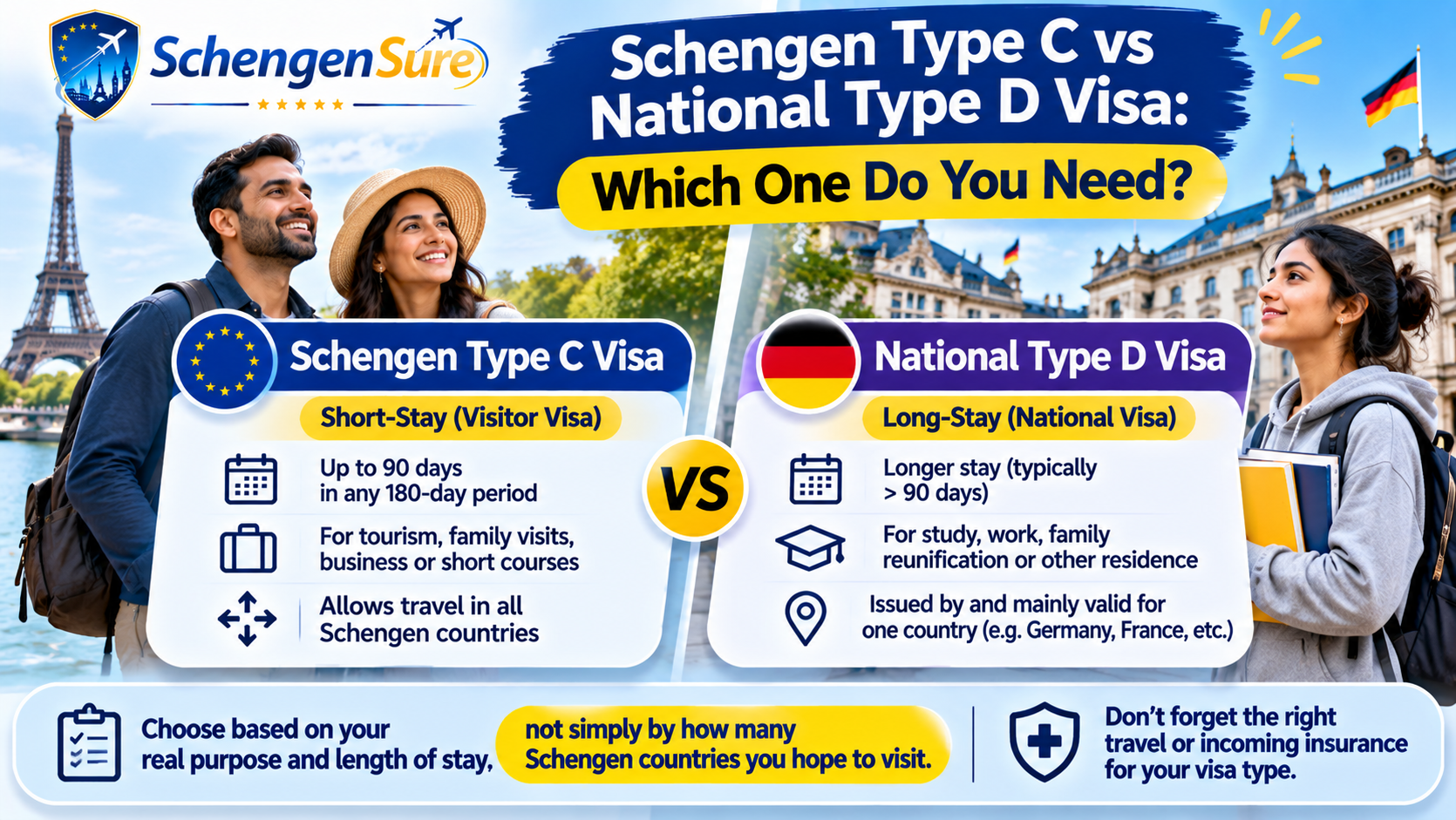
| A Schengen Type C visa is for a short, temporary visit of up to 90 days in any 180-day period. A national Type D visa is for a longer stay in one issuing country, usually for study, work, family reunification or another residence purpose. Choose by your real purpose and length of stay, not simply by how many Schengen countries you hope to visit. |
|---|
Schengen Type C vs Type D visa: the difference in one minute
The simplest distinction is this: Type C supports a short visit; Type D supports a national long-stay route. Common Schengen rules cover short-stay visas, while stays exceeding 90 days follow national procedures.[1][2] A visa does not guarantee entry; border authorities may still check the entry conditions.[3]
What is a Schengen Type C visa?
A Type C visa is also called a uniform Schengen visa or short-stay visa. It is designed for temporary visits totaling no more than 90 days in any rolling 180-day period across the Schengen Area.[1]
Common purposes include:
- Tourism and holidays
- Visiting relatives or friends without moving to join them
- Business meetings, trade fairs or conferences
- Short study, training or cultural activities where the chosen country permits them under this route
- Medical visits or other temporary travel
A uniform Type C visa is generally valid across Schengen, although territorial limits can apply. The sticker’s validity dates, entries and authorised days must all allow the trip.
For a multi-country journey, apply to the country where you will spend the longest time. If the stays are equal, the European Commission says to apply to the first country you will visit.[1]
| A Type C visa answers, “May I make this short trip?” It does not normally answer, “May I move here, take a job or become resident?” |
|---|
What is a national Type D visa?
A national Type D visa is a long-stay visa issued by one country under its national immigration rules. It is commonly used when a person plans to stay for more than 90 days for a recognised national purpose.[2][4]
Typical routes include:
- A degree course or other long-term study
- Employment, research or another authorised economic activity
- Family reunification or joining a family member to live together
- Long-term training or residence for another approved reason
Categories, documents, insurance and post-arrival duties vary by country and purpose. In some systems, the D visa allows entry before registration or a residence-permit application. Germany, for example, describes this process for stays exceeding 90 days.[5]
| Important: A Type D visa is national. It does not give a general right to live, study or work in every Schengen country. |
|---|
Type C versus Type D visa comparison
| Issue | Schengen Type C visa | National Type D visa |
|---|---|---|
| Main purpose | Temporary visit | Long stay or residence purpose |
| Length of stay | Up to 90 days in any rolling 180-day period | Usually more than 90 days; exact validity follows national rules |
| Rule system | Common Schengen Visa Code for short stays | Law and procedures of the issuing country |
| Main territory | Generally the Schengen Area, subject to the visa sticker | Long stay in the issuing country |
| Other Schengen travel | Within the visa’s validity, entries and authorised days | Short visits in other Schengen states may be possible up to 90 days in any 180-day period |
| Work or long study | Not a general work or residence permission | Only when the national visa or permit authorises the activity |
| Insurance | Schengen travel medical insurance rules apply to uniform visa applicants | Requirements are country- and purpose-specific |
| After arrival | Normally no residence-permit step for the short visit | Registration or a residence-permit step may be required |
Can you visit other Schengen countries with a Type D visa?
Generally, a valid D visa can support short visits to other Schengen states for up to 90 days in any 180-day period, subject to entry conditions.[4][6]
This is travel permission, not Schengen-wide residence permission. A French D visa, for example, may support a weekend visit to Belgium, but it does not by itself authorise the holder to relocate to Belgium or work there.
Practical examples: which visa route fits?
Tourist visiting several countries
Priya plans 12 days in France and five in the Netherlands. France is her main destination, so Type C through the competent French consulate is the likely route. She must confirm whether her nationality requires a visa and use the official local checklist.
Student starting a degree
Mateo has admission to a two-year German course. This is not short tourism, even if his first entry precedes registration. He should follow Germany’s national student route, normally Type D if a visa is required.
Conference visitor versus employee
Nadia will attend a four-day conference and return home, so a Type C business-visit route may fit. Paid work or an assignment requires a check of national work rules; “business” does not automatically make employment lawful under Type C.
Family visit versus family reunification
Arun will visit his sister for six weeks and return home, so Type C may fit. Moving to live with a spouse or parent usually points to a national family-reunification route.
Travel insurance: neutral buying guidance
For a Type C application
The Visa Code requires adequate travel medical insurance for uniform visa applicants. It must cover the relevant territory and stay, including medical repatriation, urgent medical care, emergency hospital treatment and death, with minimum coverage of EUR 30,000.[3]
Before buying, compare:
- Territory and dates on the certificate
- Medical and repatriation benefits
- Excess, exclusions, age limits and treatment of pre-existing conditions
- Claims assistance and emergency contact access
- Refund or date-change terms
- Certificate format required by the current consular checklist
SchengenSure can help travellers compare suitable short-stay options, but the applicant remains responsible for checking the official consular requirements.
For a Type D application
Do not assume a short-stay Schengen policy will satisfy a national route. A student, worker or family applicant may need temporary incoming cover, long-term health insurance, enrolment in a national system or a specific certificate.
Check the official country-and-purpose checklist before buying. If it is unclear, ask the embassy, official visa service or a qualified professional before paying for non-refundable cover.
Common mistakes to avoid
- Choosing a visa by trip length while ignoring the real purpose
- Treating a Type C visa as permission to work, relocate or start long-term study
- Assuming a Type D visa permits residence or employment across Schengen
- Confusing the visa’s validity window with the number of authorised stay days
- Believing a brief exit automatically resets the 90-in-180 calculation
- Using a generic “Type D checklist” instead of the issuing country’s exact category
- Buying short-stay travel insurance before checking a long-stay health-insurance rule
Visa decision checklist
- Confirm whether your nationality needs a visa for the planned trip.
- Write down the real purpose: visit, business meeting, study, work or family reunification.
- Count all intended days in the Schengen Area using the rolling 180-day rule.
- Identify the main destination for Type C, or the country of long-term residence for Type D.
- Check whether the activity needs work, study or residence authorisation.
- Read the official embassy or immigration checklist for your category and place of residence.
- Match your insurance to that checklist before buying.
- Recheck validity dates, entries, authorised days and any post-arrival duties after issuance.
Points requiring an official source check
| VERIFY BEFORE APPLYING Confirm the current official position for paid or remote work, Type C-to-D conversion, extensions, family reunification, minors, dependants, entry through another Schengen state, residence-permit deadlines and national health insurance. Complex cases need qualified legal or immigration advice. |
|---|
Frequently asked questions
What is the main difference between a Schengen Type C and Type D visa?
Type C is for temporary visits of up to 90 days in any 180-day period. Type D is for an approved long stay in one issuing country.
Is a Type D visa a Schengen visa?
It is a national visa, not the uniform short-stay visa. It can usually support limited travel elsewhere in Schengen, but long-stay rights remain national.
Can I work with a Type C visa?
A Type C visa does not create a general right to work. Check the destination country’s rules for the exact activity.
Can I change a Type C visa into a Type D visa after arrival?
Do not assume so. National conversion rules are limited, and many applicants must use the correct long-stay route from abroad.
Which visa is used for a family visit?
A temporary family visit generally points to Type C. Moving to live with family generally points to a national reunification route, often Type D.
Does the 90/180 rule apply when travelling with a Type D visa?
It generally limits short visits in other Schengen states. The authorised long stay in the issuing country follows national rules.
What insurance do I need for Type C versus Type D?
Type C applicants generally need Visa Code-compliant travel medical insurance. Type D applicants need the issuing country’s purpose-specific cover; a short-stay policy may not be enough.
Conclusion
The Schengen Type C vs Type D visa decision starts with one question: is this a temporary visit or a plan to live in one country? Use Type C for qualifying short visits and the issuing country’s Type D route for long-term study, work or family residence. Verify the official checklist before applying or buying insurance.
Reliable sources
- European Commission — Applying for a Schengen visa — short-stay definition, application country and documents.
- European Commission — Visa policy — common short-stay and national long-stay procedures.
- EUR-Lex — consolidated Visa Code — scope, insurance and visa rights.
- Italian Ministry of Foreign Affairs — Types of Visa and Duration — official Type C and D descriptions.
- German Missions — Long-stay national visas — Type D and residence-permit examples.
- German Federal Foreign Office — Travel with a national visa — short travel in other Schengen states.