
Schengen Visa Validity vs Duration of Stay
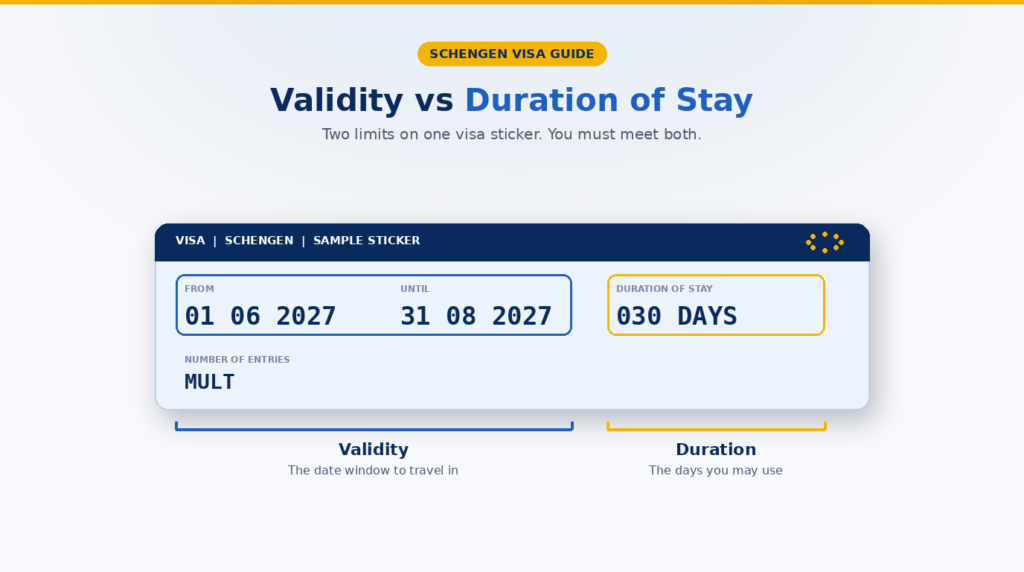
Schengen visa validity and duration of stay are two different limits. The “FROM” and “UNTIL” dates show the period in which the visa can be used, while “DURATION OF STAY” shows the maximum number of authorised days you may spend in the Schengen Area.
You must satisfy both limits. Unused stay days do not let you remain after the visa’s “UNTIL” date, and a visa that is still valid does not let you exceed the authorised duration printed on the sticker.
Schengen Visa Validity vs Duration of Stay: The Difference
A short-stay Schengen visa is an entry authorisation for temporary visits. EU guidance describes it as allowing visits of up to 90 days in any 180-day period, but an individual visa can authorise fewer days.
France-Visas gives two separate instructions to visa holders: leave the Schengen Area no later than the expiry date shown on the visa, and do not exceed the authorised length of stay during the visa’s validity.
That is the easiest way to understand the sticker: validity defines the calendar window; duration of stay defines how many authorised days can be used inside that window.
How to Read the Main Fields on a Schengen Visa Sticker
Visa field | What it means | Practical question |
FROM | Start of the visa validity window | What is the earliest date the visa can be used? |
UNTIL | End of the visa validity window | By what date must the permitted stay fit? |
DURATION OF STAY | Maximum authorised stay in days | How many days may I actually spend in Schengen? |
NUMBER OF ENTRIES | One, two or multiple entries | How many times may I enter during validity? |
MULT | Multiple entries permitted | Can I make repeated trips while the visa remains valid? |
These fields work together. A long validity period does not automatically mean a long authorised stay, and multiple entry does not increase the number of days you are permitted to spend in Schengen.
Example: Visa Valid for Three Months but Stay Limited to 30 Days
Suppose your visa says FROM 1 June to UNTIL 31 August and DURATION OF STAY: 30 days. The visa has a three-month validity window, but you may spend no more than 30 authorised days in the Schengen Area within that window.
You could use those 30 days in one trip if the entry rules allow it, or across several trips if the visa also permits multiple entries. But you cannot stay for the full three months merely because the visa remains valid until 31 August.
Likewise, if you have used only 20 of your 30 authorised days by 31 August, the remaining 10 days do not carry forward beyond the visa’s expiry date.
What Does the 90/180 Rule Mean?
For ordinary Schengen short stays, the overall ceiling is 90 days in any rolling 180-day period. The European Commission explains that you look back 180 days from each day of stay and make sure the total does not exceed 90.
However, the visa sticker can impose a shorter authorised stay. The Commission’s official short-stay calculator specifically says that if your short-stay visa shows an authorised stay of fewer than 90 days, you should follow the period printed on the sticker rather than treating the calculator as permission for 90 days.
Does the 90-day allowance reset when you leave?
No. Leaving the Schengen Area for a few days does not automatically reset the allowance. The calculation is based on a rolling 180-day reference period, so previous Schengen days can continue to count. [3]
Do Arrival and Departure Days Count?
Yes. Under the Schengen Borders Code, the date of entry is counted as the first day of stay and the date of exit as the last day of stay.
For example, entering on 10 July and leaving on 19 July counts as 10 calendar days, not nine. This is important when your authorised stay is short or you are close to the 90/180 limit.
What Does MULT Mean on a Schengen Visa?
MULT means the visa allows multiple entries while it remains valid. EU guidance describes a multiple-entry visa as allowing several visits for as long as the visa is valid. [1]
It does not mean unlimited days. A one-year, two-year or five-year multiple-entry visa can provide a long window for repeated travel, but each stay must still comply with the authorised duration and the applicable 90/180 rule.
Can You Stay Until the Visa Expiry Date?
Only if doing so also keeps you within the authorised duration of stay. The “UNTIL” date is not an extra allowance of days.
For example, if your visa remains valid until 30 September but your permitted 20 days have already been used, you cannot stay until 30 September just because the visa has not expired. Conversely, unused permitted days do not let you stay beyond 30 September. France-Visas states that travellers must leave no later than the visa expiry date. [2]
Can You Use Unused Days After the Visa Expires?
No. Duration of stay must be used within the visa validity period. Think of the visa as having two controls: a date window and a day allowance. Your trip must fit inside both.
Common Mistakes
- Reading the “UNTIL” date as permission to stay continuously until that date.
- Assuming a 90-day validity period automatically gives 90 days of stay.
- Treating MULT as unlimited time in the Schengen Area.
- Using the 90/180 calculator even though the visa sticker authorises fewer than 90 days.
- Forgetting that both the entry day and exit day count.
- Believing a short trip outside Schengen resets the 90-day allowance.
- Planning travel after the “UNTIL” date because authorised days remain unused.
- Changing flights without checking whether the new travel dates still fit the visa and insurance.
Pre-Travel Visa Date Checklist
☐ Read the FROM date.
☐ Read the UNTIL date.
☐ Check the DURATION OF STAY number.
☐ Check whether NUMBER OF ENTRIES says 01, 02 or MULT.
☐ Count any Schengen days already used during the relevant period.
☐ If applicable, use the European Commission’s official short-stay calculator.
☐ Count arrival and departure as days of stay.
☐ Make sure the complete itinerary fits within both validity and authorised stay.
☐ Check that your travel medical insurance covers the actual trip dates.
☐ If the sticker appears incorrect, contact the issuing consulate rather than altering or interpreting it yourself.
OFFICIAL-SOURCE CHECK: Schengen rules and digital border procedures can change. Recheck the current Visa Code, Schengen Borders Code and European Commission short-stay guidance whenever this article is updated.
Buying Guidance: Make Insurance Dates Match the Actual Trip
Once you have confirmed when you may travel and how long you may stay, check your travel medical insurance. The policy period should cover the trip you actually intend to make, not an outdated itinerary.
If flights move within the visa validity window, do not assume the insurance dates move automatically. Ask the insurer whether the policy can be amended and obtain an updated certificate when necessary.
When comparing Schengen travel insurance through SchengenSure or elsewhere, consider medical coverage, repatriation, territorial scope, exclusions, assistance and the accuracy of the insurance certificate—not price alone. Always check the current visa requirements that apply to your application.
FAQs
What is the difference between Schengen visa validity and duration of stay?
Validity is the period between the visa’s FROM and UNTIL dates. Duration of stay is the maximum authorised number of days you may spend in the Schengen Area during that validity period.
My visa is valid for 90 days but says duration of stay 30 days. How long can I stay?
You may stay for a maximum of 30 authorised days within the visa’s validity window, subject to the number of entries and other entry conditions. The 90-day validity window does not turn the 30-day authorisation into 90 days.
Does my arrival day count as a Schengen day?
Yes. The Schengen Borders Code counts the date of entry as the first day of stay and the date of exit as the last day. [4]
Does leaving Schengen reset the 90/180 rule?
No. The rule uses a rolling 180-day period. Previous days can continue to count after you leave and re-enter. [3]
What does MULT mean?
MULT means multiple entries are allowed during the visa’s validity. It does not remove the authorised stay limit or the 90/180 rule.
Can I use unused days after the UNTIL date?
No. Unused authorised days cannot be carried beyond the visa’s validity period.
Should I use the EU short-stay calculator?
Use it when the 90/180 rule is relevant. The European Commission says that if your visa sticker authorises fewer than 90 days, follow the shorter period printed on the visa. [3]
Conclusion
Schengen visa validity vs duration of stay becomes simple once you separate the two limits: the validity dates tell you when the visa can be used, while the duration tells you how many authorised days you can spend in the Schengen Area.
Before travelling, check FROM, UNTIL, DURATION OF STAY and NUMBER OF ENTRIES together. Then count previous Schengen days where relevant and make sure flights, accommodation and travel insurance fit within the dates you are legally allowed to travel.