
A Schengen visa for minors normally requires the child’s own application documents plus proof of parental authority or guardianship. Birth-certificate, consent, custody and parent-identity requirements depend on who travels with the child and the competent consulate’s current checklist. The child’s name, travel dates and destinations should remain consistent across the application, consent, itinerary and insurance certificate.[1][3][4]
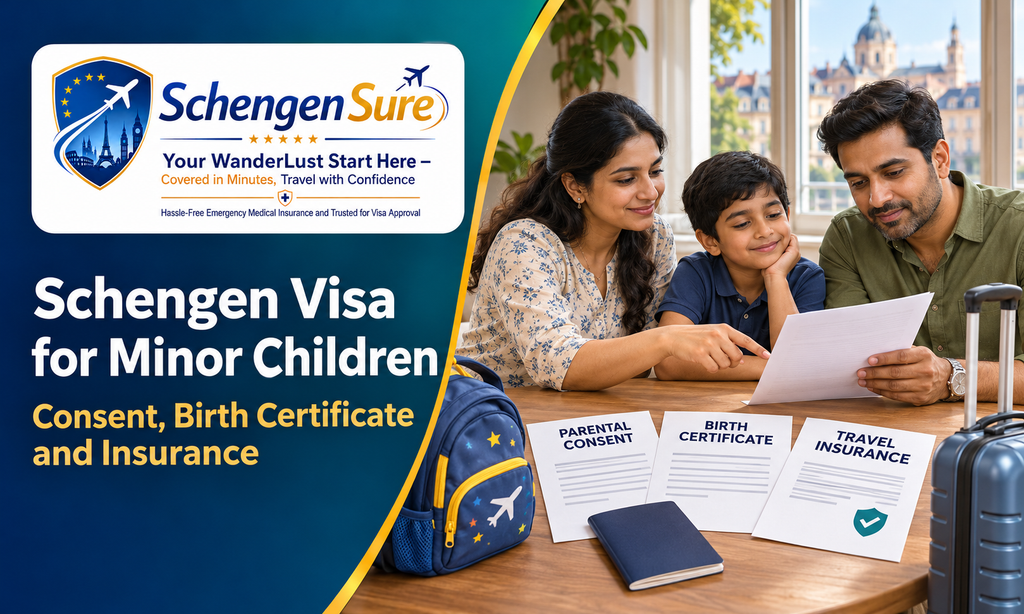
Start with the child’s travel situation
There is no single parental travel-authorisation rule for every EU country. Departure, destination and transit countries may apply different rules, and airlines may use their own forms.[2]
| Travel situation | Consent to check | Supporting evidence to check | Main risk |
|---|---|---|---|
| With both parents | Checklist-specific | Birth certificate; parents’ identity or visa copies | Assuming no extra minor documents |
| With one parent | Non-travelling parent’s consent may be required | Parent ID; custody evidence if relevant | Missing or undated consent |
| Travelling alone | Consent from both parents or guardians may be required | Parent IDs; journey and handover details | Consent does not match itinerary |
| With another adult | Consent from parents or guardians may be required | Adult’s details and relationship | Accompanying adult not identified |
| Sole custody | Other parent’s consent may not apply | Court order or official custody proof | Custody claim not documented |
| One parent deceased | Consent cannot be given by that parent | Death certificate if requested | Family status left unexplained |
Core documents for a minor’s Schengen visa
1. The child’s application and travel document
The Visa Code states that a minor’s application form must be signed by a person exercising parental authority or legal guardianship. Local checklists can specify whether one or both parents must sign and whether the child must attend the appointment.[1][3]
Use the child’s own valid travel document and application details. Do not place the child only as an informal addition to a parent’s file.
2. Birth certificate or civil-status record
The birth certificate usually helps prove the relationship between the child and parent or parents. Check whether the mission requests an original, copy, recent extract, translation, legalisation or apostille. These format rules are not uniform.[4][5]
Compare names, dates and places of birth with the passports and application. If a parent’s or child’s surname has changed, include the official linking document requested by the checklist, such as a marriage, divorce or name-change record.
3. Parental consent or travel authorisation
Consent should identify the child, the consenting parent or guardian, the accompanying person, the journey and the authorised dates. Whether it must be notarised, witnessed, legalised, translated or submitted on a specific form depends on the mission and travel route.[2][3][4]
Quote-worthy rule: parental consent is strongest when it authorises the trip the application actually describes—not a vague future journey.
4. Parent, guardian and custody documents
A checklist may request passport or identity-document copies from parents or guardians. If consent cannot be obtained because of sole custody, guardianship or a parent’s death, submit the relevant official evidence required for that situation.[3][4]
Do not replace a custody order or guardianship document with a personal explanation when the official checklist asks for legal proof. Family-law questions should be reviewed by a qualified professional where necessary.
5. The child’s itinerary and funding
The child’s flights, accommodation and travel dates should align with the accompanying adult’s documents. If a parent or another person pays, check the sponsor section for relationship evidence, a sponsorship statement and financial documents.[3]
A minor travelling for a school, cultural or sports event may also need an invitation, school confirmation or organiser information under the relevant purpose-of-travel checklist.
Travel medical insurance for a minor
Travel medical insurance is separate from parental consent and civil-status evidence. The Visa Code addresses adequate and valid insurance, while current consular checklists specify the certificate details to submit.[1][3][4]
Before buying, confirm that the certificate clearly identifies or covers the child and matches the required countries and travel period. If the child is included in a family policy, make sure the certificate makes that coverage clear rather than assuming the parent’s name alone is enough.
Insurance comparison for parents
| Check | Why it matters | Question for the insurer or certificate |
|---|---|---|
| Insured person | The child’s cover must be identifiable | Is the child named or clearly included? |
| Territory | The policy must match the required region | Does the certificate cover the full route? |
| Dates | Coverage must match the required travel period | Are arrival and departure dates covered? |
| Medical and repatriation cover | The certificate must meet official requirements | Does the wording satisfy the checklist? |
| Exclusions | Activities or conditions may affect cover | Are relevant exclusions understood? |
| Assistance | A parent may need help during an emergency | How is assistance contacted and a claim handled? |
Neutral buying guidance
Choose insurance by certificate suitability and policy terms, not only price. Compare individual and family policies, but verify that the chosen structure produces acceptable proof for every visa applicant. Never suggest that one insurer or purchase channel guarantees visa approval.
Families who still need cover can compare Schengen travel medical insurance through SchengenSure. Check the insurer’s current policy wording and the competent consulate’s checklist before purchase. SchengenSure may receive a commission from an affiliate link; this should not change the neutral comparison criteria.
Common mistakes
- Assuming both parents travelling means no additional minor documents
- Using a generic consent letter with no precise dates or destination
- Submitting consent that conflicts with the itinerary or accompanying adult
- Ignoring different surnames or inconsistent spellings
- Assuming every birth certificate needs the same translation or apostille
- Omitting custody, guardianship or death evidence when the checklist asks for it
- Showing only a parent’s name on insurance without confirming the child is covered
- Checking the visa checklist but not departure, transit or airline requirements
Minor-child visa checklist
- I downloaded the current checklist for the correct destination, purpose and filing location.
- The child’s passport, form and photographs meet the stated requirements.
- The correct parent or guardian has signed the application.
- The birth certificate and any required translation or certification are ready.
- Consent matches the child, accompanying person, destinations and dates.
- Parent IDs, visas and custody or guardianship documents are included where required.
- Funding and sponsorship for the child are clear.
- The insurance certificate clearly covers the child and required trip.
- I checked border, transit-country and airline permission rules separately.
Frequently asked questions
Does a minor need a separate Schengen visa application?
A minor who requires a visa needs an application using the child’s own details and travel document. The form must be signed by a person exercising parental authority or legal guardianship, subject to the local checklist.
Must both parents sign the child’s application?
The Visa Code requires a signature from a person exercising parental authority or guardianship. A mission’s checklist may require both parents’ signatures or additional authorisation, so verify the exact rule.
Is consent needed when a child travels with one parent?
It may be. Many checklists request consent from the non-travelling parent unless the travelling parent proves sole custody or another recognised exception. The required form and certification vary.
Does a birth certificate need translation or an apostille?
Not in one universal format. Requirements depend on the issuing country, document language, destination and application location. Follow the competent mission’s checklist.
What if one parent is deceased or cannot provide consent?
Submit the official evidence relevant to the situation, such as a death certificate, custody order or guardianship record, when required. Obtain legal advice if parental authority is disputed.
Can a child use the parents’ family travel insurance?
Possibly, if the policy covers the child and the certificate provides acceptable evidence for the visa application. Confirm that the child’s cover, territory and dates are clear.
What is needed when a child travels with grandparents or a school group?
Check consent from the parent or guardians, the accompanying adult’s details, organiser or school documents, accommodation, handover arrangements and country or airline requirements.
Conclusion
A Schengen visa for minors is easier to assess when parental authority, relationship, travel permission, itinerary, funding and insurance are documented consistently. Start with the child’s travel situation, use the competent consulate’s checklist as the final authority and verify separate border and airline rules before departure.
Reliable sources
- EUR-Lex — Consolidated Visa Code — minor signatures, supporting documents and insurance
- Your Europe — Documents for minors travelling in the EU — country, transit and airline authorisation warning
- German Missions in India — Visit / Family and Friends checklist — current minor, consent, custody and insurance example
- Netherlands Worldwide — Tourism checklist for applicants in India — birth certificate, notarised consent and parent documents
- Italian Consulate General in London — Visas for minors — country- and location-specific civil-status and insurance example
- European Commission — Harmonised Schengen visa application form — parental-authority and insurance fields
- France-Visas — Applying in India — parent or guardian submission and minor biometrics example
- VFS Global / Malta — Parental or legal-guardian consent form — official service-provider form example