
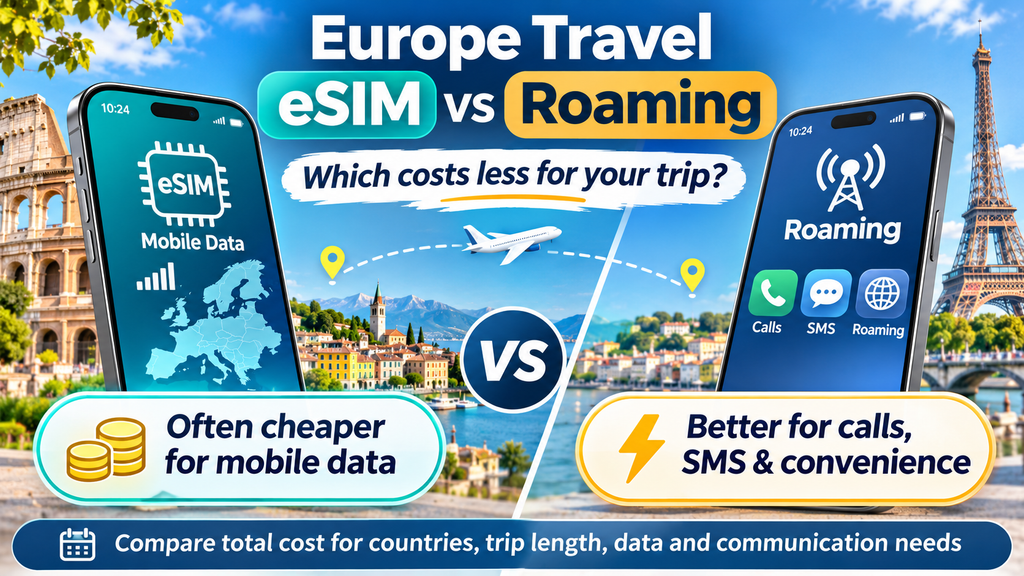
For most travellers who mainly need mobile data, a Europe travel eSIM will often cost less than a full international roaming pack. Roaming can still be better value when you need regular calls and SMS on your current number, want zero setup, or already have a suitable roaming benefit. Compare the total cost for the same countries, trip length, data and communication needs – not only the advertised starting price.
Quick answer: eSIM or roaming?
- A Europe eSIM usually suits data-focused, multi-country travellers with an unlocked, compatible phone.
- International roaming usually suits travellers who need their current number for calls, SMS or business continuity.
- A dual-SIM setup can combine both: use the travel eSIM for data and keep the current line available for essential SMS, subject to the operator’s current charges and settings.
Important: EU “Roam Like at Home” rules do not automatically make roaming free for a mobile subscription. Those rules concern eligible European subscriptions used while travelling within the covered area.[1]
What is the real difference?
The cost difference comes from the mobile plan, not the plastic: an eSIM is a SIM format, while roaming is a service.
Europe travel eSIM
An eSIM is a digital SIM profile downloaded to a compatible phone. A Europe travel eSIM normally connects to partner networks in one or more countries.[2] A “Europe local eSIM” may therefore be a regional travel product, not a direct local-operator subscription.
International roaming
Roaming keeps your current line connected through a foreign partner network. You normally activate a roaming service or pack for your destinations and dates. Benefits, covered countries and excess-use charges vary by operator and plan.[6][7][8]
Europe eSIM vs international roaming from India: comparison
| Factor | Europe travel eSIM | Indian roaming pack |
|---|---|---|
| Data price | Often competitive for data-only use; compare the checkout amount. | May bundle data, voice and SMS; compare the full pack. |
| Current number | Your current number remains separate. Dual SIM may keep it available. | Your existing number stays active for supported services. |
| Calls and SMS | Many plans are data-only; some include voice or SMS. Check the plan type.[9] | Often included or charged under pack rules. Check incoming, outgoing and SMS allowances. |
| Countries | Regional plans can cover several countries, but the list differs by product. | Coverage and benefits can differ by country, operator and prepaid/postpaid status. |
| Setup | Requires a compatible, unlocked phone and correct line settings.[3][4][5] | Usually requires pack activation and network registration after arrival. |
| Limits | Fixed data, validity, hotspot rules and fair-use speed controls may apply. | Pack quota, daily limits and pay-as-you-go charges may apply. |
| Best fit | Data-heavy tourism, navigation and app-based communication. | Frequent Indian-number calls/SMS, simple setup or employer-paid travel. |
Is an eSIM cheaper than international roaming in Europe?
Often, yes – especially when the traveller mainly needs data. But there is no universal winner. Use a like-for-like calculation:
- eSIM total = plan price + taxes or foreign-exchange costs + top-ups + any separate voice or SMS cost.
- Roaming total = pack price + taxes + excess usage + charges for services or places outside the pack.
Also compare usable high-speed data, not merely the word “unlimited”. Fair-use controls, network congestion or hotspot limits can change the practical value of a plan.[10]
Practical examples
Tourist example: A traveller spends ten days in France, Switzerland and Italy, mainly using maps, messaging and booking apps. If one regional eSIM covers all three countries and costs less than an Indian roaming pack with comparable usable data, the eSIM is the lower-cost choice. The traveller can keep the Indian SIM available for essential SMS while disabling its data roaming.
Business example: A traveller spends five days in Germany and must make and receive regular calls on the Indian number. A roaming pack that includes suitable voice, SMS and data may provide better overall value than buying data separately and paying for Indian-line calls.
Family example: Buying one eSIM per phone may change the result. Hotspot sharing can reduce the number of plans, but only if tethering is permitted and practical.
How to compare plans correctly
- List every destination and transit stop. Europe, the EU and the Schengen Area are not identical. Confirm coverage for every country on the itinerary.
- Match validity to the trip. Check whether the plan starts on purchase, installation, activation or first network connection.
- Estimate data from your own phone history. Include navigation, messaging, video, work calls, cloud backups and hotspot use.
- Decide whether you need normal calls, SMS and bank OTPs. Do not assume a data-only eSIM supplies a phone number.[9]
- Check the phone. It must support eSIM and may need to be carrier-unlocked. Dual-SIM behaviour differs by model and carrier.[3][4][5]
- Read the limits. Verify high-speed allowance, fair-use policy, hotspot rules, network generation and top-up availability.
- Compare support and refunds. Check what happens if installation fails, travel dates change or a country is not covered.
Neutral buying guidance
Choose a Europe eSIM when data is your priority, your phone is compatible, and the plan clearly covers the whole route. Choose international roaming when keeping the current number fully usable is more important than finding the lowest data price, or when your operator already provides an appropriate benefit.
For a dual-SIM setup, select the travel eSIM as the mobile-data line, disable data roaming and automatic data switching on the current line, and follow the eSIM provider’s instructions about whether data roaming must be enabled on the travel line. Apple and Google both provide device-specific dual-SIM guidance.[3][4][5]
Compare before you buy: review Europe eSIM options through SchengenSure. Confirm the live price, countries, validity, data policy, hotspot allowance and refund terms on the final provider page.
Affiliate disclosure: SchengenSure may earn a commission if you buy through a partner link. Compare the final price and terms independently; a commission should not decide which plan is suitable for you.
Common mistakes to avoid
- Assuming one “Europe” plan covers every Schengen country, the UK and every transit location.
- Comparing an eSIM data plan with a roaming bundle that also includes voice and SMS without valuing those extras.
- Leaving mobile data or automatic data switching active on the current SIM and creating avoidable roaming usage.
- Treating “unlimited” as unlimited high-speed data or unlimited hotspot use without reading the fair-use terms.
- Installing or testing too late, then depending on airport Wi-Fi to solve activation problems.
- Deleting the eSIM profile before checking whether the provider permits reinstallation.
- Assuming OTP delivery is guaranteed. It depends on the Indian line, roaming activation, partner network and sender.
Pre-departure connectivity checklist
- Confirm that the phone is eSIM-compatible and unlocked.
- Check every destination and the exact validity window.
- Save the QR code, manual installation details and support contact securely.
- Install early if permitted, but activate only as instructed by the provider.
- Label the lines clearly: “India” and “Europe data”.
- Set the eSIM as the data line and review data-switching settings.
- Check charges for receiving calls, voicemail and sending SMS on the Indian line.
- Download offline maps, tickets, insurance documents and hotel addresses.
- Recheck current terms immediately before purchase and departure.
Frequently asked questions
Is a Europe eSIM always cheaper than international roaming?
No. It is often cheaper for data-focused travel, but roaming can be better when calls, SMS, current-number continuity or an existing plan benefit matter. Compare the total trip cost for equivalent use.
Can I receive OTPs on my current SIM while using a Europe eSIM?
Often, a dual-SIM phone can keep the current line active for SMS while the eSIM supplies data. Delivery and charges depend on the operator, roaming status, partner network and sender, so verify before departure.
Will WhatsApp keep current number?
Normally, using a different SIM for mobile data does not itself change the number registered to WhatsApp. Avoid choosing the app’s Change Number option unless you intend to move the account.
Does one Europe eSIM work in every Schengen country?
Not necessarily. Coverage lists differ, and Europe, the EU and Schengen are different groupings. Check each destination and transit country on the specific plan page.
Do travel eSIMs include calls and SMS?
Many are data-only, although some plans include calls, texts or a number. A data-only plan can still support internet calling and messaging apps.[9]
Should data roaming be switched on for the travel eSIM?
Some travel eSIMs require data roaming on their own line because they connect through partner networks. Follow the provider’s setup instructions, while keeping data roaming off on the current line unless your roaming plan requires it.
Conclusion
For many travellers, a regional Europe eSIM costs less when the main need is data. International roaming remains sensible when calls, SMS and uninterrupted use of the current number are central. The fairest decision compares identical destinations, dates and usage, then checks compatibility, fair-use limits and excess charges before payment.
Sources and fact-check references
[1] European Union – Mobile roaming costs. Official explanation of EU roaming and fair-use rules.
[2] GSMA – What is eSIM for Consumer and IoT?. Industry-standard explanation of remote SIM provisioning and multiple profiles.
[3] Apple Support – Use eSIM while travelling internationally. Official travel eSIM, unlocking and roaming guidance.
[4] Apple Support – Using Dual SIM with an eSIM. Official dual-SIM guidance for travel.
[5] Google Pixel Help – How to use dual SIMs. Official Android line-selection and eSIM setup guidance for supported Pixel phones.
[6] Airtel – International roaming packs. Official current Airtel plan and country-check page.
[7] Jio – International roaming plans. Official current Jio roaming-plan page.
[8] Vi – International roaming packs. Official current Vi pack, activation and terms page.
[9] Airalo Help – Calls and SMS with an eSIM. Provider explanation of data-only versus voice/text services.
[10] Holafly – Terms and conditions. Provider terms explaining possible fair-use limits for unlimited plans.