
| For most travellers, 5–7 GB is a sensible starting point for 7 days, 7–10 GB for 10 days, and 10–15 GB for 15 days when the trip includes maps, messaging, bookings and some social media. Choose less if you rely on Wi-Fi and offline downloads; choose 20 GB or unlimited data if you expect frequent video, video calls, hotspot use or remote work. These are planning ranges, not guarantees, because every phone and travel style uses data differently. |
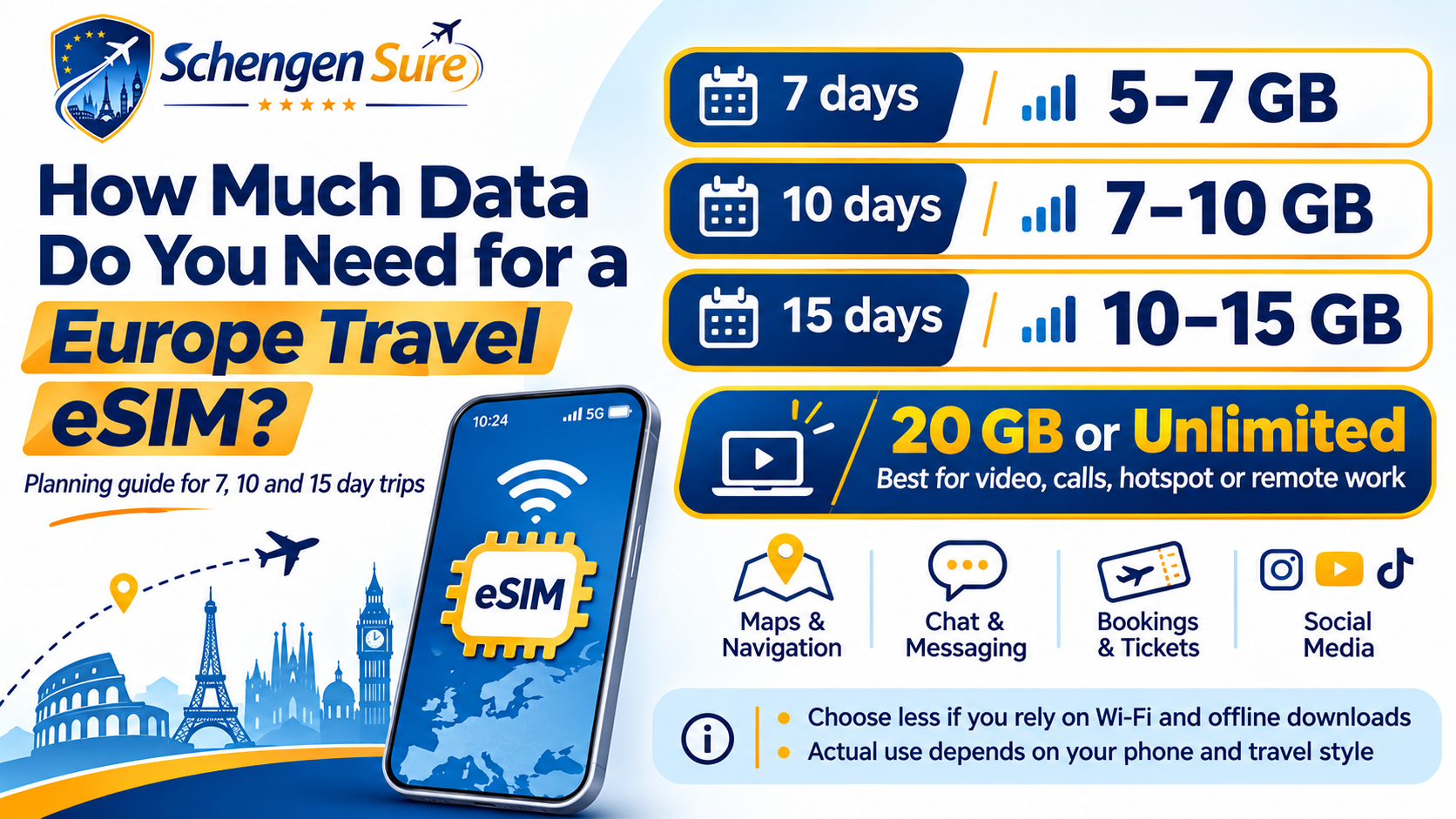
Quick answer: eSIM data by trip length
The question “how much eSIM data do I need for Europe?” is best answered by combining trip length with usage style. Use the table as a practical planning guide, then adjust it using your own phone history.
| Usage style | 7 days | 10 days | 15 days |
|---|---|---|---|
| Light: maps, messages, email, tickets | 2–3 GB | 3–5 GB | 5–7 GB |
| Moderate: plus browsing, music and social media | 5–7 GB | 7–10 GB | 10–15 GB |
| Heavy: video, calls, uploads, hotspot or work | 10–20 GB | 15–25 GB | 20–40 GB or unlimited |
Planning note: The ranges are SchengenSure editorial estimates, not network-provider guarantees.
What changes your Europe eSIM data requirement?
Maps, messages and everyday travel tasks
Navigation, messaging, email, restaurant searches, train apps and digital tickets usually fit a light or moderate plan. Downloading destination areas in Google Maps before departure can reduce mobile use, although offline maps have functional limits and should be updated over Wi-Fi.
Social media, cloud photos and automatic updates
Photo and video uploads can consume data quietly, especially when cloud backup runs in the background. App updates, photo syncing and autoplay should normally be restricted to trusted Wi-Fi during a limited-data trip.
Streaming, video calls and hotspot use
Video—not maps—is usually the biggest threat to a small travel-data plan. Netflix says usage can range from up to 0.3 GB per hour on its low setting to much more at higher quality. YouTube also offers a Data Saver quality setting. A laptop connected through your phone can use data through updates, cloud storage and video meetings.
How much data for 7, 10 or 15 days?
Seven-day Europe trip
Choose around 3 GB for essential travel use with regular Wi-Fi. A 5–7 GB plan gives a typical tourist more flexibility for maps, messages, bookings and occasional social media. Consider 10 GB or more if you will upload video, make frequent video calls or share data with another device.
Ten-day Europe trip
A moderate traveller should consider 7–10 GB. This allows more room for travel days, app use and occasional uploads without automatically paying for an unlimited plan. Heavy users should compare 15–25 GB with unlimited options.
Fifteen-day Europe trip
For two weeks or slightly longer, 10–15 GB is a balanced starting range for normal tourism. Light users may manage with 5–7 GB when Wi-Fi is reliable. Remote workers, frequent streamers and hotspot users should consider 20–40 GB or a suitable unlimited plan.
Local eSIM or regional Europe eSIM?
A local eSIM normally targets one country. A regional Europe eSIM is designed to work across the destinations listed by the provider. If your itinerary includes France, Germany and Switzerland, a regional plan may be simpler than three separate local plans—but only if all three countries appear in its coverage list.
“Europe” and “Schengen” are not interchangeable coverage labels. The Schengen Area currently has 29 countries, including four non-EU members: Iceland, Norway, Switzerland and Liechtenstein. Provider lists may also include non-Schengen destinations such as the United Kingdom or Türkiye. Always check the exact country list.
Fixed data versus unlimited eSIM: comparison
Choose a fixed-data plan when:
- you mainly need maps, messages, email and bookings;
- you can use secure Wi-Fi for updates and entertainment;
- the plan allows an easy top-up if required; or
- you want a clear data allowance and can monitor it.
Consider unlimited data when:
- you expect regular streaming or video calls;
- you will work online or use a phone hotspot;
- several travel days have little dependable Wi-Fi; or
- predictability matters more than minimising cost.
Unlimited does not always mean unrestricted. Some plans apply fair-use rules, daily high-speed limits, reduced speeds or hotspot restrictions. Read the provider’s current terms before purchase.
How to estimate your own data more accurately
- Check your phone’s recent mobile-data use. On iPhone, Settings > Cellular/Mobile Data shows usage by app. Android menu names vary by manufacturer.
- Remove unusually heavy home use, such as daily video streaming over mobile data.
- Divide the remaining usage by the number of days measured to estimate a daily amount.
- Multiply by 7, 10 or 15 and add a modest buffer for navigation, delays and unexpected Wi-Fi gaps.
- Confirm whether unused data expires and whether the plan can be topped up.
Practical examples
City tourist: Priya spends 10 days in Paris and Amsterdam. She uses maps, WhatsApp, museum tickets and limited Instagram, while downloading entertainment on hotel Wi-Fi. A 7–10 GB regional plan is a reasonable starting point.
Business traveller: Daniel attends a seven-day trade fair and uses email, Teams calls and a laptop hotspot. He should compare a higher fixed allowance with an unlimited plan that permits tethering.
Family visitor: A parent visiting Germany for 15 days uses messaging, video calls and maps. If home Wi-Fi is available most evenings, 10–15 GB may be enough; daily long video calls could justify more.
Common eSIM data mistakes
- Buying by trip length without considering video, hotspot or cloud backup.
- Assuming every country on the itinerary is covered.
- Confusing plan purchase, installation and validity-start dates.
- Leaving the home SIM’s data roaming active and receiving unintended charges.
- Assuming unlimited data includes unlimited high-speed tethering.
- Choosing the smallest plan when top-up is difficult or unavailable.
Europe eSIM buying checklist
- Confirm that the phone is unlocked and eSIM-compatible.
- Confirm that every destination is on the provider’s coverage list.
- Check that the validity period covers arrival and departure days.
- Understand exactly when the validity period begins.
- Check high-speed limits, fair-use rules and possible throttling.
- Confirm that hotspot/tethering is allowed if required.
- Check whether calls and SMS are included or the plan is data-only.
- Confirm that top-up or support is available if the data runs out.
- Configure the home SIM to prevent unintended roaming charges.
Frequently asked questions
Is 5 GB enough for seven days in Europe?
Often yes for maps, messaging, bookings, email and occasional social media, especially with Wi-Fi. It may be too little for frequent video, cloud uploads or hotspot use.
Is 10 GB enough for a 10-day Europe trip?
For many moderate users, yes. It gives about 1 GB per day, but actual use can rise quickly with streaming, video calls and automatic backups.
How much eSIM data do I need for 15 days in Europe?
Start with 10–15 GB for normal tourist use. Consider 20 GB or more for frequent video, work calls, uploads or tethering.
Do I need unlimited data in Europe?
Not necessarily. Fixed data is often sufficient for ordinary travel tasks. Unlimited data is more useful for streaming, remote work or heavy hotspot use.
Can one eSIM cover several Schengen countries?
Yes, if it is a regional plan and every destination is included. Check the provider’s current country list rather than relying on the word “Europe.”
Does an eSIM include calls and SMS?
Many travel eSIMs are data-only. Internet calling and messaging may still work, but a normal phone number, voice minutes and SMS must be confirmed in the plan details.
Can I buy more data during the trip?
Some plans support top-ups and others require a new package or eSIM. Check this before buying, particularly if you choose a small allowance.
Conclusion: choose by behaviour, not only by days
For a typical traveller, 5–7 GB for seven days, 7–10 GB for ten days and 10–15 GB for fifteen days are useful starting ranges. Choose less when Wi-Fi and offline downloads will carry most of the load; choose more when video, work or hotspot use is central to the trip.
Neutral next step: compare coverage, validity, data limits and tethering terms before choosing a plan. You can review Europe eSIM options through SchengenSure. Availability and plan terms should be verified on the provider’s official page at the time of purchase.