
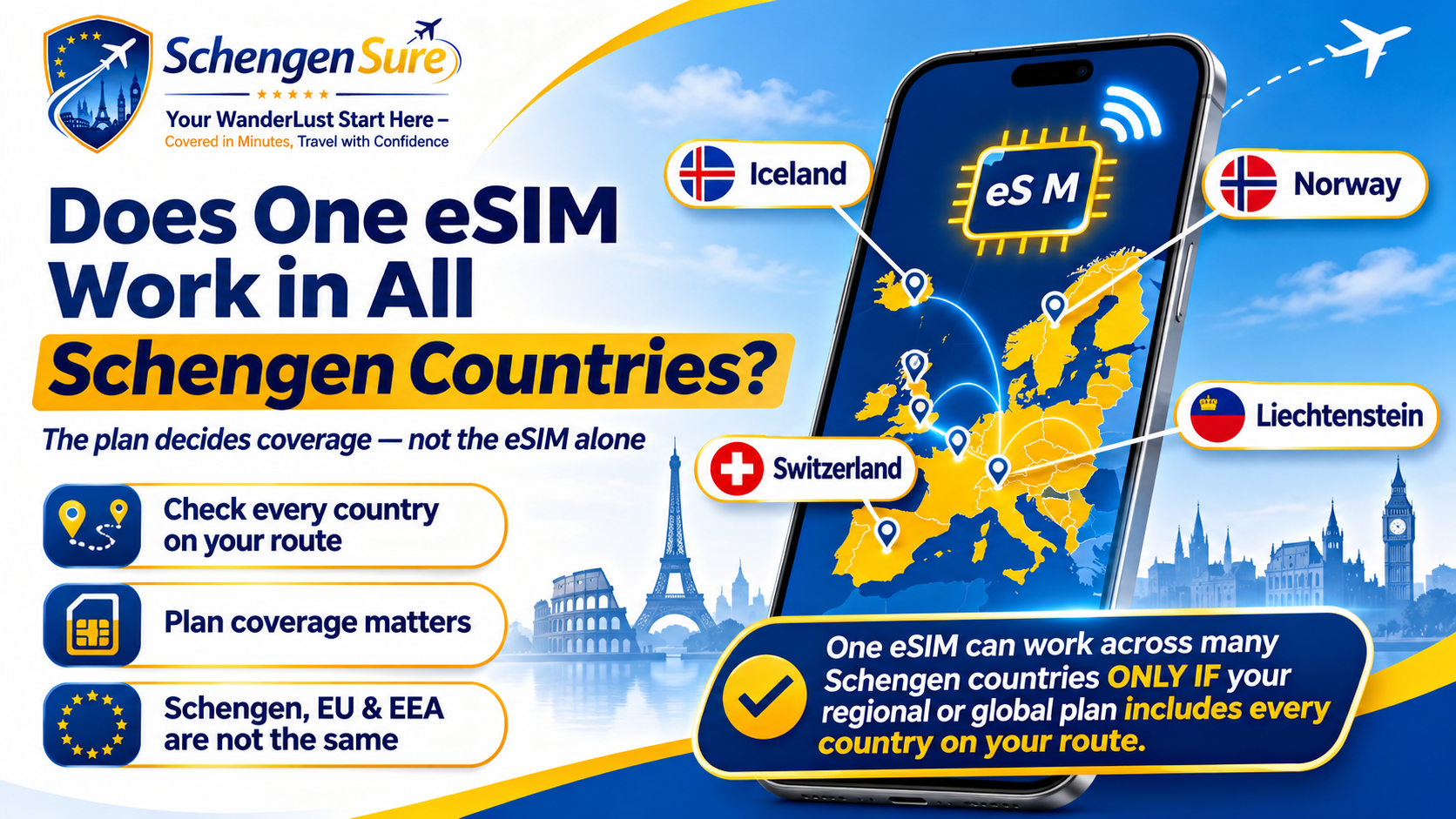
One eSIM can work in all Schengen countries, but only if the exact regional or global plan lists every country on your route. The eSIM is the delivery technology; the purchased plan decides where it connects. Check Switzerland, Iceland, Norway and Liechtenstein individually because Schengen, EU and EEA are not interchangeable coverage labels.
Quick answer
- A regional Europe eSIM may cover all 29 Schengen countries with one installation and one data allowance.
- A single-country eSIM normally works only in the listed country or limited area.
- The word “Europe” is not a coverage guarantee. Open the exact plan’s current country list before paying.
- Crossing a Schengen border does not itself create mobile coverage; the eSIM connects through the provider’s partner networks.
- Your phone must support eSIM, be carrier-unlocked and use the provider’s required data-roaming settings.
Official-source check: Schengen membership and provider coverage can change. Recheck the official EU country list and the exact eSIM product page on the publication and purchase dates.
Why the plan matters more than the eSIM
An eSIM is a digital SIM profile. It does not have a universal travel area. Coverage comes from the data package attached to that profile and the agreements its provider has with local mobile networks.
Quote-worthy answer: “One eSIM can cover an entire Schengen trip only when one active plan includes every country on that itinerary. Schengen membership alone does not make an eSIM work there.”
Schengen, EU, EEA and Europe eSIM are different
| Label | What it means | What it means for mobile data |
|---|---|---|
| Schengen Area | A border-free travel area of 29 countries: 25 EU states and four non-EU states.[1] | It does not require an eSIM provider to cover every member. |
| EU/EEA roaming | Regulated roaming for qualifying home plans in the EU plus Iceland, Liechtenstein and Norway.[2] | It does not automatically govern a travel eSIM bought by a visitor. Switzerland is outside this regime. |
| Europe eSIM | A commercial regional plan. | Only the provider’s published country list defines coverage. |
| Single-country eSIM | A plan sold for one destination. | Do not assume it will roam into neighbouring countries. |
Which Schengen countries must be included?
The current Schengen Area has 29 countries: Austria, Belgium, Bulgaria, Croatia, Czechia, Denmark, Estonia, Finland, France, Germany, Greece, Hungary, Iceland, Italy, Latvia, Liechtenstein, Lithuania, Luxembourg, Malta, the Netherlands, Norway, Poland, Portugal, Romania, Slovakia, Slovenia, Spain, Sweden and Switzerland.[1]
For a one eSIM for all Schengen countries claim to be accurate, all 29 must appear on that plan’s live coverage list. A plan can still be suitable when it covers only your actual itinerary; it does not need all 29 if you will visit three.
Why Switzerland needs a separate check
Switzerland is in Schengen but is not in the EU or EEA roaming regime. An EU-labelled home plan or travel eSIM may include Switzerland voluntarily, but the label alone is not proof.[2] The same careful check is useful for Iceland, Norway and Liechtenstein because they are Schengen and EEA countries, not EU members.
Regional, country and global eSIM comparison
| Plan type | Best for | Main check |
|---|---|---|
| Single-country | A trip mainly within one country | Does it allow any cross-border use? |
| Regional Europe | Two or more European countries | Does the exact list include every stop and transit country? |
| Global | Europe plus another region | Is broader coverage worth the data, speed and validity trade-off? |
What happens when you cross a border?
A compatible regional eSIM usually searches for an approved partner network in the new country. The handover may be automatic, but a brief loss of signal can occur. Vodafone and Holafly describe Europe plans that connect through networks in multiple covered countries; their pages are examples, not proof for another provider or package.[3][4]
- Leave the travel eSIM switched on and selected for mobile data.
- Enable data roaming on the travel line when the provider instructs you to.
- Keep data roaming off on the Indian SIM unless you intentionally use an Indian roaming plan.
- If service does not return, toggle Airplane Mode, restart, or select a supported network as instructed.
- Do not delete the eSIM before asking support; some activation codes cannot be reused.
How to check one plan before buying
- Open the exact product page, not only the provider’s general homepage.
- Match every destination and transit stop against the current coverage list. Check the UK separately because it is not in Schengen.
- Review validity, total or daily high-speed data, speed reductions, hotspot rules and top-up options.
- Check when validity starts: purchase, installation, a chosen date, activation or first supported-network connection.
- Confirm that the phone supports eSIM and is unlocked. Apple states that an iPhone using another travel provider must not be carrier-locked.[5]
- Read support and refund terms, especially the rule for an incompatible phone or an already-installed profile.
Practical route examples
India to France, Germany and Switzerland
A regional plan is suitable only when France, Germany and Switzerland are all listed. “EU coverage” is not enough evidence for Switzerland. Keep the Indian SIM for SMS if needed, but select the travel eSIM for data and review charges on the home line.
Italy, Austria, Slovenia and Croatia by train
One regional profile can remain installed while the phone changes partner networks. No new eSIM is normally required at each land border when all four countries are covered.
London plus a Schengen trip
The UK is outside the Schengen Area. Some Europe plans include it and others do not. Treat London as a separate coverage check even when the plan covers all Schengen stops.
Neutral buying guidance
For a short multi-country trip, a regional plan is often simpler than several local plans. Compare the usable data, validity and support rather than the country count alone. A cheaper single-country plan may be better for a long stay in one destination, while a global plan may suit an itinerary continuing outside Europe.
After checking the route and phone: review Europe eSIM options through SchengenSure. Confirm the live country list and final provider terms before payment.
Affiliate disclosure: SchengenSure may earn a commission if you buy through a partner link. Compare suitability independently; a commission should not decide which plan you choose.
Common mistakes
- Assuming “Europe” means every European or Schengen country.
- Confusing a Schengen visa’s validity area with mobile-network coverage.
- Forgetting Switzerland or a UK transit stop.
- Buying a country plan for a multi-country route.
- Checking the provider brand but not the exact package.
- Ignoring fair-use, hotspot, speed-reduction or activation rules.
- Leaving the Indian SIM selected for data or automatic data switching.
One-eSIM coverage checklist
- Every destination and transit country appears on the live plan page.
- Switzerland, Iceland, Norway and Liechtenstein are checked individually when relevant.
- The UK and other non-Schengen stops are checked separately.
- Phone compatibility, carrier unlock and installation method are confirmed.
- Validity trigger, data allowance, hotspot rules and speed policy fit the trip.
- Travel and Indian SIM data settings are planned before departure.
- Provider instructions and support details are saved offline.
Frequently asked questions
Does one eSIM work in all Schengen countries?
Yes, if the exact regional or global plan lists all 29 Schengen countries. A country-specific plan or an incomplete Europe plan will not.
Do I need a separate eSIM for each European country?
Usually not for a multi-country route covered by one regional plan. Separate plans may still make sense when coverage, data or validity is better for a long single-country stay.
Does a Schengen visa make an eSIM work across Schengen?
No. A visa concerns permission to travel; eSIM coverage comes from the provider’s network agreements and plan terms.
Is Switzerland included in every Europe eSIM?
No. Switzerland is in Schengen but outside the EU/EEA roaming regime. Check for Switzerland by name on the exact plan page.
Will the eSIM reconnect automatically after a border?
It often connects to a partner network automatically. If it does not, wait briefly, toggle Airplane Mode, restart, and follow the provider’s network-selection instructions.
Can I keep my Indian SIM active?
Usually yes on a compatible dual-SIM phone. Select the travel eSIM for data, disable unwanted data switching, and check roaming charges for calls and SMS on the Indian line.[5]
Does a Europe eSIM include calls and SMS?
Not necessarily. Many travel eSIMs are data-only. Check whether the exact plan includes a number, voice or SMS before buying.
Conclusion
One eSIM can cover a complete Schengen journey, but the plan must match the route. Verify every country, especially Switzerland and any non-Schengen stop, then compare data, validity, phone compatibility and support. The reliable rule is simple: trust the exact live coverage list, not the word “Europe”.
Sources and fact-check references
[1] European Commission – Schengen Area. Official composition of the 29-country Schengen Area.
[2] Your Europe – Roaming: using a mobile phone in the EU. Official EU/EEA roaming scope, fair-use rules and outside-EU warning.
[3] Vodafone Travel – Europe eSIM. Provider example of a multi-country Europe plan and its coverage route.
[4] Holafly – Europe eSIM. Provider example explaining multi-country regional coverage.
[5] Apple Support – Use eSIM while travelling internationally. Official carrier-unlock, travel-line and dual-SIM guidance.
[6] Vodafone Travel – eSIM FAQ. Provider explanation that multi-country support depends on the plan.