
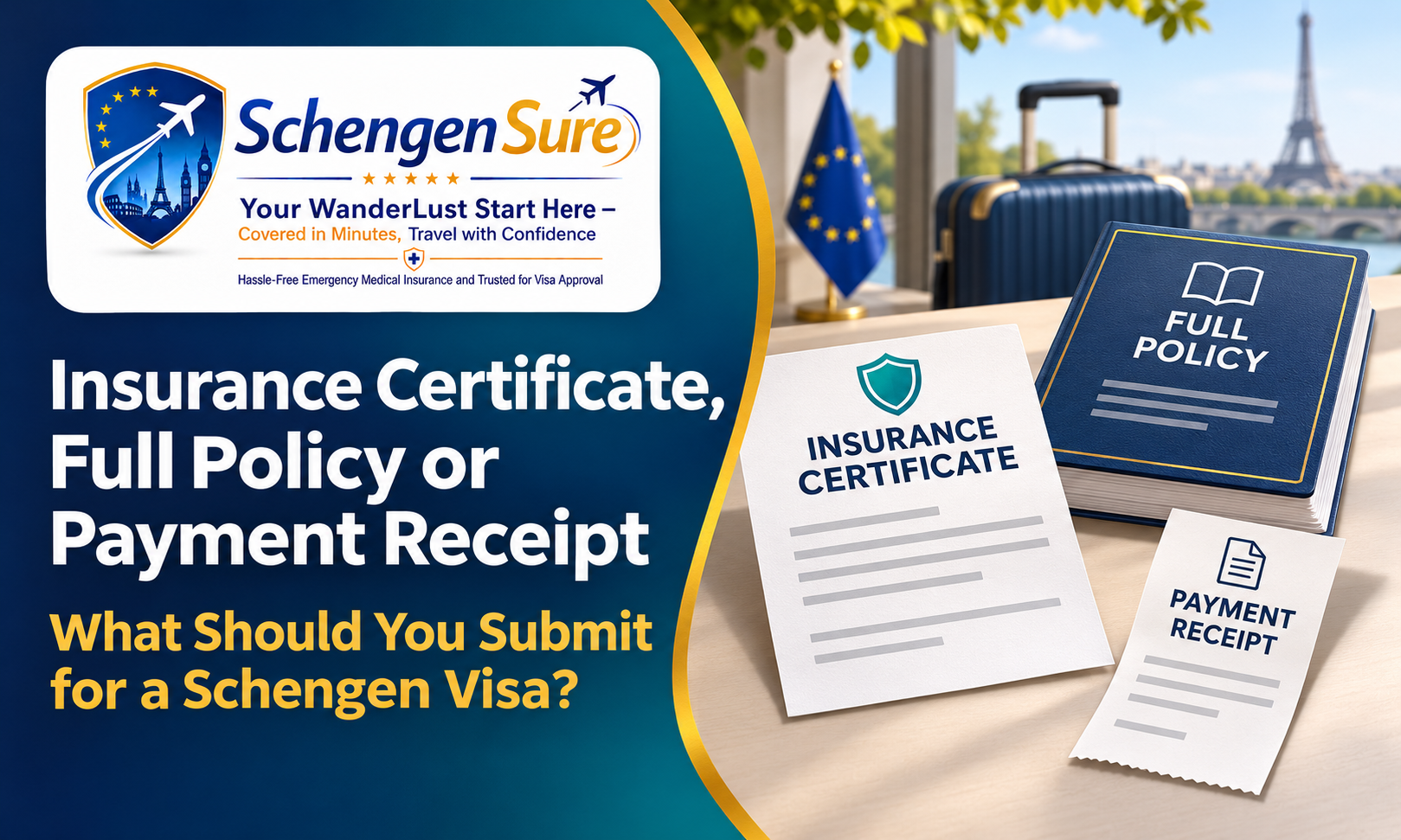
For most short-stay applications, submit insurer-issued proof of cover – usually a Schengen visa insurance certificate or the first policy-schedule page – that names the applicant and clearly shows the dates, Schengen territory, coverage amount and required medical and repatriation benefits. Add the full policy wording only when the official checklist asks for it or the summary document leaves an important point unclear. A payment receipt can support the file, but it should not be the only proof of insurance.
Scope: This guide concerns short-stay Schengen visas under the EU Visa Code. National long-stay visa insurance rules can be different. Always check the live checklist for the destination, travel purpose and country where you apply. [1][2]
Quick comparison: which insurance document should you submit?
| Document | What it proves | Best role | Can it stand alone? |
|---|---|---|---|
| Insurance certificate / visa letter | Personalised summary of cover | Primary proof when complete | Usually yes, if the checklist accepts it |
| Policy schedule / first policy page | Who is insured, dates and main benefits | Primary proof when complete | Often yes; the Netherlands gives this as an example [3] |
| Full policy wording / booklet | Detailed terms, definitions and exclusions | Supplement or required attachment | Usually not if it does not identify the applicant |
| Payment receipt / invoice | A payment or transaction occurred | Supporting evidence only | No – it normally does not prove coverage |
Best default: Submit the shortest insurer-issued document that makes every required fact easy to verify. A longer file is not automatically stronger evidence.
What the certificate or policy schedule should show
The Visa Code requires proof of adequate and valid travel medical insurance. The document should let the decision-maker verify the following without searching through a long booklet. [1]
- The applicant’s full name, matching the passport.
- The policy or certificate number and the insurer’s identity.
- Cover for the entire intended stay or transit, using the correct dates.
- Territorial validity throughout the Schengen States.
- At least EUR 30,000 of cover.
- Medical repatriation, urgent medical attention, emergency hospital treatment and death-related repatriation cover.
- Clear confirmation that the applicant is insured, even if another person paid.
An assistance telephone number, verification link or QR code can make checking easier, but these features do not replace the required coverage information unless the local checklist says otherwise.
When should you add the full policy?
Add the full wording or relevant terms when the official checklist expressly requests a policy, when a benefit is defined on another page, or when employer, bank-card or group cover needs explanation. Put the personalised certificate or schedule first so the applicant, dates and territory are immediately visible.
A generic policy booklet alone can be weak evidence because it may describe a product without proving that you personally hold active cover for the trip.
Why a payment receipt is not enough
A receipt normally proves payment, not insurance compliance. It may omit the insured person’s name, travel dates, territory, benefit limits and repatriation wording. Include it only as supporting evidence if the checklist requests proof of purchase or if it helps explain who paid.
Quote-worthy rule: Payment proves a transaction; the certificate proves the cover.
How to choose the right file for your application
- Open the current official checklist for your destination, purpose and application country.
- Choose the certificate or schedule that contains every required fact.
- Compare the name and coverage dates with the passport, itinerary and application form.
- Add full wording or a receipt only when requested or needed to clarify the primary proof.
- Keep the same proof available for travel; border authorities may ask for it. [6]
Online upload versus a paper appointment
Use the unedited insurer-issued PDF. Avoid cropped screenshots, password-protected files and unreadable scans. Use a descriptive filename such as FamilyName_Travel_Insurance_Certificate.pdf.
Follow the local instruction on originals, colour copies and upload categories. For example, the Dutch checklist for applicants in India currently asks for a colour copy of the proof; another authority may organise the file differently. [4]
Practical examples
- Complete certificate: It names Priya, covers all Schengen States for her full trip and lists the required benefits. Submit it as the primary proof unless the checklist asks for more.
- Incomplete schedule: It shows the dates and price but not repatriation. Ask the insurer for revised proof instead of adding only the receipt.
- Family or group policy: Make sure every applicant is identifiable as insured and has the required cover. Do not assume the purchaser’s name covers everyone.
- Credit-card or employer insurance: Obtain personalised confirmation of active cover, plus the relevant schedule or terms if the summary is incomplete.
Common insurance-document mistakes
- Submitting only the payment confirmation.
- Uploading a brochure or quotation instead of active proof of cover.
- Using a nickname or misspelt name that does not match the passport.
- Buying dates that end before the intended trip ends.
- Using vague regional wording that does not clearly cover the Schengen area.
- Ignoring a locally applicable approved-insurer list, such as the list used by Schengen missions in India. [5]
- Making the officer search a long booklet for the applicant-specific facts.
Checklist before submission
- Official destination and application-location checklist rechecked.
- Applicant name matches the passport.
- Policy number and insurer are visible.
- Dates cover the entire intended stay or transit.
- All Schengen States are covered.
- At least EUR 30,000 cover is shown.
- Required medical, hospital and repatriation benefits are stated.
- PDF or copy is complete, readable and unaltered.
- Extra policy pages or receipt included only when useful or requested.
Neutral buying guidance
Before buying, ask whether the insurer issues a personalised Schengen visa insurance certificate immediately and whether you can see a sample. Compare the wording, dates, territory, benefit limits, exclusions, excess, assistance service and visa-refusal cancellation or refund terms – not price alone.
Check whether the insurer or policy must appear on a locally approved list and whether claims would be recoverable in a Schengen State. No insurer or certificate can guarantee visa approval. [1][5]
If you still need cover, you may compare Schengen travel medical insurance through SchengenSure after checking the official checklist. SchengenSure is a comparison/referral publisher, not an insurer, broker, visa adviser or decision-maker; provider terms and affiliate relationships may apply.
Official-source or expert check: Recheck the responsible consulate’s live checklist on the day you prepare the file. If authenticity is questioned, insurance is recorded as a refusal ground, or the authority asks for a different document, request official clarification or qualified specialist advice.
Frequently asked questions
Is an insurance certificate enough for a Schengen visa?
Often yes, if it is insurer-issued, contains all required information and the responsible authority accepts that format. The local checklist controls.
Do I need to submit the full travel insurance policy?
Submit it when the checklist asks for it or when the certificate or schedule does not explain an important benefit, definition or exclusion.
Can I submit only the insurance payment receipt?
No. A receipt normally proves payment but not the applicant, dates, territory, coverage amount or required medical benefits.
Can I use insurance from my employer, bank or credit card?
Possibly, but obtain personalised proof showing that the cover is active and meets the EU and local checklist requirements.
Can one family certificate cover several applicants?
It can if every applicant is clearly identified and individually covered. If that is unclear, request separate certificates or a complete named schedule.
Is an emailed PDF acceptable?
Many applications use printed or uploaded insurer-issued PDFs, but rules on originals, copies and upload format vary. Follow the current local instruction.
What insurance proof is needed for a multiple-entry visa?
At application, the Visa Code requires proof covering the first intended visit. Valid insurance is still needed for subsequent stays, and proof may be requested while travelling. [1][6]
Conclusion
For a Schengen visa, lead with a complete insurance certificate or policy schedule, not a receipt. Add the full policy only when the checklist requests it or the summary needs support, and make every applicant-specific fact easy to verify.
Official sources
- [1] EUR-Lex – Consolidated Visa Code, Article 15
- [2] European Commission – Applying for a Schengen visa
- [3] Government of the Netherlands – Insurance proof and policy schedule
- [4] Government of the Netherlands – India tourism checklist
- [5] German Missions in India – Travel medical insurance information
- [6] France-Visas – Frequently asked questions