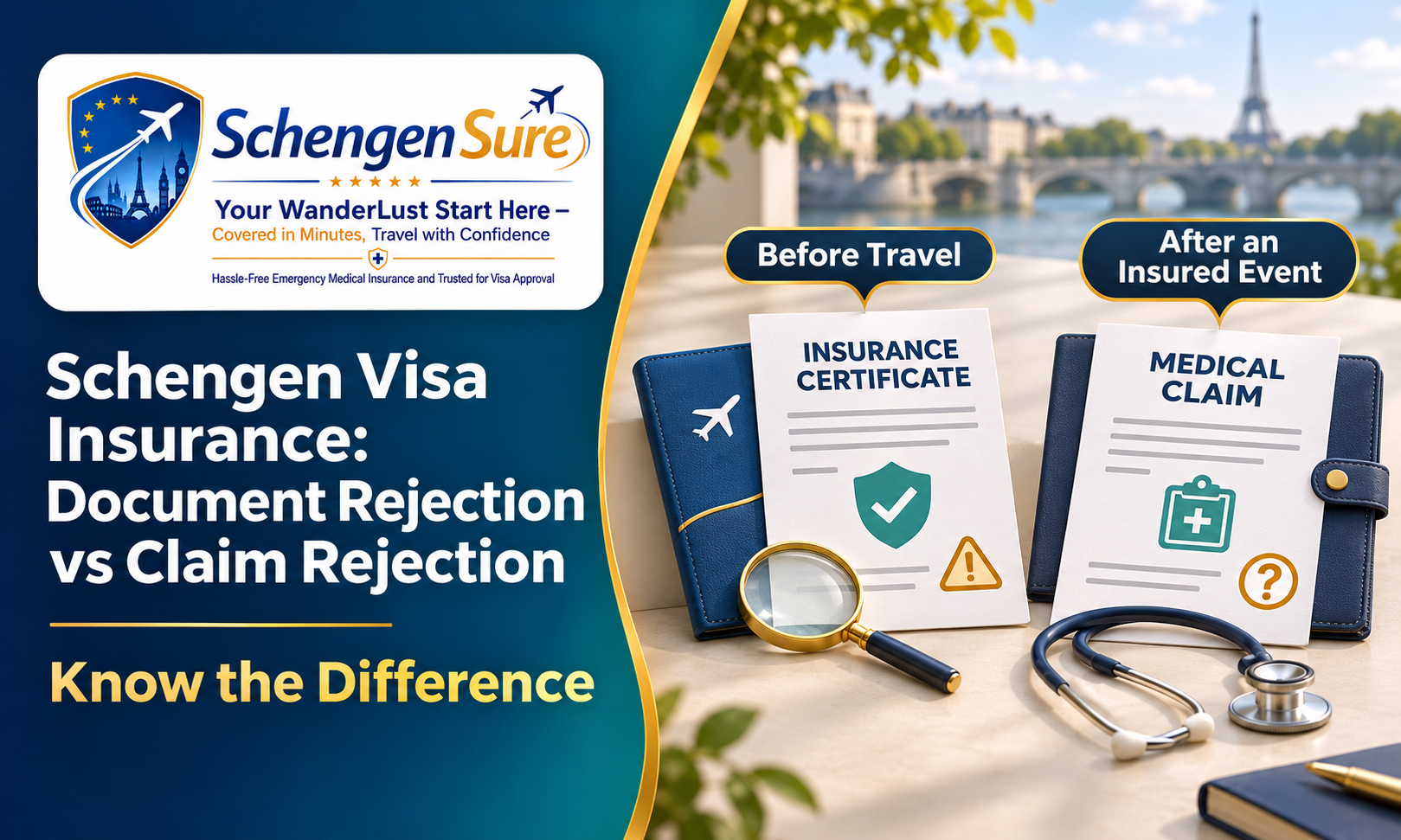
| A Schengen visa insurance document rejected by a consulate is not the same as an insurer rejecting a medical claim. The visa problem occurs before travel because the certificate did not clearly prove the required cover. A claim rejection happens after an insured event because the insurer says the loss is excluded, undocumented or not handled under the policy rules. |
First, read the refusal notice carefully. The standard Schengen refusal form includes a specific ground stating that the applicant did not provide proof of adequate and valid travel medical insurance. In the current form, this appears as ground 16. Do not assume insurance caused the refusal unless that box, or an equivalent written reason, was selected. [1]
This distinction matters because the solution is different. A defective certificate may be corrected before a fresh application or addressed through the appeal procedure described in the refusal notice. A denied medical claim must be challenged through the insurer’s evidence, complaint or appeal process.
Why this issue deserves careful attention
EU and Schengen-associated consulates received more than 12 million short-stay visa applications in 2025. India accounted for about 1.15 million applications, and the worldwide refusal rate was 14.6%. These figures do not show how many refusals involved insurance, but they demonstrate the scale of the process and the importance of documents that can be verified quickly. [2]
The practical question is not only, “Did I buy travel insurance?” It is: “Does the certificate clearly prove compliance to the consulate reviewing my application?”
Why was my Schengen visa insurance document rejected?
1. The emergency medical limit was below €30,000
Article 15 of the EU Visa Code requires minimum cover of €30,000. Check the actual emergency medical-expense limit, not a headline total that combines baggage, cancellation, delay or personal-liability benefits. For family applications, the certificate should make the cover for each insured applicant clear. [1]
| Fix: Confirm that every applicant has at least €30,000 in qualifying travel medical cover and that sublimits do not reduce the relevant medical benefit below the minimum. |
2. Repatriation or the required medical benefits were missing
The insurance must cover expenses connected with medical repatriation, urgent medical attention, emergency hospital treatment and death. A certificate that says only “medical expenses covered” may be too vague if the required benefits cannot be identified from the evidence submitted. [1]
| Fix: Use a visa certificate that expressly states emergency medical treatment, hospitalisation, medical repatriation and expenses connected with death. |
3. The policy dates did not cover the entire trip
The cover must remain valid for the full intended stay or transit. Common errors include starting the insurance one day after arrival, ending it before the return flight, or keeping old dates after changing the itinerary. The application form, flight reservation, accommodation plan and insurance dates should tell the same story. [1]
| Fix: Compare every travel date across the application and obtain a corrected certificate before submission. |
4. The geographical validity was too narrow
For a uniform Schengen visa, the policy must be valid throughout the territory of the Member States. Cover limited only to France, Germany, Italy or another main destination can be insufficient even when most nights are spent there. [1]
| Fix: Look for wording such as “valid throughout the Schengen Area” or “all Schengen countries”, then check the exclusions section for territorial limitations. |
5. The insured person’s details did not match the passport
Spelling differences, missing surnames, reversed names, an incorrect date of birth or a certificate issued only in the purchaser’s name can make it unclear who is insured. This is especially common when an adult child buys insurance for parents. The Visa Code allows another person to take out the policy, but the applicant must still be clearly insured. [1]
| Fix: Match the passport spelling exactly and verify each traveller’s date of birth, passport number, policy number and travel dates wherever shown. |
6. The insurer or policy was not accepted under local consular rules
Some consular jurisdictions publish an approved-insurer or approved-policy list. For example, the German Missions in India state that they accept Indian travel medical insurance only from approved Indian insurers on their published list. Because local lists can change, a policy accepted for one application channel should not automatically be assumed acceptable everywhere. [3]
| Fix: Check the live checklist and insurance guidance of the embassy or consulate handling the application before purchasing or replacing the policy. |
7. The certificate did not show that claims were recoverable in a Schengen state
The Visa Code requires consulates to assess whether claims against the insurer would be recoverable in a Member State. A policy may offer international benefits but still leave the officer unable to verify the insurer, assistance contact, claims route or territorial recoverability. [1]
| Fix: Use a certificate from an identifiable insurer that clearly states the territory, emergency-assistance details and claims arrangement relevant to the Schengen Area. |
8. Credit-card insurance was supported only by generic documents
Credit-card travel insurance is not automatically unacceptable. The problem is usually proof. A card brochure, statement or general benefits page may not establish the applicant’s name, exact travel dates, territory, €30,000 medical limit and repatriation cover. [3]
| Fix: Request a personalised certificate from the card insurer or assistance company and compare it line by line with the consulate’s checklist. |
9. The certificate was unclear, incomplete or difficult to verify
A local-currency amount is not automatically invalid, but the officer must be able to confirm that the cover is equivalent to at least €30,000. Problems also arise from illegible scans, missing policy numbers, unclear insurer names, inconsistent pages or certificates in a language not accepted by the relevant mission. [1]
| Fix: Submit a clean, complete certificate showing the insurer, insured applicant, policy number, dates, territory, qualifying benefits and coverage amount. Follow any language or translation instruction in the local checklist. |
What to do now: a five-step response
- Confirm the refusal ground. Read every selected box and written comment. Insurance may be only one of several concerns.
- Audit the certificate against the live consular checklist. Check the amount, benefits, dates, territory, identity details, insurer acceptance and document language.
- Ask the insurer for a corrected visa certificate. Do not rely only on a policy booklet or marketing summary. Request a concise certificate that proves the required points.
- Choose appeal or reapplication based on the refusal notice. The available procedure and deadline are country-specific. A corrected reapplication may be practical when the document defect is obvious, but an appeal may be appropriate when the original certificate was compliant and the decision appears mistaken.
- Address every other refusal reason. Do not replace the insurance and ignore concerns about finances, accommodation, purpose, itinerary reliability or intention to leave the Schengen Area.
Pre-submission Schengen travel insurance checklist
☐ At least €30,000 in qualifying emergency medical cover for each applicant
☐ Urgent medical treatment and emergency hospitalisation included
☐ Medical repatriation and expenses connected with death included
☐ Every intended arrival, stay and departure date covered
☐ Validity throughout the Schengen Area
☐ Every traveller identified with passport-matching details
☐ Insurer name, policy number, assistance contact and limits clearly visible
☐ Policy accepted under any local insurer-approval rule
☐ Claims recoverable in a Schengen state
☐ Full wording or supporting schedule included when the checklist requests it
Visa-document rejection versus insurance claim rejection
| Question | Visa-document rejection | Insurance claim rejection |
|---|---|---|
| When? | Before travel, during the visa decision | After an illness, accident or other insured event |
| Who decides? | Embassy or consulate | Insurer or claims administrator |
| Main issue | The certificate does not prove visa compliance | The loss is excluded, undocumented or not handled under the policy procedure |
| Typical response | Correct the certificate and follow the visa refusal procedure | Provide missing evidence, challenge the decision or use the complaint process |
Frequently asked questions
Why is my travel insurance not accepted for a visa?
Usually because the evidence does not clearly prove one or more requirements: €30,000 minimum medical cover, required medical and repatriation benefits, full trip dates, Schengen-wide validity, correct applicant details, an acceptable insurer or recoverable claims. The exact reason should be read from the refusal notice and the relevant consulate’s checklist.
Does buying Schengen travel insurance guarantee visa approval?
No. Insurance is only one requirement. The consulate also assesses the purpose and conditions of the stay, finances, accommodation, travel plan, passport and intention to leave before the visa expires.
Is travel insurance bought in India accepted for a Schengen visa?
It can be, but acceptance may depend on the consular jurisdiction and the insurer or policy. Some missions publish an approved list. Check the live guidance of the embassy or consulate that will decide the application rather than relying on a generic statement from a seller.
Can another person buy the insurance for the applicant?
Yes. Article 15 allows another person to take out the insurance in the applicant’s name. The certificate must still identify the applicant clearly and satisfy the required amount, dates and territory. [1]
Can I use credit-card travel insurance?
Potentially, provided the card insurer issues personalised evidence showing the insured applicant, dates, Schengen territory, qualifying medical cover of at least €30,000 and repatriation benefits. A generic card brochure is normally weak evidence.
Do multiple-entry visa holders need insurance for every trip?
Applicants for a multiple-entry visa prove insurance for the first intended visit and declare awareness that insurance is needed for later stays. Travellers should carry valid insurance evidence for each journey; France-Visas expressly advises multiple-entry visa holders to carry a health-insurance certificate during every trip. [5]
Choose insurance for the visa — and for the real journey
A certificate can satisfy the visa-document requirement without necessarily offering the easiest experience during a medical emergency. Before purchasing, compare exclusions, deductibles, emergency-assistance procedures, direct-settlement possibilities, pre-existing-condition rules and the evidence required for reimbursement. “Visa-compliant” and “practical during travel” are related, but they are not the same test.
| Compare Schengen travel medical insurance through SchengenSureReview destination-based options, certificate details and emergency-support features before you apply.Visit SchengenSure.com |
| Important disclaimerSchengenSure is not a visa authority and cannot guarantee visa approval. Always check the current checklist of the embassy or consulate handling your application. This article provides general information, not legal or insurance advice. |
Official sources
[2] European Commission — 2025 Schengen short-stay visa statistics, published 28 May 2026
[3] German Missions in India — information on accepted travel medical insurance
[4] German Missions in India — declaration on travel and health insurance requirements
[5] France-Visas — documents required at the border and insurance for multiple-entry travel