
There is generally no fixed Schengen-wide waiting period before you can submit a new visa application after a refusal. You may be able to reapply immediately, but doing so only makes sense if you understand the refusal reasons and can submit a stronger, corrected application.
The practical rule is simple: do not reapply because time has passed; reapply when the problem that caused the refusal has been meaningfully addressed.
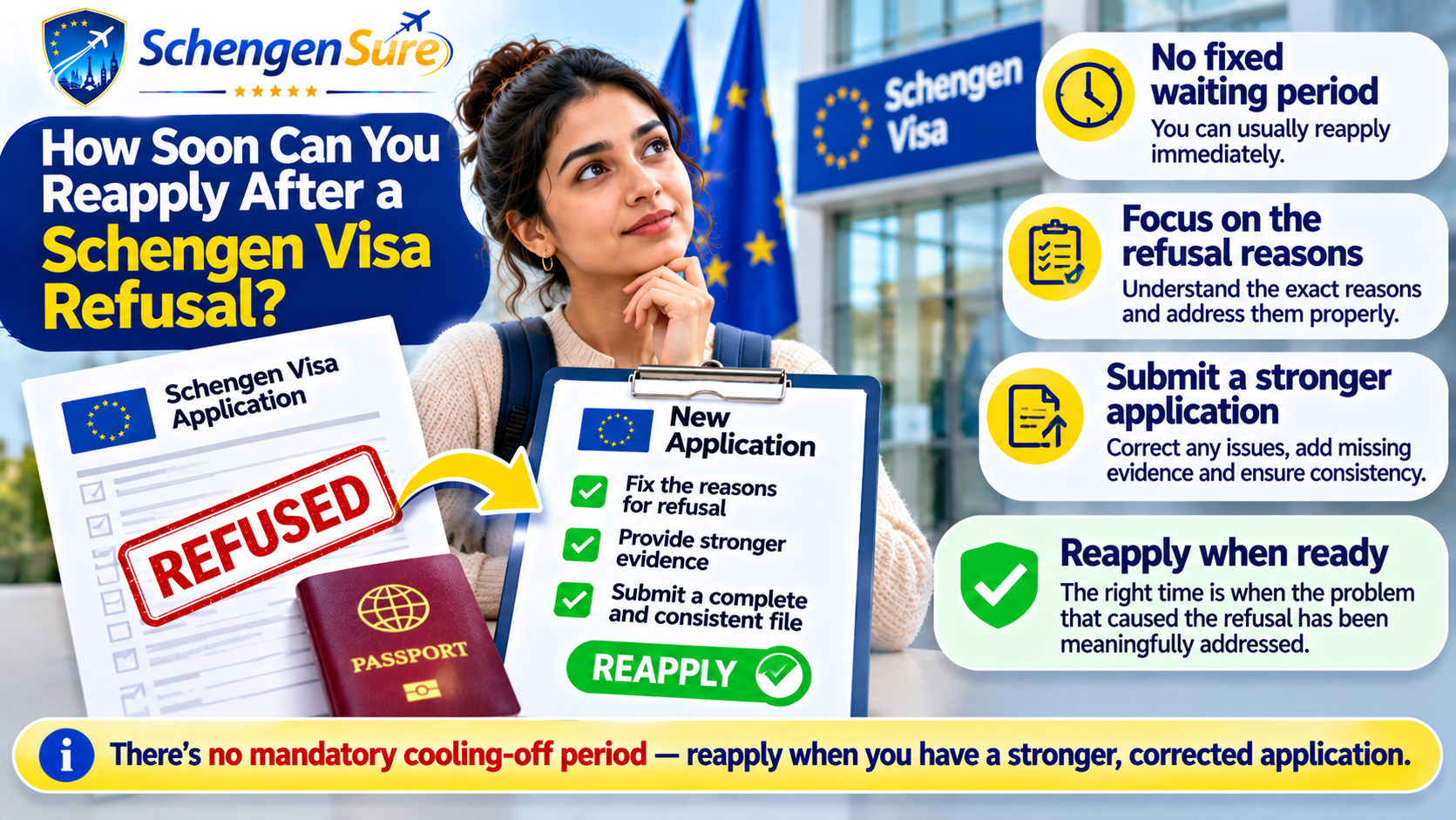
Is There a Waiting Period After a Schengen Visa Refusal?
The EU Visa Code sets out the grounds for refusal and the right to appeal, but it does not create a general 7-day, 30-day, 3-month or 6-month cooling-off period before a fresh application. [1]
German Missions in India currently state that a refused applicant is free to reapply and recommend taking account of the earlier refusal reasons before submitting again. Their separate post-refusal guidance says a new application can be made at any time with additional information and documentation. [2][3]
So the better question is not “How many days must I wait?” but “What has changed since the refusal?”
When Does Reapplying Quickly Make Sense?
A quick reapplication can make sense when the refusal arose from a problem that can genuinely be corrected quickly. Examples include a missing required document, an incorrect insurance certificate, an obvious inconsistency or a document that was not properly explained.
By contrast, some weaknesses may need more time. If the refusal concerned the credibility of your finances, economic situation, purpose of travel or intention to leave the Schengen Area, resubmitting the same evidence a few days later may add little.
Reapply Now or Wait? A Practical Comparison
| Refusal issue | Reapply quickly? | Better approach |
| Missing document | Potentially | Add the correct evidence and recheck the full file |
| Insurance document inadequate | Potentially | Obtain compliant evidence before reapplying |
| Typo or internal inconsistency | Potentially | Correct every affected document |
| Unclear itinerary or travel purpose | Only after fixing | Submit a coherent, credible trip plan |
| Weak or unexplained finances | Maybe not | Improve genuine evidence and explain source/availability of funds |
| Doubts about return intention | Maybe not | Add meaningful evidence of employment, study, family or economic ties |
| You believe the refusal itself was wrong | Consider appeal | Check the issuing country’s appeal procedure and deadline |
This comparison is practical guidance, not a guarantee of approval. Every new application is assessed on its own facts.
Start With the Refusal Letter
Before deciding when to reapply after a Schengen visa refusal, read the refusal form and any accompanying decision carefully. Identify the exact grounds marked or explained and connect each one to the evidence you previously submitted.
The Netherlands, for example, advises refused applicants who choose a new application to read the refusal decision closely and correct the problem, such as by providing the correct documents. [4] German guidance follows the same logic: consider the earlier refusal reasons and make the necessary changes before trying again. [2]
Reapply or Appeal a Schengen Visa Refusal?
Reapplication and appeal are different. A new application asks the consulate to assess a new set of facts and documents. An appeal challenges the legal or factual correctness of the refusal decision.
Article 32 of the Visa Code gives refused applicants a right to appeal, but the appeal is made under the national law of the Member State that took the final decision. This means deadlines, procedures and authorities are not identical across Schengen countries. [1]
For example, the Netherlands allows an applicant either to object or submit a new application. Germany abolished its voluntary remonstration procedure worldwide from 1 July 2025; applicants can still submit a new application or use the legal remedy stated in the refusal notice. [3][5]
If you believe the decision was wrong even though your original evidence was complete and strong, an appeal may deserve consideration. If the application itself had correctable weaknesses, a new application may be more practical. For legal advice on an appeal, consult a qualified professional in the relevant jurisdiction.
Can You Apply to Another Schengen Country After Refusal?
A previous refusal does not mean you must always reapply to the same country. But you should not switch consulates simply because you think another country is easier.
Your new application should go to the Schengen country genuinely competent for the new trip, normally the country associated with the main purpose or main destination. A fabricated itinerary designed only to avoid the earlier refusing consulate can create new credibility problems. [6]
Will Another Schengen Country Know About the Previous Refusal?
Schengen visa applications and decisions are processed through the Visa Information System (VIS). The European Commission explains that VIS connects consulates and external border points and contains visa-application data and decisions. [7]
Do not try to hide the earlier refusal. A better strategy is to make the new application internally consistent and clearly address what was wrong before.
How to Strengthen a Second Application
- Read every refusal ground before changing documents.
- Correct missing, contradictory or outdated evidence.
- Explain the genuine purpose of travel clearly and consistently.
- Use realistic accommodation and transport plans.
- Show genuine, accessible financial means and explain unusual transactions where relevant.
- Provide meaningful evidence of employment, study, family or economic ties where relevant.
- Use compliant travel medical insurance evidence for the new intended trip.
- Check that names, dates, passport details and itinerary information match across the file.
If Travel Insurance Contributed to the Refusal
Do not simply resubmit the same insurance document. Check the refusal reason and the current consular checklist, then verify that the new policy or certificate clearly demonstrates the coverage required for the intended trip.
When comparing replacement cover through SchengenSure or elsewhere, consider the insured dates, territorial validity, emergency medical cover, hospitalisation, repatriation, exclusions and certificate wording. The goal is not to buy a more expensive policy; it is to submit evidence that genuinely meets the applicable requirements.
Common Mistakes When Reapplying
- Resubmitting the same application immediately without fixing the refusal reason.
- Assuming you must wait 30 days, three months or six months without an official rule saying so.
- Changing consulates purely to search for an “easier” country.
- Adding borrowed or artificial funds shortly before reapplying without credible explanation.
- Changing the itinerary but leaving old hotel, flight or insurance dates elsewhere in the file.
- Ignoring a previous refusal instead of addressing it directly.
- Using a generic cover letter that does not explain what has changed.
- Missing an appeal deadline while assuming all Schengen countries use the same procedure.
Reapplication Checklist
☐ Read the refusal decision carefully.
☐ List each refusal reason and the evidence connected to it.
☐ Decide whether the problem is correctable through a new application or whether an appeal should be considered.
☐ Check the appeal procedure and deadline of the issuing country if relevant.
☐ Prepare genuinely improved supporting documents.
☐ Use the correct consulate for the new trip.
☐ Update flights, accommodation and itinerary dates.
☐ Check financial evidence for consistency and genuine source of funds.
☐ Obtain compliant travel medical insurance for the new intended trip.
☐ Run a final consistency check across the entire application before submission.
OFFICIAL-SOURCE CHECK: appeal procedures, deadlines and post-refusal remedies are country-specific and can change. Recheck the current Visa Code, the refusal notice and the official website of the Member State that made the decision whenever this article is updated.
FAQs
Can I reapply immediately after a Schengen visa refusal?
Generally, there is no fixed Schengen-wide waiting period. You may be able to submit a new application immediately, but it is usually sensible only when the earlier refusal reasons have been addressed. [1][2]
Should I wait 30 days before reapplying?
There is no general Schengen rule requiring a 30-day wait. The right timing depends on when you can submit a materially stronger application.
Is it better to reapply or appeal?
Reapply when you can correct or strengthen the application. Consider an appeal when you believe the refusal was legally or factually wrong. Appeal procedures and deadlines depend on the country that refused the visa. [1]
Can I apply to another Schengen country after rejection?
Yes, if that country is genuinely competent for your new trip. Do not switch countries only to avoid the previous refusal.
Will the next consulate see my previous refusal?
Schengen visa applications and decisions are processed through VIS, so you should assume the previous application is part of the relevant visa record. [7]
Can I reuse the same documents?
Some documents may still be valid, but do not automatically reuse the entire file. Update anything that is outdated, inconsistent or connected to the refusal reason.
Can a second Schengen visa application be approved?
Yes, a previous refusal does not prevent a later approval. The new application must independently satisfy the applicable requirements, and correcting the earlier weaknesses can improve the quality of the file.
Conclusion
You generally do not have to wait a fixed number of days to reapply after a Schengen visa refusal. But speed is not the objective: the strongest time to reapply is when you can show that the problem behind the earlier refusal has actually been addressed.
Read the refusal letter, decide whether reapplication or appeal is the appropriate route, correct the evidence and submit a coherent new application to the country genuinely responsible for the trip. If insurance was part of the problem, fix the insurance evidence before you apply again.
Reliable Sources and Citations
- Regulation (EC) No 810/2009, consolidated Visa Code, Article 32 – refusal grounds, notification and right to appeal; no general Schengen-wide waiting period for a new application is created by the Code. https://eur-lex.europa.eu/legal-content/EN/TXT/HTML/?uri=CELEX%3A02009R0810-20240628
- Federal Foreign Office, German Missions in India, “Schengen Visa FAQs” – refused applicants are free to reapply and should take account of the earlier refusal reasons. https://india.diplo.de/in-en/service/schengen-visa-faq-2610538
- Federal Foreign Office, German Missions in India, “My visa application got rejected. What can I do?” – a new visa application may be submitted at any time with additional information/documentation. https://india.diplo.de/in-en/service/2680032-2680032
- NetherlandsWorldwide, “I have not been granted a visa for the Netherlands. What can I do?” – applicants may object or submit a new application and should correct the problem identified in the refusal decision. https://www.netherlandsworldwide.nl/visa-the-netherlands/objecting-refuse-application
- Federal Foreign Office, German Missions in India, “Abolition of the remonstration procedure from 1 July 2025” – Germany ended the voluntary remonstration procedure worldwide from 1 July 2025. https://india.diplo.de/in-en/2716462-2716462
- NetherlandsWorldwide, “Visiting more than one Schengen country” – apply to the Schengen country associated with the main purpose/main destination of travel. https://www.netherlandsworldwide.nl/visa-the-netherlands/visiting-more-than-one-schengen-country
- European Commission, Visa Information System (VIS) – VIS connects consulates and border points and processes Schengen visa application data and decisions. https://home-affairs.ec.europa.eu/policies/schengen/visa-information-system_en