
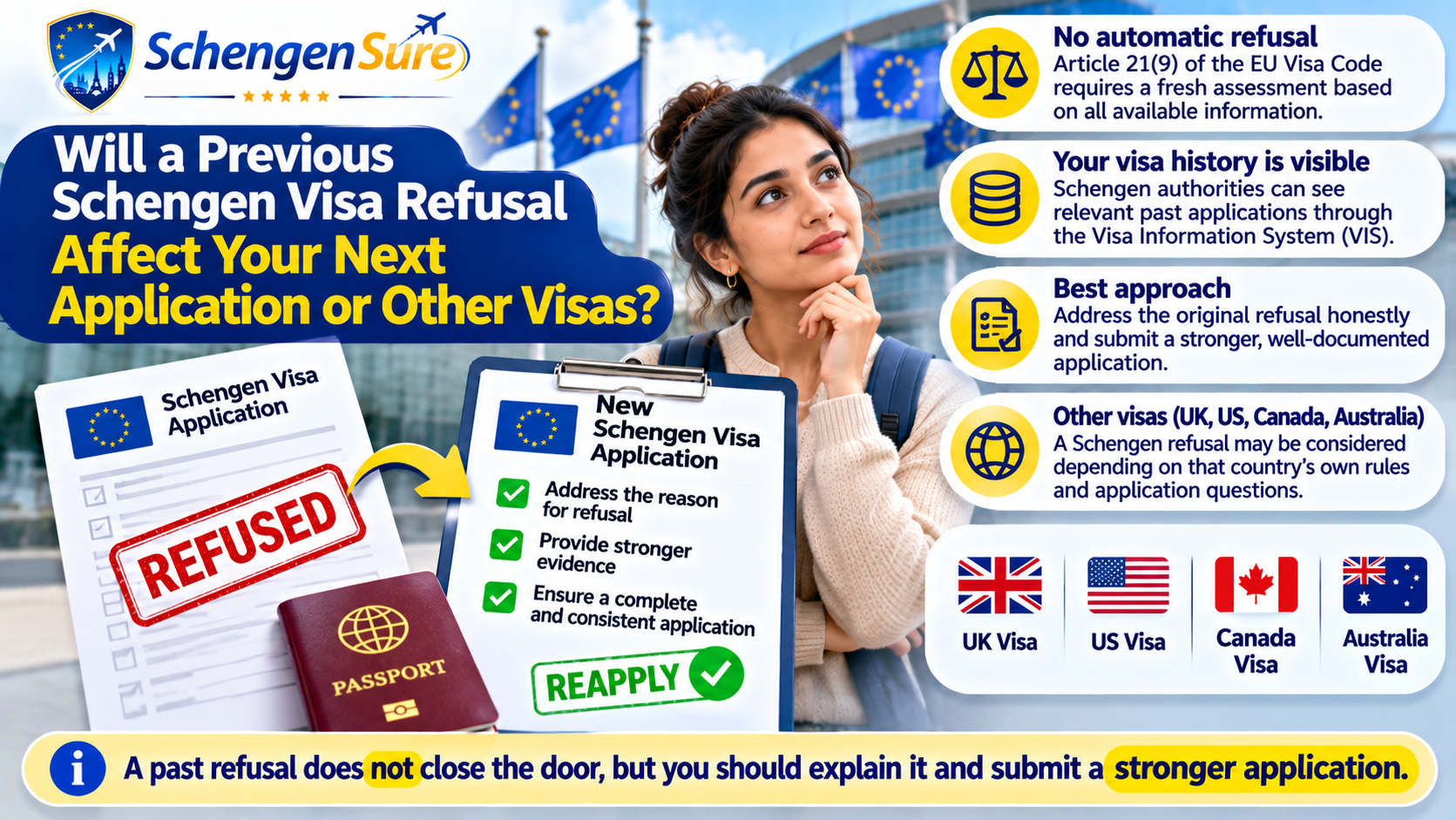
A previous Schengen visa refusal can be relevant to a future application, but it does not automatically cause another refusal. Article 21(9) of the EU Visa Code requires a new application to be assessed on all available information rather than refused simply because an earlier application failed.
Schengen authorities can see relevant visa history through the Visa Information System (VIS), so the safest strategy is to address the original refusal honestly and submit a stronger application. Whether a Schengen refusal matters for a UK, US, Canadian or Australian visa depends on that country’s own rules and application questions.
Does a Previous Schengen Refusal Automatically Affect the Next Application?
No. The Visa Code is explicit: a previous visa refusal must not lead to the automatic refusal of a new application. The new application must be assessed using all available information. [1]
That does not mean the earlier refusal becomes irrelevant. If the same concern remains – for example unclear travel purpose, weak financial evidence, inconsistent documents or inadequate insurance – the new application may face the same problem.
German Missions in India currently confirm that applicants are free to reapply after refusal and recommend taking note of the earlier reasons and making necessary amendments before submitting again. [2]
Does a Schengen Visa Refusal Stay on Record?
Yes, for a defined period in the Schengen Visa Information System. The European Commission says VIS stores data relating to visa applications and decisions, and that data is kept for five years. For a negative decision, the retention period starts from the date the refusal decision is taken. [3]
This means a previous refusal should not be treated as invisible when you apply again through another Schengen authority. VIS exists so participating authorities can exchange relevant visa information.
Can Another Schengen Country See Your Previous Refusal?
Competent Schengen authorities can access relevant visa application and decision information through VIS. Applying through France after a German refusal, for example, does not create a clean slate. [3]
You may apply through another Schengen country when that country is genuinely responsible for your new trip. You should not invent a new itinerary simply to avoid the country that refused you. The competent consulate is determined by the genuine sole or main destination, with first entry used only where a main destination cannot be determined. [4]
Previous Refusal vs Entry Ban: They Are Not the Same
A routine visa refusal is not automatically a Schengen entry ban. The Schengen Information System (SIS) separately contains alerts for third-country nationals who are subject to refusal of entry or stay. [5]
So a refusal letter should not be described as a ban unless an official decision or alert actually creates that consequence. VIS records visa applications and decisions; SIS refusal-of-entry or stay alerts are a different legal and technical concept.
What Matters Most on Your Next Schengen Application?
The practical question is not simply ‘Was I refused before?’ It is ‘Has the problem that caused the refusal now been addressed?’
| Earlier problem | What should improve next time |
| Missing or inadequate documents | Submit the correct evidence and current checklist items |
| Unclear travel purpose | Make purpose, itinerary and bookings coherent |
| Weak financial evidence | Show genuine accessible funds and explain their source |
| Doubts about return | Provide stronger genuine employment, study, family or economic ties |
| Insurance problem | Use compliant travel medical insurance evidence |
| Accommodation concern | Provide credible current accommodation |
| Contradictory information | Correct inconsistencies across the whole application |
Do not create artificial balances, fake bookings or explanations merely to make the application look stronger. A credible reapplication should be genuinely stronger, not cosmetically different.
Should You Explain the Previous Refusal?
If the current application or consulate asks about previous refusals, answer accurately. Do not hide or misstate immigration history.
Even where a separate explanation is not expressly required, a short factual cover-letter paragraph can sometimes help when the new evidence directly addresses the earlier refusal. Keep it simple: identify the previous concern, explain what has changed and point to the supporting document.
Will a Schengen Refusal Affect a UK Visa?
A Schengen refusal does not automatically determine a UK visa outcome. UK visitor applications are assessed under UK immigration rules.
Current UK Home Office visitor guidance tells caseworkers to consider an applicant’s previous immigration history, including travel to the UK and other countries, as part of the overall genuineness assessment. It also says travel history should not be the only consideration and that all relevant circumstances must be considered. [6]
Because UK forms and questions can change, check the current official application and answer every immigration-history question exactly as asked.
Will a Schengen Refusal Affect a US Visa?
A Schengen refusal is not itself a US visa refusal ground. US visa applications are approved or denied according to standards in US immigration law and the applicant’s eligibility for the visa category. [7]
The US Department of State also warns that false or misleading statements on a visa application can have serious consequences. Therefore, answer the current US form and any interview questions truthfully rather than assuming a foreign refusal is irrelevant or automatically disqualifying. [8]
Will a Schengen Refusal Affect a Canadian Visa?
Canada is more explicit about disclosure. The current visitor-visa guide asks whether the applicant has ever been refused a visa or permit, denied entry or ordered to leave Canada or any other country or territory. [9]
That means a previous Schengen refusal may need to be declared on a Canadian visitor-visa application. It does not automatically mean Canada will refuse the application; IRCC says immigration applications are assessed individually and encourages applicants to address the reasons behind earlier refusals. [10]
Will a Schengen Refusal Affect an Australian Visa?
Australian requirements depend on the visa and forms requested. Current Form 80, when required, asks whether the applicant has ever been refused a visa to any country and asks for the dates, countries and circumstances. [11]
A Schengen refusal therefore may be relevant to an Australian application even though it is not an automatic Australian refusal. Follow the current form for your visa category and provide accurate information.
Common Mistakes After a Previous Refusal
- Submitting the same Schengen application again without fixing the original problem.
- Assuming another Schengen consulate cannot see the previous decision.
- Applying to a different country with an artificial itinerary.
- Calling a normal visa refusal an entry ban without evidence.
- Hiding a refusal when another country’s application asks about foreign visa history.
- Changing only the cover letter while leaving weak evidence unchanged.
- Using borrowed money, fake bookings or altered documents to ‘repair’ the application.
- Assuming a Schengen refusal automatically means UK, US, Canada or Australia will refuse you.
Checklist Before Your Next Application
☐ Read the previous refusal letter carefully.
☐ Identify each reason or credibility concern.
☐ Decide what new evidence genuinely addresses it.
☐ Check the current document checklist for the correct Schengen country.
☐ Keep the new itinerary consistent with the genuine main destination.
☐ Explain previous refusal briefly if useful or required.
☐ Answer all visa-history questions truthfully.
☐ Check that financial documents show genuine accessible funds.
☐ If insurance was a problem, replace or correct the insurance evidence.
☐ Review the whole application for contradictions before submission.
OFFICIAL-SOURCE CHECK: visa forms, disclosure questions and data rules can change. Recheck the current VIS rules and the current UK, US, Canadian and Australian application instructions whenever this article is updated.
Buying Guidance if Insurance Contributed to the Refusal
If the previous Schengen refusal involved inadequate travel medical insurance, do not simply submit the same certificate again. Compare the refusal reason with the current consular insurance requirement and obtain corrected evidence before reapplying.
When comparing replacement cover through SchengenSure or elsewhere, check the insured travel dates, Schengen territorial coverage, emergency medical and hospitalisation cover, repatriation, exclusions and the clarity of the visa-facing certificate. Price alone does not determine whether the document is suitable.
If the refusal was unrelated to insurance, buying a different policy will not fix weaknesses in finances, travel purpose, return intention or document credibility.
FAQs
Will a previous Schengen visa refusal automatically cause another refusal?
No. Article 21(9) of the Visa Code says a previous refusal must not automatically lead to refusal of a new application. [1]
Can another Schengen country see my refusal?
Relevant visa application and decision information is shared through VIS, so applicants should assume competent Schengen authorities can see previous Schengen visa history. [3]
How long is a Schengen refusal kept in VIS?
The European Commission currently states that VIS data is kept for five years, starting from the date of a negative decision in a refusal case. [3]
Does a visa refusal mean I am banned from Schengen?
No. A visa refusal and an SIS refusal-of-entry or stay alert are different concepts. [5]
Can I apply to another Schengen country after refusal?
Yes, when that country is genuinely competent for the new trip. Do not switch countries using a false itinerary simply to avoid the previous consulate.
Does a Schengen refusal affect a Canadian visa?
It may be relevant because Canada’s current visitor-visa guide asks about visa refusals by any country. Disclose it when asked, but it does not automatically decide the Canadian application. [9]
Should I hide a previous Schengen refusal?
No. Provide accurate information whenever a visa application asks about previous refusals or immigration history. False or misleading answers can create a more serious problem than the original refusal.
Conclusion
A previous Schengen visa refusal can affect the context of your next application, but EU law prevents it from becoming an automatic reason for another refusal. The strongest response is to understand the earlier decision, correct the underlying weakness and submit a transparent, coherent new application.
For visas outside Schengen, the effect depends on the destination country’s rules. Some applications explicitly ask about foreign refusals, while others consider immigration history more broadly. Always use the current official form, answer truthfully and avoid treating a refusal as either irrelevant or permanently disqualifying.
Reliable Sources and Citations
Editorial note: VIS rules, national visa forms and disclosure questions can change. Recheck the current official sources before future updates.
- Regulation (EC) No 810/2009, consolidated Visa Code, Article 21(9) – a previous visa refusal must not automatically cause refusal of a new application. https://eur-lex.europa.eu/legal-content/EN/TXT/HTML/?uri=CELEX%3A02009R0810-20240628
- Federal Foreign Office, German Missions in India, Schengen Visa FAQs – applicants may reapply after refusal and should address the earlier refusal reasons. https://india.diplo.de/in-en/service/schengen-visa-faq-2610538
- European Commission, Visa Information System (VIS) – visa application/decision data and five-year retention rule. https://home-affairs.ec.europa.eu/policies/schengen/visa-information-system_en
- European Commission, Applying for a Schengen visa – competent consulate is based on the sole/main destination and, where necessary, first entry. https://home-affairs.ec.europa.eu/policies/schengen/visa-policy/applying-schengen-visa_en
- European Commission, Alerts and data in SIS – refusal-of-entry or stay alerts are a separate SIS category. https://home-affairs.ec.europa.eu/policies/schengen/schengen-information-system/alerts-and-data-sis_en
- UK Home Office, Visit caseworker guidance, version published 25 February 2026 – previous immigration and travel history can form part of the genuine-visitor assessment. https://www.gov.uk/government/publications/visit-guidance/visit-caseworker-guidance-accessible–2
- US Department of State, Visa Denials – US visa applications are approved or denied under standards established in US law. https://travel.state.gov/content/travel/en/us-visas/visa-information-resources/visa-denials.html
- US Department of State, DS-160 FAQs – false or misleading statements can lead to serious visa and entry consequences. https://travel.state.gov/content/travel/en/us-visas/visa-information-resources/forms/ds-160-online-nonimmigrant-visa-application/ds-160-faqs.html
- Immigration, Refugees and Citizenship Canada, Guide 5256 – visitor applicants are asked about visa or permit refusals, denied entry or removal involving Canada or any other country or territory. https://www.canada.ca/en/immigration-refugees-citizenship/services/application/application-forms-guides/guide-5256-applying-visitor-visa-temporary-resident-visa.html
- IRCC Help Centre – past immigration decisions do not automatically determine a new application and applicants should address refusal reasons. https://ircc.canada.ca/english/helpcentre/answer.asp?qnum=1485&top=16
- Australian Department of Home Affairs, Form 80 – when required, asks whether the applicant has ever been refused a visa to any country. https://immi.homeaffairs.gov.au/form-listing/forms/80.pdf