
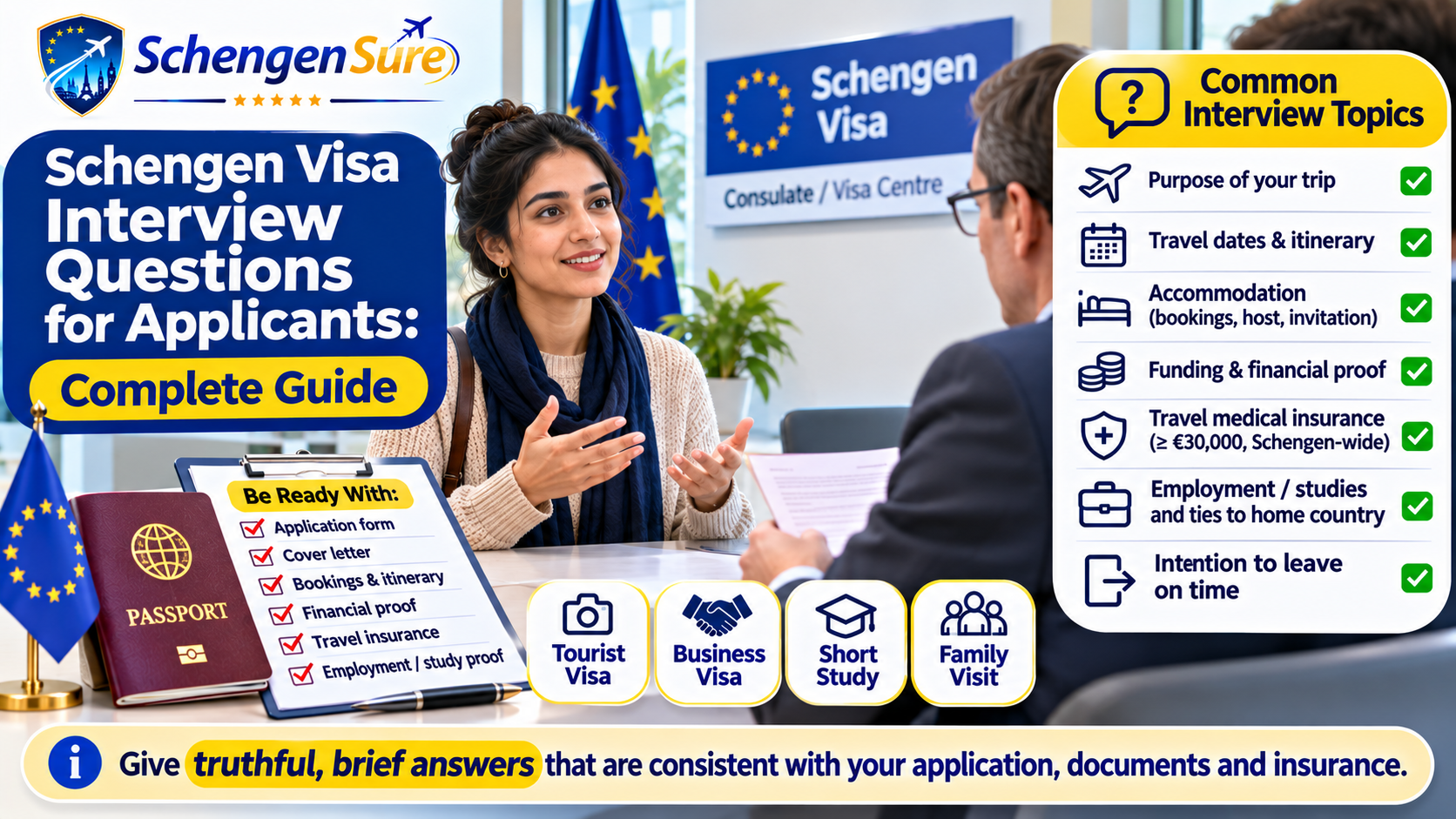
| Schengen visa interview questions for applicants usually focus on the trip’s purpose, itinerary, funding, accommodation, insurance, document credibility and the applicant’s intention to leave on time. Not every applicant has a formal interview: a consulate may contact an applicant by telephone, video call or an in-person meeting when clarification is needed. Give truthful, brief answers that match your application form, cover letter, bookings, financial evidence, employment documents and insurance certificate. |
|---|
Does every applicant have a Schengen visa interview?
No. The European Commission’s Visa Code Handbook says a consulate may conduct an interview in justified cases. If the available information does not allow a decision, the consulate may telephone the applicant or arrange a personal or video interview.[1]
The interview must be conducted by consular staff. VFS Global, BLS International, TLScontact or another external service provider may collect an application and biometrics, but it does not make the visa decision.[1][2]
| Key distinction: A visa-application appointment is not automatically a consular interview. An interview is an additional examination step that may occur during processing. |
|---|
Application appointment, consular interview and border questions compared
| Interaction | Who normally handles it | Main purpose |
|---|---|---|
| Application submission and biometrics | Consulate or authorised external service provider | Receive the file, identity data and biometrics |
| Verification call or visa interview | Consular staff | Clarify facts and assess whether the information is reliable |
| Questions when entering Schengen | Border authorities | Check entry conditions for the actual trip; a visa does not guarantee entry |
The exact procedure varies by destination country, location and case. Follow only the instructions sent through the embassy, consulate or its authorised service provider.
What is the consulate trying to confirm?
For a short-stay visa, the examination can cover the purpose and conditions of the visit, accommodation, financial means, travel medical insurance, the reliability of documents and whether the applicant intends to leave before the visa expires.[1][2][3]
The officer is not looking for an impressive speech. The officer needs clear facts that make sense together.
| The safest interview answer is not a memorised answer. It is a truthful answer that is brief, specific and consistent with the submitted file. |
|---|
How to answer Schengen visa interview questions
Use this five-part method:
- Listen to the complete question.
- Answer the exact point in one or two sentences.
- Use the same dates, destinations and funding details shown in your documents.
- Explain unusual facts directly, such as a large deposit or a change of hotel.
- If you do not know or remember something, say so instead of guessing.
Do not learn model answers word for word. Use examples only to understand the level of detail required.
General Schengen visa interview questions for Indian applicants
These are possible questions, not an official or mandatory list. One applicant may receive only a few questions, while another may be asked for detailed clarification.
Identity and application details
- What is your full name and date of birth?
- Where do you currently live in India?
- How long have you lived at your current address?
- What is your marital status?
- Who are the members of your immediate family?
- What passport are you travelling with?
- Did you complete the visa application yourself?
- If someone helped you, who helped and why?
- Did you read the complete application before signing it?
- Which type of visa have you requested?
- Which country did you apply to, and why is it the correct country?
- When and where did you submit the application?
- What documents did you submit?
- Has any information changed since submission?
- Have you submitted another visa application for the same trip?
Purpose, dates and itinerary
- What is the main purpose of your trip?
- What are your exact arrival and departure dates?
- How many days will you remain in the Schengen Area?
- Which country is your main destination?
- Which country will you enter first?
- Which other Schengen countries will you visit?
- How many nights will you spend in each country?
- Why did you choose these destinations?
- Can you explain your route in chronological order?
- What will you do on the first day?
- What are the main activities in your itinerary?
- Where will you stay each night?
- What is the name and address of your hotel or host?
- Are the accommodation reservations confirmed?
- Who made the flight and hotel reservations?
- Have you paid for any bookings?
- How will you travel between cities or countries?
- Who is travelling with you?
- Why are your travel companions applying separately or travelling on different dates?
- What will you do after leaving the Schengen Area?
Money, employment and sponsorship
- What is the estimated total cost of your trip?
- Who will pay for the trip?
- What is your monthly income?
- What is your current bank balance?
- What are the regular sources of money entering your account?
- How much of the trip will you pay from your own funds?
- Which expenses have already been paid?
- Will you use cash, cards or both while travelling?
- Do you have access to emergency funds?
- Why is there a recent large deposit in your account?
- Why does your bank balance differ from your declared income?
- Do you have loans or regular financial commitments?
- How many people depend financially on you?
- If sponsored, who is the sponsor?
- What is your relationship with the sponsor?
- Why is the sponsor paying for this trip?
- How does the sponsor earn income?
- Can the sponsor afford the trip and their own expenses?
- Is your employer paying any part of the journey?
- What financial documents support your explanation?
Employment, home ties and intention to return
- What do you do for a living?
- What is the name and address of your employer?
- What is your job title and main responsibility?
- When did you start this job?
- What is your approved leave period?
- Who approved your leave?
- When are you expected back at work?
- What work must you complete after returning?
- If self-employed, who will manage the business while you are away?
- How long has your business operated?
- What income does the business generate?
- Are you currently studying in India?
- When must you return to your course or examinations?
- Which family members remain in India?
- Do you care for children, parents or other dependants?
- Do you own or rent your home?
- What professional, family or financial commitments require your return?
- Why are you confident that you will return to India?
- Do you intend to seek employment in Europe?
- Do you intend to remain longer than the authorised stay?
Travel history and previous applications
- Have you travelled outside India before?
- Which countries have you visited?
- Did you comply with the conditions of previous visas?
- Have you previously visited the Schengen Area?
- When did you last visit, and for what purpose?
- Did you use your previous Schengen visa as stated in that application?
- Have you ever overstayed a visa?
- Have you ever been refused a visa?
- Which country refused the application, and when?
- What reason was given for the refusal?
- What has changed since the refusal?
- Have you ever cancelled or abandoned an international trip?
- Do you have relatives or close friends in Europe?
- Have you declared all of them where the application requires it?
- Have you previously applied through a different Schengen country?
Insurance and supporting documents
- Do you have travel medical insurance for this trip?
- Which insurer issued the policy?
- What dates are shown on the insurance certificate?
- Which territory does the policy cover?
- What medical and repatriation cover does it provide?
- Does the certificate show your correct name and passport details?
- Who purchased the policy?
- Why did you choose this insurance?
- What would you do if you needed emergency medical care?
- Does the policy cover the complete planned stay?
- Have your travel dates changed since the policy was issued?
- Can the policy dates be amended if the trip changes?
- What documents can you provide if the consulate asks for clarification?
- Is any document inconsistent with the information you have given?
- Did you submit a certificate, full policy wording or both?
Schengen tourist visa interview questions
Tourists should be able to explain a realistic holiday, not merely repeat a list of famous attractions.
- Why have you chosen Europe for this holiday?
- Why did you choose this particular country?
- Which places do you plan to visit?
- Why are those places important to you?
- Can you describe a normal day in your itinerary?
- Is the itinerary realistic for the time available?
- Why are you visiting so many countries in a short period?
- Why are you spending the longest time in the country you applied to?
- Why is another country your first point of entry?
- Have you checked the travel time between your destinations?
- How will you move within each city?
- Where will you stay in every destination?
- Why did you select those hotels?
- Are any reservations cancellable or unpaid?
- What will you do if a hotel booking changes?
- Did a travel agent prepare the itinerary?
- Is this an organised tour or an independent trip?
- Who selected and paid for the tour package?
- What is your daily travel budget?
- Have you budgeted for meals, local transport and attractions?
- Why are you travelling alone?
- How do you know the people travelling with you?
- Why is a family member not joining the trip?
- Is this your first international holiday?
- Why did you choose Schengen for your first foreign trip?
- What research have you done about the destination?
- Do you know the permitted duration of your intended stay?
- What will you do if weather or transport disrupts the plan?
- When is your return flight to India?
- What commitment do you have immediately after returning?
How to answer: Name the purpose, dates, principal destination and two or three meaningful activities. Avoid describing an itinerary that your bookings, leave period or budget cannot support.
Schengen business visa interview questions
A short business visit is not the same as taking employment. The activity must match the invitation, employer letter and any country-specific permission.
- Who is your current employer?
- What is your role in the company?
- How long have you worked there?
- Why must you personally make this trip?
- Which company or organisation invited you?
- What is your relationship with the inviting organisation?
- How long have the two organisations worked together?
- Who is your contact person in Europe?
- What is the contact person’s role?
- What is the purpose of each planned meeting?
- Can you explain the meeting agenda?
- Which conference, trade fair or event will you attend?
- Why is the event relevant to your work?
- What are the event dates and venue?
- Who registered you for the event?
- Who will pay for flights, accommodation and daily expenses?
- Does your employer continue to pay your salary during the trip?
- What does the invitation letter promise to cover?
- Will you sign contracts or only hold discussions?
- Will you provide services to a European client?
- Will you receive payment from an organisation in Europe?
- Will you perform hands-on or operational work?
- Are you carrying equipment, samples or commercial goods?
- Do you need a separate work authorisation for the proposed activity?
- Which colleagues are travelling with you?
- Why are you staying before or after the business event?
- Have you met the inviting company before?
- Have you made similar business trips previously?
- What project or responsibility requires your return to India?
- Who will handle your duties while you are away?
- What will you report or complete after the trip?
- What would you do if the meeting were cancelled?
How to answer: Explain the specific business activity and its connection to your Indian employment. Do not call an employment assignment a “meeting.” If the work-versus-business boundary is unclear, obtain country-specific advice before applying.
Schengen visa interview questions for students
This section applies to short study, academic visits, competitions, conferences or training that may fit a Type C stay. A degree or stay exceeding 90 days normally follows the destination country’s national Type D rules, which require a separate official check.[4]
- What course, programme or event will you attend?
- Which institution admitted or invited you?
- Where is the institution located?
- What are the programme’s start and end dates?
- Why did you choose this programme?
- How does it relate to your present studies or career?
- What is your current school, college or university in India?
- Which subject are you studying in India?
- What is your academic background?
- Can you show the admission or invitation letter?
- Have the programme fees been paid?
- Who is paying the fees and travel expenses?
- Where will you stay during the programme?
- Is accommodation arranged by the institution?
- What language will be used for instruction?
- Do you understand that language sufficiently?
- Is attendance compulsory?
- Will you receive academic credit or a certificate?
- Is any internship or practical placement included?
- Is the internship paid or unpaid?
- Will you work outside the stated programme?
- Why can the same course not be taken in India?
- What will you do immediately after the programme?
- When must you resume studies in India?
- Do you have examinations, a semester or a project after returning?
- Are you planning to apply later for a long-term European course?
- Why is a short-stay visa appropriate for this visit?
- Does the insurance meet the requirements for the complete visit?
- Who is your emergency contact in India?
- What would you do if the programme dates changed?
How to answer: Connect the short programme to your current education and give a clear return plan. If your actual purpose is a long-term course, use the correct national visa route instead of presenting it as short tourism.
Schengen family-visit visa interview questions
A temporary family visit is different from moving to Europe under a family-reunification route.
- Whom are you visiting?
- What is your exact relationship to the host?
- How long have you known the host?
- When did you last meet in person?
- Where does the host live?
- What is the host’s nationality or residence status?
- What does the host do for a living?
- Who lives with the host?
- Why are you visiting at this particular time?
- Is there a birthday, wedding, birth, illness or other family occasion?
- Can you provide evidence of the event if required?
- How long will you stay with the host?
- Will you stay anywhere else?
- Has the host issued an invitation or sponsorship document?
- Who will pay for the flights?
- Who will pay for accommodation and daily costs?
- Can the host afford the promised support?
- How much will you contribute personally?
- How do you normally communicate with the host?
- Can you show evidence of the family relationship?
- Have you visited this host before?
- Has the host visited you in India?
- Do you have other relatives in the Schengen Area?
- Why are you not visiting those relatives?
- Will you travel around Schengen with the host?
- What tourist activities are planned?
- Which family members remain in India?
- Who will care for your dependants while you travel?
- What requires you to return to India?
- Are you planning to live with the host permanently?
- Have you applied for family reunification or residence?
- Why is a short family visit the correct route?
- What will you do if the host cannot accommodate you?
- Is the host providing travel medical insurance?
- When will you leave the host’s home and return to India?
How to answer: Be precise about the relationship, visit purpose, funding, accommodation and return date. Do not hide a relative because you think disclosure will weaken the case; an unexplained contradiction is usually more damaging than a clear fact.
Questions for sponsored, self-employed, retired and homemaker applicants
Sponsored applicants
- Why are you not paying for the complete trip yourself?
- Who is sponsoring you?
- What is your relationship with the sponsor?
- Why has the sponsor agreed to pay?
- Which exact expenses will the sponsor cover?
- What expenses will you pay personally?
- What is the sponsor’s occupation and income?
- Does the sponsor support anyone else?
- Has the sponsor paid for previous trips?
- Why was money transferred to your account before the application?
Self-employed applicants
- What business do you own or operate?
- When was the business established?
- Where is it registered?
- What is your role in daily operations?
- What are the main sources of business income?
- Why does business income vary between months?
- Who will manage clients and staff during your absence?
- What meetings or deadlines require your return?
- Are business and personal transactions mixed in one account?
- What tax or registration records support the business?
Retired applicants
- When did you retire?
- What was your previous occupation?
- What pension or other regular income do you receive?
- Who is paying for the trip?
- What savings are available for travel?
- Are you travelling with family?
- What family, home or financial ties do you maintain in India?
- Do you have medical conditions relevant to the journey?
- Have you checked the policy’s age limits and exclusions?
- Who can assist you in an emergency?
Homemakers and applicants without regular employment
- What is your present occupation?
- Who supports the household financially?
- Why is that person sponsoring the trip?
- What personal funds do you have?
- What does your spouse or sponsor do?
- Which family members travel with you?
- Which family members remain in India?
- What household or family responsibilities require your return?
- Why are you travelling on these dates?
- How does the trip fit the family’s finances?
First-time travellers or applicants with a previous refusal
- Why is this your first international trip?
- Why did you choose the Schengen Area for it?
- How did you plan and research the trip?
- What gives you confidence that the budget is sufficient?
- Have you previously applied for this or another visa?
- What was the stated reason for the refusal?
- Did you disclose the refusal in the new application?
- What documents or circumstances are different now?
- Why should the new application be assessed differently?
- Is any issue from the previous application still unresolved?
Practical sample answers without memorised scripts
“What is the purpose of your trip?”
Answer pattern: State the purpose, dates, main destination and key activity.
Example: “I am taking a nine-day holiday in France and Belgium during my approved annual leave. France is my main destination, with six nights in Paris and Lyon, followed by three nights in Brussels before I return to India.”
“Who is paying for the trip?”
Answer pattern: Identify each payer and the expenses covered.
Example: “I will pay for my flights and personal expenses from my salary savings. My sister, whom I am visiting, will provide accommodation at her home, as stated in her invitation.”
“Why will you return to India?”
Answer pattern: Give specific commitments rather than a general promise.
Example: “My approved leave ends on 18 October, and I resume work on 19 October. I also live with and support my parents in Pune.”
“What will you do during this business trip?”
Answer pattern: Describe the permitted activity precisely.
Example: “I will attend product-planning meetings with our German partner and the listed trade conference. I remain employed and paid by my Indian employer, and I will not take local employment.”
“Why was your previous visa refused?”
Answer pattern: State the official reason, then explain the material change.
Example: “The refusal notice said the information about funding was insufficient. This application includes my updated bank history, salary evidence and a clear breakdown of expenses.”
These examples are formats, not answers to copy. Replace every fact with your own verified information.
Travel insurance questions and neutral buying guidance
Uniform Schengen visa applicants generally need travel medical insurance covering the relevant territory and the entire intended stay. The Visa Code refers to medical repatriation, urgent medical attention, emergency hospital treatment and death, with minimum coverage of EUR 30,000.[2]
Before buying, compare:
- Territory and travel dates on the certificate
- Medical, hospital and repatriation benefits
- Excess, exclusions and pre-existing-condition wording
- Age limits and suitability for senior travellers
- Emergency assistance and claims process
- Refund or date-change terms if the visa or journey changes
- Whether the certificate format matches the destination consulate’s current checklist
SchengenSure can help applicants compare short-stay travel medical insurance options. However, no insurer, comparison platform or certificate can guarantee that a visa will be granted. The consulate assesses the complete application.
Common interview mistakes
- Treating the appointment at an application centre as a guaranteed formal interview
- Giving dates that differ from the form, cover letter or bookings
- Calling one country the main destination when the itinerary shows another
- Memorising a long answer and continuing after the question has been answered
- Guessing a hotel address, sponsor income or bank figure
- Hiding a relative, previous refusal or travel-history problem
- Describing employment as a business meeting
- Giving a trip budget that does not match the bank evidence
- Using a generic answer about returning instead of naming real commitments
- Becoming defensive when asked for clarification
- Submitting changed bookings without understanding the new itinerary
- Buying insurance with incorrect names, dates or territory
- Claiming that insurance guarantees visa approval
- Sending unverified documents or personal data to unofficial contacts
- Failing to check country-specific rules before the interview
Schengen visa interview preparation checklist
- Read the complete application form and cover letter again.
- Make a one-page timeline of dates, countries, hotels and transport.
- Know the main destination and why you applied there.
- Review the source of every important bank transaction.
- Know the trip budget and who pays each expense.
- Confirm your leave dates, return-to-work date or study schedule.
- Review the host, sponsor or inviting company’s details.
- Check that flight and accommodation details remain current.
- Check the insurance certificate’s name, dates and territory.
- Keep any requested original or updated documents organised.
- Prepare a truthful explanation for any refusal, deposit or inconsistency.
- Practise brief answers aloud without memorising a script.
- Keep your telephone reachable during processing.
- Verify uncertain messages through official contact details.
- Recheck the embassy or consulate’s current instructions before attending.
Points requiring an official source check
| Country practice can differ. Check the responsible embassy or consulate if your case involves a long-term student visa, paid or hands-on work, remote work, family reunification, an EU/EEA citizen’s qualifying family member, a minor, accessibility assistance, a previous overstay, suspected document fraud, entry through a different country or a request for a specific interview document. Obtain qualified immigration advice for complex cases. |
|---|
Frequently asked questions
Does every Indian Schengen visa applicant have an interview?
No. A consulate may conduct an interview when clarification is needed. It may take place by telephone, video call or in person.[1]
Does VFS, BLS or TLS decide the visa application?
No. An authorised external provider may receive applications and biometrics, but the competent consular authorities examine and decide the application.[1][2]
What are the most common Schengen visa interview questions?
Common topics include the travel purpose, dates, main destination, itinerary, accommodation, funding, employment, sponsor, travel history, home ties, intention to return and travel medical insurance.
How long does a Schengen visa interview take?
There is no universal published duration. It depends on the questions that the consulate needs to clarify. Prepare for a focused conversation rather than a fixed time.
In which language will the interview be conducted?
Language arrangements vary by consulate and location. Follow the interview notice or ask the responsible authority through its official contact channel.
What if I do not remember an exact figure or address?
Do not invent an answer. Say that you do not recall the exact detail and refer to the relevant document if permitted.
Can a consulate call after VFS submission?
Yes. The Visa Code Handbook allows consular contact by telephone and interviews by personal meeting or video when clarification is required.[1]
Can inconsistent interview answers affect the decision?
They can affect how the consulate assesses the reliability of the application. Correct a genuine mistake promptly and provide an explanation or supporting document if requested.
Should I disclose a previous visa refusal?
Answer the application and interview questions truthfully. Explain the official refusal reason and what is materially different in the new application.
Can travel insurance be discussed during the interview?
Yes. Insurance is part of the supporting documentation for a uniform visa, so an applicant may be asked about the insurer, coverage, territory or dates.
Are student interview questions the same for Type C and Type D visas?
No. Type C covers qualifying short stays. Long-term study follows national Type D and residence rules, so use the destination country’s official student-visa guidance.
Is a family visit the same as family reunification?
No. A short visit and a plan to move and live with family are different immigration purposes and normally follow different routes.
Conclusion
Preparation for Schengen visa interview questions for Indian applicants is mainly an exercise in consistency. Know the facts in your own file, answer honestly, explain unusual points clearly and use the correct route for tourism, business, short study or a family visit. The goal is not to perform a perfect answer; it is to help consular staff understand a credible, properly documented temporary trip.
Reliable sources
- European Commission – Visa Code Handbook I, 2024 – interviews, examination, external service providers and intention to leave.
- EUR-Lex – Regulation (EC) No 810/2009, consolidated Visa Code – visa examination, travel medical insurance and external service providers.
- European Commission – Applying for a Schengen visa – application country, documents, finances, accommodation, insurance and intention to return.
- European Commission – Schengen visa policy – common short-stay rules and national procedures for stays exceeding 90 days.