
| DIRECT ANSWER: Couples and families can often book appointments and submit their Schengen visa applications together, but every traveller needs a separate application form and an individual file. Shared documents can connect the applications, yet each adult and child receives a separate decision.[1][2] |
|---|
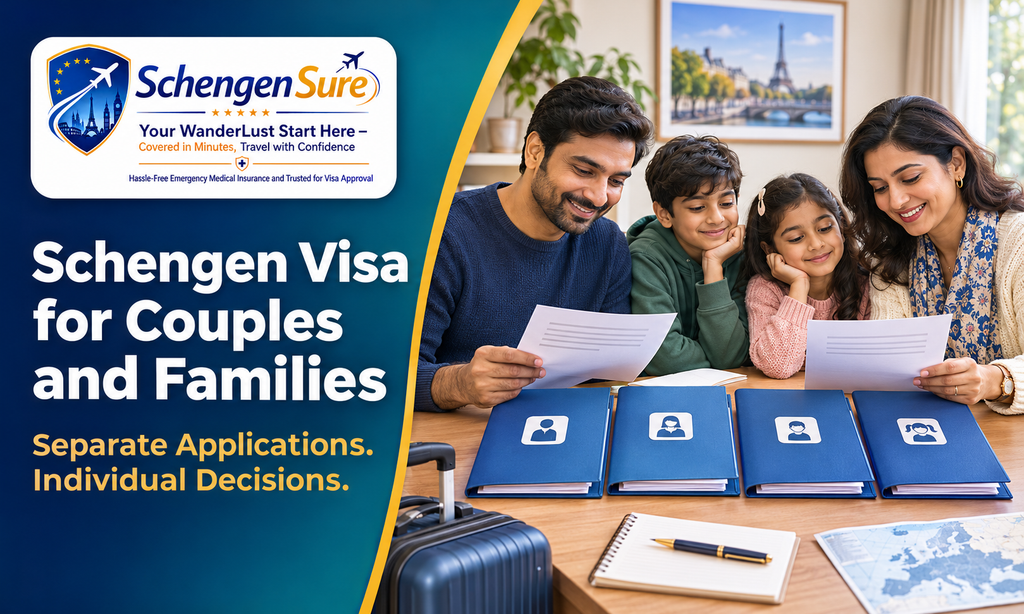
What does applying together actually mean?
A Schengen visa family application is not one application covering the whole household. It is a coordinated set of individual applications for people taking the same trip.
- booking linked or consecutive appointments;
- attending the visa application centre on the same day;
- using the same itinerary, transport and accommodation evidence;
- explaining shared finances or sponsorship consistently.
The system may still require a separate booking for each person. Some centres offer a family or group option; others do not.
| OFFICIAL-SOURCE CHECK: Follow the instructions of the responsible consulate and its authorised application centre. Appointment, document-copy and minor-attendance procedures differ by location. |
|---|
Does each family member need a separate application?
Yes. EU visa rules require each applicant to submit a completed and signed form. This also applies to a child and to a person included in another traveller’s passport. A minor’s form must be signed as required by the rules on parental authority or legal guardianship.[1]
Each applicant needs an individual file. A consulate may link the files of people travelling together, but it still examines each person separately.[2]
| QUOTE-WORTHY: A family may present one travel plan, but it does not receive one collective Schengen visa. |
|---|
Apply together or separately: comparison
| Situation | Coordinated submission is usually practical | Separate handling may be necessary |
|---|---|---|
| Couple or family sharing one trip | Same dates, destinations, bookings and main destination | Different travel dates, purposes or main destinations |
| Applicants living in one jurisdiction | Same responsible consulate or application centre | Family members legally resident in different consular jurisdictions |
| Shared finances | One person clearly sponsors some or all travellers | Each adult pays independently and has separate evidence |
| Children travelling with parents | Shared itinerary plus each child’s documents | A parent is absent, creating extra consent or custody evidence |
| Appointment booking | The system permits linked or consecutive slots | The system requires separate appointments |
Applying together can make a shared trip easier to understand. It does not guarantee identical decisions.
Which documents can a couple or family share?
Shared evidence can usually be copied into every relevant file:
- flight or other transport reservations showing all travellers;
- hotel bookings covering the full itinerary and correct occupancy;
- a day-by-day travel plan;
- a family cover letter or coordinated individual cover letters;
- a family travel insurance policy listing every insured person;
- proof of relationship, where it explains the group or sponsorship; and
- a sponsor’s documents when one person pays for others.
Write the names exactly as they appear in the passports. If a booking shows only the lead guest, obtain a confirmation listing the other guests where possible.
Which documents must remain individual?
Each traveller normally needs their own:
- application form and required signature;
- valid passport and passport copies;
- compliant photograph;
- proof of legal residence, where relevant;
- personal employment, study or other status evidence;
- financial evidence or a clear sponsorship explanation;
- previous travel evidence requested by the checklist; and
- insurance evidence confirming that the person is covered.
Documents depend on the destination, purpose, residence country and local checklist. Consulates may request additional documents.[3]
Special points for couples
Married couples
A marriage certificate can explain the relationship, shared funds and why one spouse pays for the other. It does not replace each spouse’s personal application or automatically prove sufficient funds.
If one spouse is the main earner, show the sponsor’s finances, a sponsorship explanation and the other spouse’s own circumstances. Use an official sponsorship form if required.
Unmarried or recently married couples
Do not describe an unmarried partner as a spouse. State the relationship accurately and provide relevant evidence only when it helps explain joint travel, accommodation or funding.
Recently married applicants should keep names on passports, forms, bookings and certificates consistent. Explain any lawful name difference and include requested evidence.
Special points for families with children
Every child needs a separate application. Birth certificates or other civil-status documents may be requested to show parentage.
If a child travels without one or both parents or guardians, the checklist may require consent, parental identity copies, or custody, guardianship or death records. The Netherlands’ official checklist provides one country-specific example.[4]
Do not assume that a young child is exempt from attending. Check the local instructions.
| EXPERT-REVIEW POINT: Seek qualified advice where there is a custody dispute, adoption, guardianship issue, missing consent, inconsistent civil-status records or concern about international child travel. |
|---|
One payer: how should family sponsorship be shown?
One spouse or parent may pay for the group. The file should make the arrangement easy to follow.
- a signed sponsorship letter stating who pays for whom and what is covered;
- the sponsor’s bank statements and income or business evidence;
- proof of the relationship;
- shared bookings; and
- any official national sponsorship or guarantee form required.
There is no universal bank-balance figure for every application. Required means and proof depend on the destination and circumstances. Explain unusual transactions.
Family travel insurance: neutral buying guidance
Every applicant subject to the insurance requirement must be covered. A family policy can be convenient, but the certificate should identify every insured traveller and match the trip.
Before buying, compare:
- whether the certificate is suitable for a Schengen visa application;
- medical, hospitalisation and repatriation terms;
- exclusions, deductibles and pre-existing-condition rules;
- emergency assistance and languages;
- claims and any direct-payment arrangements; and
- correction, cancellation and refund terms.
Do not choose only by price. Read the terms and check every name. SchengenSure can help travellers compare options, but the insurer’s documents and consular requirements remain decisive.
Practical example
Ravi, Meera and their child plan the same trip. Ravi pays most costs, so copies of his financial evidence and sponsorship letter appear in all relevant files. Each person still has a separate form, passport, photograph and insurance evidence. The child’s file also contains required parental documents.
This is coordinated submission, not one application.
Common mistakes
- Completing only one form for the whole family.
- Assuming one appointment automatically covers everyone.
- Leaving a child or spouse off a hotel, flight or insurance document.
- Using different travel dates or destinations across linked files.
- Showing shared funds without explaining who owns the money and who pays.
- Treating marriage as a substitute for personal financial or return evidence.
- Forgetting consent or custody documents for a minor.
- Applying to different consulates merely to find earlier appointments.
- Buying non-refundable travel solely because a visa application is pending.
Family application checklist
- Confirm that every traveller needs a visa.
- Identify the correct main destination and responsible consulate.[3]
- Check whether the booking system supports families or groups.
- Complete and sign a separate form for each traveller.
- Prepare one labelled file per person.
- Copy shared bookings and itinerary into each relevant file.
- Make names, dates and funding explanations consistent.
- Add marriage, birth, consent or custody evidence where required.
- Confirm that every traveller is named and covered by insurance.
- Recheck the consulate’s current checklist before submission.
Special route for some EU, EEA or Swiss citizens’ families
A qualifying non-EU family member accompanying or joining an EU citizen in another EU country may benefit from a facilitated procedure. Eligibility depends on the relationship, destination and travel circumstances.[5]
This differs from an ordinary family application. National rules may apply when travelling to the EU citizen’s country of nationality. Check the official route first.
| OFFICIAL-SOURCE CHECK: This guide concerns short-stay applications. Long-term family reunification, residence and national Type D visas follow different rules. |
|---|
Frequently asked questions
Can a family apply for a Schengen visa together?
Yes, family members can often coordinate appointments and submit linked files for the same trip. Each person still needs an individual application and receives an individual decision.
Should a husband and wife apply together?
It is usually practical when they share an itinerary and consular jurisdiction. Separate handling may be needed when their purpose, dates or responsible consulate differs.
Do children need a separate application form?
Yes. Every child needs a separate form and file, signed according to the applicable parental-authority rules.[1]
Can a couple use the same bank statement?
Shared evidence may be relevant, but explain account ownership and who pays. Include sponsorship evidence or an official form when required.
Can one travel insurance policy cover the whole family?
Potentially, yes. Check that every applicant is named or otherwise clearly insured and that the certificate and policy meet the applicable requirements.
Can family members receive different decisions?
Yes. Each application is assessed individually, so validity periods or outcomes can differ even when the family applies together.
Conclusion
The best way to apply for a Schengen visa as a family is to coordinate one truthful trip while preparing an individual file for every traveller. Share consistent bookings, funding and insurance evidence, but never assume one form or decision covers everyone.
Check the responsible consulate’s latest instructions before submission. A clear family application is not created by adding more paperwork; it is created by making every file tell the same accurate story.
Official sources
- Consolidated EU Visa Code, Articles 10-11: Open official source
- Visa Information System Regulation, linked application files for people travelling together, Article 8(4): Open official source
- European Commission, Applying for a Schengen visa: Open official source
- Netherlands Worldwide, documents relating to minors: Open official source
- Your Europe, travel documents for non-EU family members: Open official source
- European Commission, Harmonised Schengen visa application form: Open official source
- European Commission, Visa Code Handbook (2024): Open official source