
Is This Travel Insurance Accepted for a Schengen Visa? How to Verify a Provider and Certificate
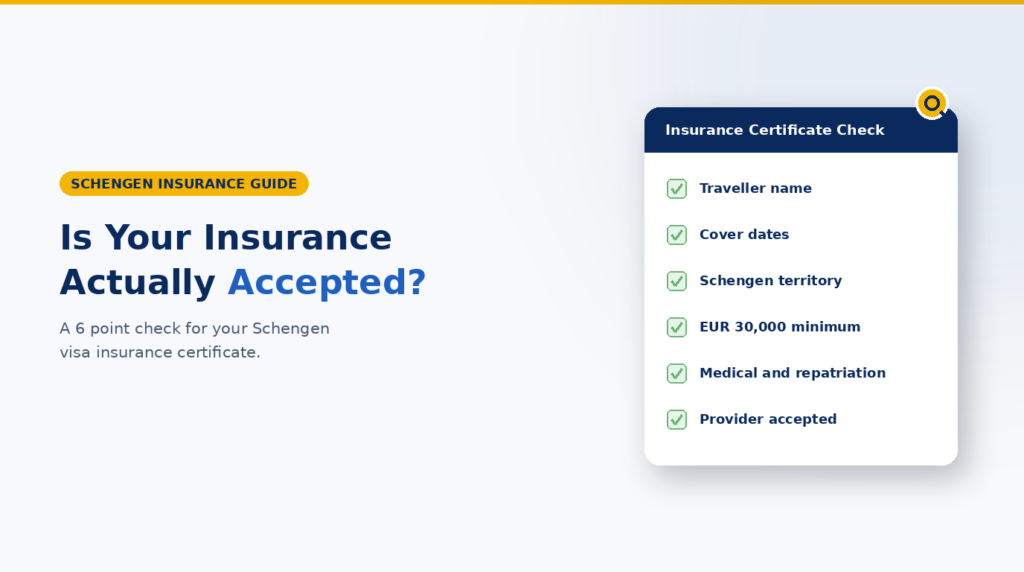
To check whether travel insurance is suitable for a Schengen visa, verify the policy itself, what the certificate actually proves, and any provider rules published for the place where you apply. A certificate that says “Schengen compliant” is useful only if the underlying cover and documentation meet the applicable requirements.[1]
What Makes Travel Insurance Valid for a Schengen Visa?
The primary question is not simply whether an insurer is famous or whether a website uses the words “Schengen insurance.” Under Article 15 of the EU Visa Code, applicants must have adequate and valid travel medical insurance covering specified emergency and repatriation risks.[1]
- Coverage must be valid throughout the relevant Schengen territory.
- It must cover the entire intended stay or transit period.
- Minimum coverage is EUR 30,000.
- It must cover medical repatriation, urgent medical attention, emergency hospital treatment and expenses connected with death.
- Consulates must consider whether claims against the insurer would be recoverable in a Member State.[1]
“A EUR 30,000 limit alone does not make a policy Schengen-compliant. Territory, dates, covered medical risks, repatriation and provider acceptability also matter.” |
The SchengenSure 6-Point Insurance Certificate Check
Use this check before submitting a certificate with your visa application. It is a practical verification framework, not a substitute for the competent consulate’s current checklist.
- NAME: Does the certificate clearly identify the insured traveller? Check spelling, passport-linked details if shown, and whether every traveller who needs cover has evidence in their own name.
- DATES: Does cover include the whole intended stay? Compare the certificate with the arrival and departure dates used in your visa application and reservations.
- TERRITORY: Does the policy clearly cover the required Schengen territory? Avoid assuming that a vague label such as “Europe” proves the territorial requirement.
- LIMIT: Is medical coverage at least EUR 30,000? Check the certificate or policy wording rather than relying only on a sales page.[1]
- MEDICAL + REPATRIATION: Can you identify emergency medical treatment, hospitalisation and repatriation cover? If the certificate is vague, ask the insurer for a clearer visa certificate or confirmation.
Policy Adequacy vs Certificate Clarity vs Provider Acceptance
Check | Question | What to do if unclear |
Policy adequacy | Does the actual cover satisfy Article 15 requirements? | Read the policy/certificate and ask the insurer to confirm missing points. |
Certificate clarity | Can the visa officer see the required cover from the evidence submitted? | Request a visa certificate or written confirmation that clearly states the relevant cover. |
Provider acceptance[5] | Does the application jurisdiction impose an approved-provider list for travel insurance from the applicant country providers or other local rules? | Check the official embassy/consulate or common Schengen guidance for that jurisdiction. |
“A policy can be adequate in substance but poorly documented. A clear certificate can also be insufficient if the underlying policy or provider does not meet the applicable rules.” |
Applying from India? Check the Approved-Insurer Information
Indian applicants should make an additional provider check. German missions in India currently state that Indian travel medical insurance is accepted only from approved Indian travel insurance companies on the applicable Schengen list.[2] Switzerland’s official India visa page, published in January 2026, links to an “Approved list of Indian travel insurance companies” dated 1 January 2026.[3] Indian travel insurance is accepted only when it comes from an insurer on the approved list. However, applicants may obtain insurance in another country if claims against that insurance company would be recoverable in a Schengen State.[5]
Find visa compliant insurance from SchengenSure.
This does not mean that every policy from a European provider is automatically acceptable, or that every Indian policy is unacceptable. Provider origin alone does not establish compliance; the applicable consular rules and the actual insurance cover remain decisive.
Does the Certificate Need to Say “Schengen”?
The Visa Code sets substantive insurance requirements; it does not create a universal rule that one specific marketing phrase must appear on every certificate.[1] In practice, a certificate that clearly states the covered territory, dates, insured person, medical limit and relevant emergency/repatriation cover is easier to assess than a vague document.
For example, official Dutch guidance for applicants in India says the insurance document must state that cover applies in all Schengen-area countries for the entire stay and provides at least EUR 30,000 in medical expenses, including hospital treatment, emergency care and repatriation.[4]
What If Your Insurance Certificate Is Missing Information?
- Do not alter or edit the certificate yourself.
- Ask the insurer for an updated visa certificate, policy schedule or written confirmation.
- Check whether the missing point is actually stated elsewhere in the policy wording accepted with the certificate.
- Recheck your travel dates if the certificate was issued before your itinerary changed.
- If the provider is not accepted under a jurisdiction-specific list, compare another suitable policy rather than trying to explain around the list.
Common Mistakes When Checking Schengen Visa Insurance
- Assuming the words “Schengen compliant” are enough without checking the evidence.
- Checking only the EUR 30,000 figure and ignoring territory, dates or repatriation.
- Submitting a certificate with dates shorter than the intended trip.
- Using a policy that covers “Europe” without confirming whether the required Schengen territory is included.
- Using an old approved-insurer list found on a third-party website.
- Confusing visa-document acceptance with how easy or difficult an insurance claim may be.
- Buying a second policy immediately when the existing insurer could simply issue a clearer certificate.
Final Checklist Before Your Visa Appointment
☐ Insured traveller’s name is correct.
☐ Coverage dates include the full intended stay.
☐ Territorial cover satisfies the applicable Schengen requirement.
☐ Medical cover is at least EUR 30,000.
☐ Emergency medical and hospital treatment are covered.
☐ Medical repatriation and death-related repatriation/expenses are covered as required.
☐ Certificate wording is clear enough to evidence the cover.
☐ Provider is acceptable under any local approved-insurer rule.
☐ The latest official consular checklist has been checked.
☐ Policy documents are saved and ready to submit.
Information on Travel Medical Insurance: German Mission India
Indian travel insurance is accepted only when it comes from an insurer on the approved list. However, applicants may obtain insurance in another country if claims against that insurance company would be recoverable in a Schengen State.[5] Find visa compliant insurance from SchengenSure.
The German Missions in India state that:
- If travel medical insurance is purchased from an Indian insurance company, it must be issued by a company on the approved list and comply with any listed age or policy restrictions.
- This does not mean applicants must always purchase insurance in India. An applicant may obtain insurance in another country, provided that claims against the insurer are recoverable in a Schengen State.
- The policy must cover the entire Schengen Area for the full intended stay or transit, with at least €30,000 coverage for urgent medical treatment, emergency hospitalisation, medical repatriation and death-related repatriation.
- For a multiple-entry visa, insurance must initially cover the first intended visit; valid insurance is also required for subsequent trips.
Buying Guidance: When Should You Replace a Policy?
Do not replace a policy only because you are uncertain. First compare it against the official requirements and ask the insurer to clarify or reissue the certificate if necessary.
Consider another policy when a material requirement is missing, the provider cannot supply adequate evidence, the dates or territory cannot be corrected, or the applicable consular guidance does not accept the insurer. When comparing alternatives, look beyond visa acceptance: also review exclusions, assistance arrangements, claims process, cancellation terms and how medical bills are handled during the trip.
SchengenSure can be used as a comparison step after this verification—not as a substitute for checking the destination country’s official visa instructions.
FAQs
How do I know if my travel insurance is valid for a Schengen visa?
Check the traveller’s identity, dates, territory, minimum EUR 30,000 medical cover, emergency medical/hospital treatment and repatriation cover. Then check any provider-specific rule published for the jurisdiction where you apply.[1]
Is any travel insurance accepted for a Schengen visa?
No. The insurance must meet the applicable Schengen requirements, and some application jurisdictions also publish approved-provider rules or lists.
Is EUR 30,000 coverage enough by itself?
No. EUR 30,000 is the minimum coverage amount, but the policy must also satisfy territorial, duration and covered-risk requirements.[1]
Can I use Indian travel insurance for a Schengen visa?
Potentially, but applicants in India should check the current approved-insurer information published by the Schengen mission handling the application. Official India guidance may restrict which Indian insurers are accepted.[2][3]
Do my insurance dates need to match my visa application?
The insurance must cover the entire intended stay. Compare its dates with the travel dates used in your application and supporting documents.[1]
What if my certificate does not mention repatriation?
Check the full policy wording and ask the insurer for a clearer visa certificate or written confirmation. Do not assume the cover exists if the evidence is ambiguous.
Can someone else buy the insurance for me?
Yes. The Visa Code allows another person to take out insurance in the applicant’s name, provided the required conditions are met.[1]
Can a visa application be refused over invalid insurance?
Travel medical insurance is a required supporting element for applicants who are subject to Article 15. If the submitted insurance is not adequate or valid, the application may fail to meet the visa requirements; check the official refusal and checklist rules for the specific case.
Conclusion
If you are asking, “Is my travel insurance valid for a Schengen visa?”, do not judge the policy by brand name or marketing language alone. Verify the cover, verify what the certificate proves, and verify any provider rule that applies where you submit the visa application.
The safest sequence is simple: requirement -> certificate -> provider -> consulate check -> correction or comparison if needed. That approach reduces uncertainty without buying unnecessary duplicate